

Lead in School Drinking Water: 70% of Monroe County Schools Exceed State Limit
The Short Version
- 70% of Monroe County school buildings — 102 of 146 — had at least one water outlet test above the state's 5 ppb lead limit in 2023–25, nearly double New York's 42% statewide rate.
- Monroe County ranked 8th in New York for the share of schools exceeding the legal limit; 1,069 of 7,862 individual outlets in the county failed the standard.
- The lead comes from inside the building — pipes, valves, soldering, and fountain hardware — not the municipal water supply, so fixing city infrastructure changes nothing at the tap.
- New York's three-year testing cycle has a structural flaw: lead levels fluctuate, so a passing test doesn't mean a fixture is safe on any given school day before the next cycle.
- A statewide filter-first fix is estimated to cost a maximum of $100 million — Pittsburgh already completed this transition between 2016 and 2024.
- A filtered-water bill stalled in the 2025 legislative session; Pittsford families can contact state legislators to push it forward, and school districts can release outlet-level test data today without waiting for Albany.
The drinking water in most Monroe County school buildings has a lead problem. A new report covering the 2023–25 school year found that 102 of 146 school buildings — 70% had at least one water outlet testing above New York's legal limit of 5 parts per billion for lead. The statewide average is 42%. For Pittsford families, Monroe County is the number that matters — and this county's rate is nearly double the state norm.
Monroe County's Numbers Stand Out Statewide

Monroe County's Numbers Stand Out Statewide
Monroe County ranked 8th in New York State for the share of school buildings testing above the legal lead limit, according to a report released September 17 by Environment America Research & Policy Center and NYPIRG. The building-level percentage (70%) understates what is happening at the fixture level: 1,069 of 7,862 individual water outlets across Monroe County school buildings — nearly one in seven — exceeded the threshold. Statewide, 12,452 of 221,078 tested outlets failed the standard in the same two-year period across more than 1,900 school buildings.
The Lead Comes From Inside the Building, Not the City Water

The Lead Comes From Inside the Building, Not the City Water
Most parents assume contaminated water originates with the city supply. It does not. Lead leaches from internal plumbing components — pipes, soldering, valves, gauges, screens, and the drinking fountain hardware itself. Replacing the municipal service line solves nothing. The contamination is inside the building, at the point where a student drinks.
"Most of this lead comes from everything behind the walls, soldering in the pipes, valves, gauges, screens, even the drinking fountain components themselves."
— David Masur, Environment America Research & Policy Center
There is no safe level of lead for children. Exposure impairs brain development and is linked to learning disabilities, hearing and speech problems, and lower IQ. The 5 ppb state limit is a legal compliance standard, not a health guarantee.
Why Testing Every Three Years Isn't Solving the Problem

Why Testing Every Three Years Isn't Solving the Problem
New York requires schools to test outlets every three years and fix the ones that fail. The structural flaw: lead contamination in school water fluctuates. A fixture that passes today can exceed the limit before the next testing cycle begins. A child drinking from that outlet every school day in between has no warning. As Kate Canada of Environment America noted, "Lead at any level is bad, especially for children. It can lead to learning disabilities, hearing and speech problems, and IQ loss."
A bill introduced in the 2025 legislative session would have required filtered water stations and more frequent testing in all New York schools. It was not acted on.
What a Filter-First Fix Costs — and How to Get There
What a Filter-First Fix Costs — and How to Get There
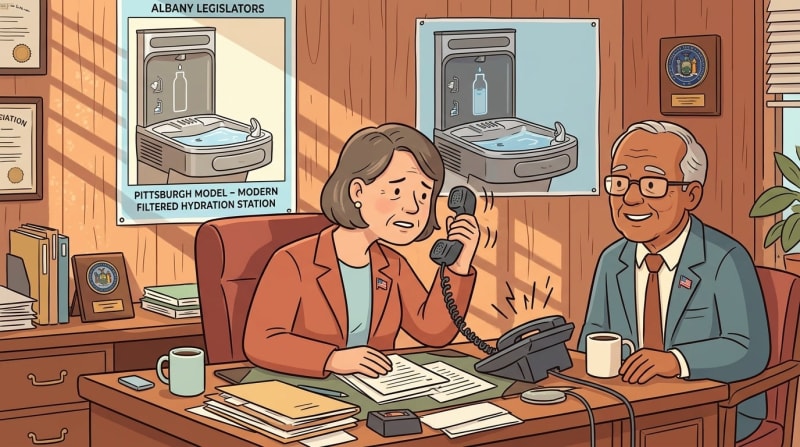
Advocates are pushing Albany past the test-and-fix model entirely. The proposal: install lead-capturing filters on every faucet used for drinking or cooking across all New York school buildings. No waiting for the next test cycle. No chasing individual failed outlets through remediation and retesting. The estimated maximum cost statewide is $100 million, which advocates say the existing Clean Water Infrastructure Fund can absorb.
Pittsburgh replaced all of its school drinking fountains with filtered hydration stations between 2016 and 2024. That transition is the model advocates are pointing Albany toward.
Pittsford families who want to move this forward can contact state legislators to support the stalled filtered-water bill. school districts can also release their own outlet-level test data publicly — that step requires no legislative action.
Content ID: A4fl1YFG2VT611tkULjYcPUj
See an error? Tell us.


Comments
Share with the Community