
The Heart of the Village: Why Pittsford's Village Bakery & Cafe Is More Than Just a Great Meal
The Short Version
- Village Bakery & Cafe isn't really a restaurant — it's the place where Pittsford actually happens, functioning as the village's third place in the sociological sense Ray Oldenburg described.
- Third places — not home, not work, but the gathering ground in between — are where community identity forms, and most suburbs have lost them entirely.
- On any given weekday morning at Village Bakery, you'll find the same mix of dog walkers, remote workers, school board candidates, and retirees that you won't find anywhere else in the village.
- The brick patio is dog-friendly, which sounds like a small thing until you realize it's the reason half the conversations in this village happen in the first place.
- What the bakery gives Pittsford can't be ordered online or replicated by another coffee chain — it's the accumulated trust of years of people choosing to show up in the same place.
- If you want to understand what holds this community together beneath the soccer schedules and the school board meetings, pull up a chair on that patio and just watch for a while.
I've lived in Pittsford long enough to have strong opinions about parking on Main Street, to know which side of the canal path gets the best morning light, and to understand — in that bone-deep way you only get from years of showing up — that Village Bakery & Cafe isn't really a restaurant. It's the place where this town actually happens. If you want to understand what makes Pittsford tick, what holds this community together beneath all the soccer schedules and school board meetings and Erie Canal trail runs, you need to pull up a chair on that brick patio and just watch for a while. The heart of the village: why Pittsford's Village Bakery & Cafe is more than just a great meal is a question worth sitting with — because the answer says more about us than it does about the menu.
What Makes a Neighborhood Cafe Become a Town Square

What Makes a Neighborhood Cafe Become a Town Square
There's a concept in urban sociology that I stumbled across years ago and haven't been able to shake since. Sociologist Ray Oldenburg spent decades researching what he called the "third place" — not home, not work, but the informal gathering ground in between where community identity actually forms. His 1989 book The Great Good Place argued that without third places, neighborhoods stop being communities and start being just collections of addresses. (You can find a solid summary of his framework at pps.org/article/roldenburg.) In an era of remote work, streaming services, and groceries delivered to the door, that argument has aged into something closer to prophecy.
Village Bakery & Cafe is Pittsford's answer to that need — and no one officially assigned it that role. It just filled it, the way water finds the low ground. In a walkable village like ours, where the sidewalks actually connect somewhere and the density is human-scaled rather than highway-scaled, a third place community gathering space like this one becomes almost irreplaceable. The impact gets amplified by proximity. When the bar and the bookstore and the cafe are all within a few blocks of each other, the overlap of lives grows — and that overlap is what a community actually is.
Which brings me to the question I find myself turning over on slow mornings: where else in Pittsford do you run into your neighbor, your kid's travel baseball coach, and your village trustee in the same twenty minutes? Not at a scheduled event. Not because anyone planned it. Just because everyone found their way to the same porch.
This piece isn't about what Village Bakery & Cafe sells. It's about what it holds.
The Morning Coffee Circle You Didn't Know You Were Part Of

The Morning Coffee Circle You Didn't Know You Were Part Of
If you've been in on a weekday morning, you've seen it. A loose cluster of regulars pulled around a communal table — coffees in hand, no agenda visible, conversation drifting from the weekend's weather to whatever the village is apparently deciding now. It's not a meeting. Nobody sent a calendar invite. And yet there's something unmistakably intentional about it, the way a daily coffee ritual in Pittsford like this one forms its own quiet gravity.
That image — men gathered around a table, the morning light coming through the windows, nobody in a particular hurry — communicates something that a menu board can't. It says: this is a place worth coming back to. And that's the whole secret, really. These aren't close friends necessarily. They're what social scientists call weak ties — casual acquaintances, familiar faces, the people you know well enough to nod at and not well enough to call in a crisis. And those connections matter more than most of us realize. Research by sociologist Mark Granovetter, whose landmark 1973 paper on the strength of weak ties remains one of the most cited in social science (scholar.harvard.edu/files/davidlazer/files/the_strength_of_weak_ties.pdf), found that weak-tie relationships are essential to social cohesion, information flow, and individual wellbeing in ways that close friendships simply can't replicate. More recent public health research has linked these kinds of casual social interactions to reduced loneliness, lower anxiety, and even longer life. The Harvard Study of Adult Development, one of the longest-running studies on human happiness, consistently points to the quality of social connection — including these light-touch, recurring ones — as among the strongest predictors of wellbeing. (See adultdevelopmentstudy.org for more.)
I'll be honest: I didn't walk into Village Bakery & Cafe looking for community. I walked in looking for a decent latte and a place to sit that wasn't my kitchen table. But somewhere between the second visit and the twentieth, I found myself knowing the guy who always takes the corner seat, recognizing the couple who splits the breakfast sandwich every Thursday. I didn't engineer any of it. The place did the work.
Where Pittsford's Civic Life Actually Gets Done

Where Pittsford's Civic Life Actually Gets Done
There's a version of Pittsford civic life that happens in official channels — at village board meetings in Village Hall, at school board sessions, in the formal machinery of a well-run municipality. And Pittsford genuinely has that. Civic participation here is high, and the community takes its governance seriously. But there's another layer beneath the official one, and it's harder to see unless you know where to look.
It happens at the counter. It happens in the corner booth when a school board member runs into a neighbor who has something to say. It happens when the owner of a Main Street shop catches a village trustee refilling his coffee and floats the idea he's been sitting on for three weeks. No motion required. No public comment period. Just the informal civic function that emerges when a Pittsford civic community space exists that's good enough to hold people for longer than it takes to drink a cup of coffee.

Look at the interior — the counter, the menu board overhead, the layout that invites you to stay rather than signals you to move along. This isn't a fast-casual operation designed for turnover. There's dwell time built into the architecture of it. And dwell time, in a community with Pittsford's level of civic energy, is where ideas get floated and problems get solved and the connective tissue between official decisions and the people those decisions affect actually gets knitted together.
The possibility that lives here isn't dramatic. It doesn't make headlines. But some of the most important things that have ever happened in any town started with someone saying, over coffee, you know what we should really do?
The Dog-Friendly Patio That Blurs Every Line

The Dog-Friendly Patio That Blurs Every Line
There's an image that lives in my head as the truest picture of what Village Bakery & Cafe is. A couple on the brick patio, coffees on the table, their Australian Shepherd settled comfortably at their feet, no one looking at a phone, no one in a hurry. It's not a posed shot. It's just a Tuesday afternoon in Pittsford, and it looks exactly like the life we moved here to have.
The dog-friendly patio in Pittsford's village is, on one level, a practical amenity. On another level, it's a philosophical statement about what kind of place this is. Patios designed for turnover have certain features: small tables, uncomfortable chairs, limited shade. This patio has none of that energy. The brick surface, the open layout, the afternoon light that falls across it — it's built for slowness. And slowness, it turns out, is its own kind of civic act.

What dogs actually do in a space like this is worth noting: they lower social barriers in a way that nothing else quite manages. Research on what's been called the "Rover effect" — documented in studies like one published in PLOS ONE (journals.plos.org/plosone/article?id=10.1371/journal.pone.0152070) — found that people with dogs were significantly more likely to receive social acknowledgment from strangers and to initiate conversation than those without. Strangers talk to each other. Kids cross the patio uninvited. Regulars learn each other's dogs' names before they learn each other's. And somehow, from that improbable entry point, a community begins.
The patio doesn't ask anything of you. It doesn't require you to have an opinion on anything or know anyone or have a reason to be there beyond wanting to sit outside with your coffee and your dog on a Wednesday. That's the Block lens landing exactly where it should: belonging that requires nothing except showing up.
What Village Bakery & Cafe Gives Pittsford That Can't Be Ordered Online

What Village Bakery & Cafe Gives Pittsford That Can't Be Ordered Online
Here's the larger argument this whole piece has been building toward: some things a community needs cannot be delivered, franchised, or optimized. They can't be replicated by a chain with a loyalty app or reconstructed once they're gone. They have to be stumbled into, earned through repetition, and held in place by the quiet loyalty of people who keep choosing them.
Ask yourself — and I mean really sit with this — what would be lost if Village Bakery & Cafe closed tomorrow, or moved, or changed its character in the way that places sometimes do when they stop being rooted in one community and start trying to be everything to everyone? Not the food. I mean the connective tissue. The civic infrastructure. The place where your neighbor tells you something important without meaning to, where you run into the person you've been meaning to call, where a whole layer of Pittsford's social life quietly maintains itself between 7 and 10 in the morning.
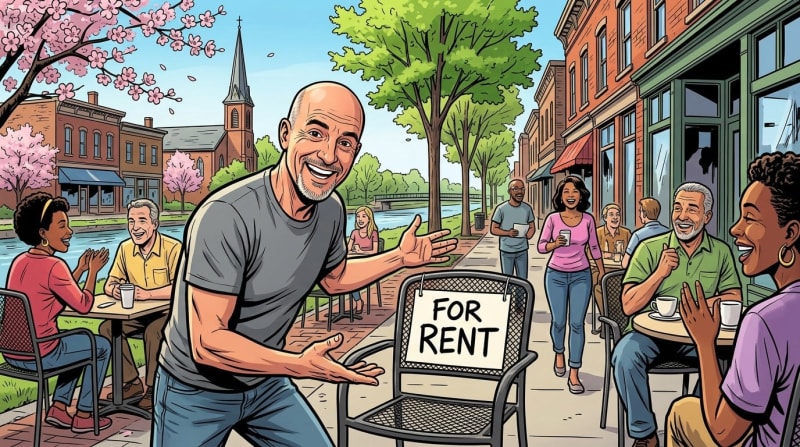
Pittsford's walkability is part of what makes this possible — and that's worth saying clearly. The cafe and the sidewalk culture around it are mutually reinforcing. One doesn't work without the other. When you look at the full building facade and the open patio and realize how much physical space this place dedicates to community rather than covers, you're seeing an expression of values made concrete. That's not nothing. In a world that keeps shrinking public space and converting every square foot to maximum revenue, a Pittsford village community anchor like this one represents a genuinely countercultural choice.
We benefit from it every day, most of us without thinking about it. Which makes this the right moment to ask: what are we responsible for protecting in a place like this?
There's a version of this morning where I make coffee at home, stay in my kitchen, and get a head start on the day. I take that version more often than I should — and I'm sure you do too. But next time you're weighing that choice, I'd gently suggest that the decision isn't really about coffee at all. It's about whether you want to be part of something. The heart of the village: why Pittsford's Village Bakery & Cafe is more than just a great meal comes down to this — places like this are only the heart of the village as long as we keep showing up to make them so. The good news is that all it takes is walking through the door.
Content ID: ZjGbngJCFSYntDibbFYGMDFq
See an error? Tell us.

Comments
Share with the Community