
The Pittsford Village Bakery Parking Lot Accident Just Made the Case Against Parking Minimums
The Short Version
- A car got loaded onto a flatbed at Village Bakery & Cafe this afternoon — minor injuries per the News Channel 8 cameraman on scene, but the lot is small enough that "minor" was mostly luck
- Roughly one in five U.S. car crashes happen in parking lots, with 50,000 incidents and 500+ deaths annually according to the National Safety Council
- Pittsford's parking law (Article 25 of Chapter 210) requires every commercial use to provide its own dedicated off-street parking on a 19th-century streetscape — a contradiction the Village's own Comprehensive Plan diagnoses but the code never resolves
- A pizza restaurant at 5 South Main Street had to go through four PZBA meetings just to get a variance from those parking requirements tonight — and still needs a separate Special Use Permit from the Trustees before it can open
- Buffalo, Hartford, Minneapolis, San Jose, and at least 99 cities worldwide have eliminated minimum parking requirements; the tools to follow them already exist in Pittsford's own code
I Walked Past the Bakery This Afternoon and a Car Was on a Flatbed

I Walked Past the Bakery This Afternoon and a Car Was on a Flatbed
I was walking the dog down State Street this afternoon when I came around the corner near Village Bakery & Cafe and saw a Monroe County Sheriff cruiser parked across the entrance with its lightbar still going. My first thought wasn't what's the story. It was please let everyone be okay.
I walked up just in time to see a Sutherland Auto Sales flatbed loading a gray Toyota out of the lot. Two deputies on scene, a small cluster of patrons standing on the patio side, the bakery's stacked metal chairs pushed out of the way. A News Channel 8 cameraman was packing up his gear, and when I asked him what happened, he told me nobody had to go to the hospital. That was the only fact I needed in that moment. Everything else could wait.

I'm at the bakery four mornings a week. Business meetings, breakfasts with trustees, coffee with friends, the occasional working session by myself with a notebook and a cinnamon roll. A real fraction of my week happens there. I walk to it — not because it's faster, but because it's the life I want. Health. Community. The architecture of buildings that have been standing here since before the Civil War. The slow noticing that only happens at three miles an hour.
Renee — my wife, founder of Walk Bike Pittsford, and a former Village Trustee — has been making the case for years that the village we say we want is a walkable one. Sitting with her on that patio in the summer, watching cars back out of those spaces with maybe twenty-four inches of clearance between a bumper and our table, is where the case stops being abstract. This would never fly in Europe, one of us says. We say it more often than I'd like to admit.
This afternoon was the day the joke stopped being a joke.
The Lot Itself Is the Story

The Lot Itself Is the Story
Take a real look at that lot the next time you're there. Count the spaces. Notice the sightlines. Notice how a person walking from a parked car to the front door has to cross the path of every other car maneuvering in the lot. Notice how the dumpster, the back service door, the patio entrance, and the customer entrance all share the same fifty feet of pavement. Notice that the patio tables — where in summer half the village seems to be eating breakfast at any given moment — are within arm's reach of where cars are reversing.

This isn't a Village Bakery problem. It's a small-village-commercial-lot problem. State Street, Schoen Place, parts of South Main — many of the lots tucked behind our oldest commercial buildings have the same shape. Built into a footprint that wasn't designed for cars at all, then squeezed to satisfy a code that says every commercial use needs its own dedicated off-street parking in a particular ratio per square foot or per seat or per employee.
That code is real. It's Article 25 of Chapter 210 of the Village Code, adopted as part of the 2019 zoning rewrite but built on parking-ratio formulas that go back decades earlier. It's not a Pittsford invention — most American villages have something just like it. Which is exactly the problem.
Because what you get when you require every business to provide its own parking on its own lot, on a 19th-century streetscape that was never designed for it, is exactly what you saw this afternoon: a tight lot, a tow truck, a sheriff, and a story that ends well only because everyone happened to be moving slow enough.
Parking Lots Are More Dangerous Than We Think

Parking Lots Are More Dangerous Than We Think
Here's what surprised me when I looked it up. Parking lots aren't just inconvenient — they're statistically the most dangerous places we drive.
According to the National Safety Council, tens of thousands of crashes happen in U.S. parking lots and garages each year, resulting in hundreds of deaths and tens of thousands of injuries. The most commonly cited NSC figure is around 50,000 crashes annually causing roughly 60,000 injuries and more than 500 deaths. Independent analyses put parking-lot incidents at roughly one in five of all U.S. car crashes.
A fifth. In the spaces we treat as safe enough to text in, eat in, and walk our kids through.
It gets worse for people on foot. The NSC reports that 9% of all pedestrian deaths in parking lots happen during backing maneuvers — drivers reversing out of a space without seeing what's behind them. A separate analysis found that nearly 40% of fatalities in parking lot crashes are pedestrians, with small children and older adults disproportionately at risk.
Why so dangerous? In a 2017 NSC public opinion survey, drivers admitted to a remarkable range of behaviors they would do behind the wheel in a parking lot but not on a highway:
Two-thirds of us are on the phone. Half of us are on Instagram. The slow speeds give us a false sense of safety. The tight quarters take that safety away.
What does it mean to require every village business to have its own version of the most dangerous driving environment we have, on the smallest possible footprint, in the heart of a walkable historic district?
Pittsford's Parking Minimums Code Was Written for a Different Village
Pittsford's Parking Minimums Code Was Written for a Different Village
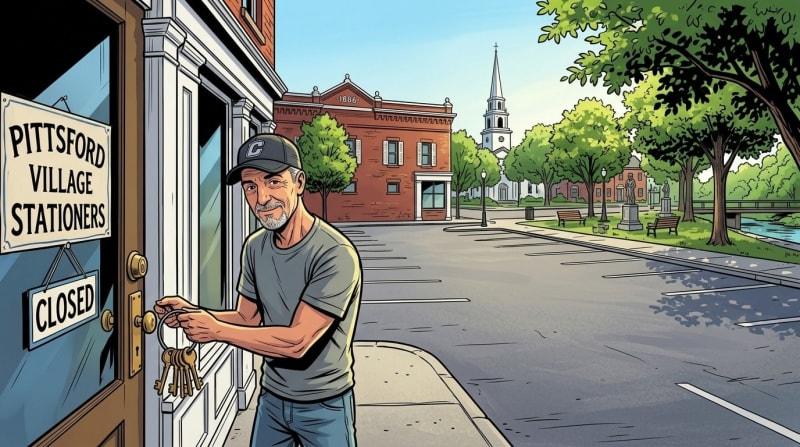
I've written before about how Pittsford's parking minimums quietly shape what businesses can open here — and how a landlord on Main Street tried three times to fill a vacant storefront with a restaurant and got blocked by parking math each time. That piece focused on what these rules do to occupancy. This piece is about what they do to the lots themselves.
The relevant code is § 210-25 of the Village Zoning Law. Its stated purpose is to ensure that all uses and development within the Village are adequately served by off-street parking and loading areas — to provide proper circulation, reduce hazards, and protect adjacent properties from noise and headlights. Reasonable goals on paper.
The problem is the premise underneath them: that every individual business should solve its own parking on its own lot. That premise comes from the post-WWII suburban planning playbook, and it shows. Read the Village's own Comprehensive Plan — the one Article 25 is supposed to implement — and it actually diagnoses the problem in plain language. The plan's introduction names that historically, villages existed to provide individuals with a sense of community and a humane living environment, and that the evolution of villages "was interrupted by suburbanization, and the accompanying shifts in economic, development and social patterns that occurred in the second half of the twentieth century." Before 1950, the plan continues, the streetscape consisted of "a walkable comfortable civic space."
The Comprehensive Plan, in other words, says we want a humane, walkable, civic village. The parking code we wrote to implement that plan keeps producing tight, dangerous lots designed around the assumption that everyone arrives by car. Those two things don't match.
And it shows up everywhere in the rest of the code, not just here. The purpose of the Mixed-Use Office/Residential District, as written, is to "enhance the aesthetic character and walkability of the district." The Low Density Residential District is supposed to support "well-connected, walkable streetscapes." The word walkable appears throughout. The word parking minimum shapes every commercial site we build.
Tonight, the Same Code Came Up Again — and the Tools to Get Around It Already Exist

Tonight, the Same Code Came Up Again — and the Tools to Get Around It Already Exist
This evening — a few hours after the flatbed left State Street — I was at Village Hall for the rescheduled Planning and Zoning Board of Appeals meeting. On the agenda: an application from Michael Collichio, represented by FORM2 Architecture, for an area variance from those exact off-street parking requirements at 5 South Main Street — a historic, zero-lot-line Main Street building that the applicant wants to turn into a pizza restaurant with an accessory bar.
This was the fourth meeting on the application. Originally scheduled for the April 1 agenda, it had been tabled at the March 4 meeting, then rescheduled to tonight. The Zoning Board granted the parking variance.
Which is good news for the project, and good news for the building, and good news for anyone who wants the village to have one more place to eat. But here's the part that should give us pause: the variance was the easy part. Under Article 24 of the Village Code, restaurants in Pittsford's commercial districts are not permitted as-of-right. They require a Special Use Permit in addition to whatever parking accommodations are made — meaning the same pizza application now has to go in front of the Village Board of Trustees, present its case again, and clear a second discretionary review under Article 35 before anyone can serve a slice.
Two layers of code where one would do. Both layers built on the assumption that a restaurant in a historic Main Street building is somehow exotic — when in fact restaurants in historic Main Street buildings are exactly what the Comprehensive Plan, in its own language, says the Village exists to be.
Here's what's striking. The same Article 25 that produced the bakery lot also already authorizes shared parking agreements — two or more uses sharing a single lot when their peak demand happens at different times. A breakfast café and an after-hours cocktail bar can share spaces. A Sunday-morning church and a weekday office can share spaces. The mechanism is in the code right now. We just don't use it much.
Other tools the Village could lean into without throwing out the rulebook:
- Curb cut consolidation. Two narrow lots sharing one driveway entrance is dramatically safer than two lots each with their own.
- Pedestrian connectivity standards. Article 25 already requires pedestrian pathways from parking to building entrances on lots over a certain size. Tightening that — and applying it to smaller lots — would force the patio-and-parking conflict into a designed solution rather than an accidental one.
- An in-lieu fee program. Several reform-minded municipalities let developers pay into a shared public parking fund instead of building their own undersized lot.
- Quietly removing the SUP requirement for restaurants in commercial zones. A pizza place on Main Street isn't a hazardous land use. Treating it like one is how you end up with empty storefronts.
What does the modern parking-reform movement actually look like elsewhere?
According to the Strong Towns parking reform tracker and coverage by the Congress for the New Urbanism, at least 99 cities and towns across eight countries have now abolished parking minimums entirely. Buffalo, an hour west of us, eliminated downtown parking minimums in 2017. Hartford did the same the same year. The late UCLA economist Donald Shoup, who died in 2025 and whose 2005 book The High Cost of Free Parking anchored the modern parking-reform movement, called minimum parking requirements a fertility drug for cars.
Pittsford isn't Buffalo. We're a village of 1,355 residents inside a town of 29,000. But the principle scales down, not just up. Especially in a village this small, where the historic streetscape was built around the canal, the rail line, and people walking. The joint Town and Village Active Transportation Plan explicitly names "improve safety for everyone on foot" as a goal.
Roughly a third of the land in a typical small-town commercial district is dedicated to parked and moving cars on private lots, drawn from analyses cited by Strong Towns and Shoup's research. In a village whose entire commercial core fits in about a quarter-mile, that math has consequences.
The Question I'm Sitting With

The Question I'm Sitting With
The bakery will be open again tomorrow. The Toyota will get repaired or sold for parts. The deputies wrote up their report and went back on patrol. The pizza restaurant at 5 South Main now has the parking variance it needed and the long road of a Special Use Permit hearing still ahead of it. Nobody had to go to the hospital, which is the gift the afternoon gave us.
But the lot will be the same lot. The code that made it that lot will be the same code. And the next time something happens there — and there will be a next time, because the math of small distracted drivers in tight spaces doesn't bend for anyone — the same questions will be the same questions.
What does it mean when a rule written to keep us safe quietly makes the places we love more dangerous to walk into?
What does it mean when the village we say we want — humane, walkable, civic, full of small businesses you can run into your friends at — is the village our zoning code was written, fifty years ago and updated only at the edges, to prevent?
What gifts has Pittsford given us that we haven't fully named yet — the shared driveways, the trusted neighbors, the breakfast meetings that turn into civic friendships, the bakery itself — and what would it look like to let our code reflect them instead of fight them?
I'll be back at the bakery on Wednesday. On foot, like always. Different question on my mind.
Content ID: ReeOohUuVoDOOlx4OQs884p3
See an error? Tell us.

Comments
Share with the Community