

Pittsford Village Empty Storefronts: What's Going On and Why It Matters to All of Us
The Short Version
- Several storefronts in Pittsford Village have been sitting empty long enough for the For Lease signs to fade — this isn't a slow Tuesday, something has shifted.
- Parking minimums are part of the problem: research shows they increase vacancy rates on main streets by making new uses economically and physically harder to approve.
- The village's use restrictions mean a space zoned for retail can't easily become a studio, a co-working space, or anything that doesn't fit the original category — flexibility matters more than most zoning boards admit.
- National retail trends are hitting every main street, not just Pittsford's — but the villages that are doing well have loosened restrictions, not tightened them.
- The Board is aware of the problem and the Chamber has been brought into the conversation — the question is whether the response moves fast enough to matter.
- A village with empty storefronts isn't just an aesthetic problem — it's a community problem, because those windows are where the neighborhood sees itself.
I've been walking past empty storefronts in Pittsford Village for a while now, and last night I finally sat down at a Trustee Meeting to hear what our Board is doing about it. I went in with a notepad, slightly under dressed, and came out with more questions than answers — which, honestly, might be exactly where all of us should be right now. Because the Pittsford Village empty storefronts problem isn't just an aesthetic one. It's a community one. And I think we all deserve a real conversation about it.
What I'm Seeing on the Streets of Pittsford Village

What I'm Seeing on the Streets of Pittsford Village
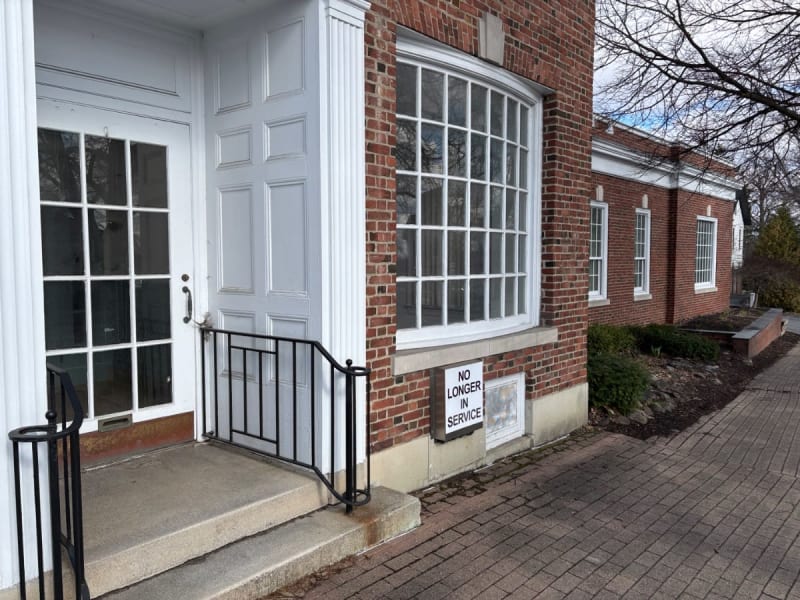
Walk the Pittsford Village storefronts on any given afternoon and you'll notice them pretty quickly — the paper-covered windows, the "For Lease" signs that have been hanging long enough to fade at the edges, the "No Longer in Service" notices still taped to glass doors. The parking lots out front sit empty in ways that feel less like a slow Tuesday and more like something has quietly shifted.
What strikes me is the variety of it. It's not just one type of space sitting idle. There's what looks like a former boutique, the kind of place that probably had a nice Instagram presence for a few years. There's at least one former bank or professional office space — a bigger footprint, harder to repurpose, sure, but still sitting there. And then there are some smaller, residential-scale buildings mixed in that feel like they should have a light on by now.

Walking past these spaces doesn't fill me with alarm, exactly. It fills me with something more like the feeling you get when a neighbor's house sits dark for too long — not panic, but genuine curiosity and the low hum of concern. These aren't abstract economic data points. They're buildings in the place where we live.
So I want to ask, genuinely: which vacancies have you noticed? Which spot do you walk past and think, something good could happen there? I think if we started treating this as a community inventory instead of a complaint session, we'd find out fast that a lot of us have been quietly noticing the same things. And that shared noticing is the beginning of something — maybe even the beginning of figuring out what a thriving village main street actually needs from all of us.
I Went to the Trustee Meeting — Here's What I Heard

I Went to the Trustee Meeting — Here's What I Heard
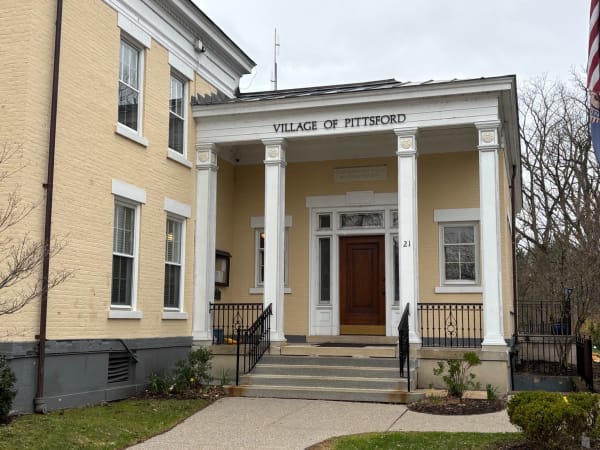
The Pittsford Board of Trustees meeting last night was the kind of local democracy experience I suspect most of us mean to attend and never quite get around to. (I'm not judging — I've driven past Village Hall more times than I've walked into it.) The room had that particular energy of people who genuinely care about the place they live, sitting under fluorescent lights, trying to get things right.
What I can tell you is this: the Board is aware of the vacancy issue. It came up in real terms, not the "we're monitoring the situation" language that sometimes substitutes for action. There is active deliberation happening. That matters, and I want to say it plainly before anything else — these are our neighbors, volunteering serious time to govern a complicated little municipality. That deserves genuine gratitude, not just the performative kind.

But gratitude doesn't mean we stop asking questions. The storefronts are empty now. The "For Lease" signs are up today. Deliberation is a virtue right up until the moment it becomes a reason the lights never come back on. The Board doesn't need criticism from neighbors — it needs partnership. It needs us showing up, bringing information, and making clear that the community wants to be part of working this out.
So consider this less a report and more an invitation. We're in this together, and the people sitting at that table deserve a full room, not an empty one.
The Planning Board Meeting Two Weeks Ago Told Me Everything
The Planning Board Meeting Two Weeks Ago Told Me Everything
Here's the story that really sharpened my thinking. Two weeks ago I sat in on a Planning Board meeting where a landlord was seeking approval — for the third time — to open a restaurant in one of these vacant spaces. The parking minimums restaurant approval process is where things got stuck, again.
Let me say that once more: a landlord tried three times to fill a vacant storefront with a restaurant. Three times. That is not the behavior of someone casually kicking tires. That is someone with real market conviction, who genuinely believes there is demand, who has spent real money on applications and probably on architects and lawyers, and who keeps running into the same wall.

The wall is parking. The village's minimum parking requirements couldn't be satisfied by the proposed use, so approval was blocked. Not because the neighbors objected. Not because the business concept was flawed. Because of a formula about how many cars need to fit on a lot.
I want to be careful here, because the Planning Board members are also neighbors doing a hard job with rules they didn't write. The problem isn't the people — it's the rules. And the right question isn't "why did they say no?" It's the one that keeps me up a little: are the rules we wrote decades ago still serving the village we actually want to be today?
The Research on Parking Minimums Is Pretty Damning

The Research on Parking Minimums Is Pretty Damning
I'll be honest — before I started digging into parking minimum reform for small towns, I assumed parking requirements were just a sensible, boring part of how places work. Then I read Donald Shoup.
Shoup's landmark work The High Cost of Free Parking (shoup.bol.ucla.edu) is the canonical reference here, and his central argument is uncomfortable in the best way: parking minimums increase development costs, reduce the amount of land available for actual buildings and uses, and systematically suppress small business formation — all while frequently providing more parking than anyone actually needs. His research has been peer-reviewed, replicated, and has now influenced policy reform in cities across the country.
The momentum is real. Buffalo, New York eliminated downtown parking minimums in recent years as part of a broader zoning reform effort, and they are not alone — cities from Minneapolis to Hartford have moved in the same direction (strongtowns.org/journal/parking-reform-tracker). The policy consensus is shifting because the evidence is consistent: in walkable, mixed-use areas, actual parking demand is significantly lower than minimum requirements predict. People walk. People bike. People share parking across different peak hours. The models that generated these minimums were largely designed for auto-dependent suburban contexts — strip malls off highway exits, not village centers with canal paths.
Pittsford has a genuinely walkable, bikeable village core. The Erie Canal trail runs right through it. Many of us live within a ten-minute walk of the village. The rules shouldn't assume we all arrived from a highway on-ramp — and yet, right now, that's essentially what they do.
National Retail Trends Are Hitting Main Streets Like Ours Too

National Retail Trends Are Hitting Main Streets Like Ours Too
It would be tempting to look at our vacant storefronts and assume something is uniquely wrong with Pittsford. It isn't. National retail trends have been reshaping main streets across the country for years, and understanding that context actually makes the path forward clearer.
The U.S. Census Bureau's e-commerce data has shown consistent year-over-year growth in online retail's share of total sales, now accounting for roughly 15–16% of all retail sales and climbing (census.gov/retail). The Retail Industry Leaders Association and ICSC (the retail real estate industry's primary research body) have documented sustained pressure on traditional brick-and-mortar retail as a result. Traditional retail square footage demand has softened, and that pressure lands hardest on small-town main streets that compete simultaneously with online retail and nearby big-box corridors.
For us, that corridor is real — Eastview Mall and Pittsford Plaza aren't far, and they offer the kind of surface-area retail that's hard to compete with on volume. Pittsford Village was never going to win that fight, and that's fine, because it isn't the right fight.
Here's what the research from the National Main Street Center actually shows (mainstreet.org): food, beverage, and service businesses — not traditional retail — are now the primary drivers of foot traffic and survival on main streets. Restaurants, coffee shops, wine bars, yoga studios, local services. These are the uses that bring people in repeatedly, that create the ambient life that makes a place feel alive on a Friday night.
Which makes what happened at that Planning Board meeting land even harder. The restaurant applicant — blocked three times — was pursuing exactly the use that research tells us saves main streets. We turned it away three times over a parking formula.
How Overly Restrictive Use Rules Can Make Vacancies Worse

How Overly Restrictive Use Rules Can Make Vacancies Worse
Parking minimums get a lot of attention, but they're not the only regulatory mechanism that can hold a village back. Zoning use restrictions — the rules that govern which business types can legally occupy which spaces — are at least as important, and often less visible to the rest of us until a landlord hits a wall.
The Urban Land Institute and Strong Towns (strongtowns.org) have both documented how restrictive use tables extend vacancy periods by keeping willing tenants out. A landlord has a space. A tenant wants to open a yoga studio, a small wine bar, a co-working room, a local food hall. The concept fits the space. The neighborhood would love it. But the zoning use table says "no" — or worse, it says "maybe, after a lengthy conditional use approval process" — and the tenant moves on, or gives up entirely. The space stays empty. The sign keeps fading.

In a village like Pittsford, the uses that neighbors actually want — the ones that would pull us off the couch on a Thursday evening — are often exactly the ones that fall outside legacy commercial zoning categories designed for a different era. A zoning use restrictions village vacancy problem isn't a failure of community appetite. It's a failure of regulatory imagination.
And here's the compounding effect that the research consistently documents: prolonged vacancy makes vacancy worse. Empty windows signal disinvestment to neighboring businesses. Foot traffic drops. The coffee shop next door loses the lunch spillover from a neighbor that no longer exists. The whole block loses something it may not be able to fully name.
Loosening use restrictions isn't about lowering standards. It's about trusting our community — the landlords, the entrepreneurs, the neighbors who will show up or not — to find the right fit. We're not an economic development office in a city that doesn't know its residents. We're Pittsford. We can make good judgments about what belongs here.
What Could Pittsford Village Look Like If We Get This Right?

What Could Pittsford Village Look Like If We Get This Right?
Let me stay in possibility for a moment, because that's where the energy actually lives.
Imagine walking through the village on a Friday night and every storefront has a light on. The restaurant that tried three times is finally open, and there's a wait. A wine bar has claimed the old boutique space. The former bank building is doing something interesting — maybe it's a small food hall, maybe it's a live music venue on weekends, maybe it's something no one has thought of yet because we haven't gotten out of the way long enough for someone to try. The canal path crowd is filtering up from the water. Kids are getting ice cream. The parking lot by the library is busy, and somehow nobody is complaining about parking because they walked.
That's not a fantasy. It's the story of several towns not far from here. Skaneateles has built an identity around exactly this kind of village vitality — walkable, food-and-beverage-anchored, with a built environment people drive an hour to experience. Cazenovia has done the same. Westfield, in Chautauqua County, has used zoning reform and Main Street investment to pull off a revival that surprises people when they hear about it. None of them started with more than what Pittsford already has.

And here's what Pittsford already has that most communities would trade a lot to get: a genuinely beautiful built environment, one of the best school districts in the state, an engaged and educated population that shops local when local gives it something worth shopping at, an Erie Canal trail that drops people into the village core, and walkable blocks that actually work. These aren't starting conditions. These are gifts. Most Pittsford village revitalization conversations could skip the first three chapters that other towns have to write.
What comes next is up to all of us, but a few things are concrete. Showing up to Planning Board meetings — even the ones that seem routine — matters. Supporting new businesses through their first shaky months, when they need regulars more than reviews, matters. And voicing support for specific policy action matters most of all.
The near-term ask is specific: the Board of Trustees and Planning Board should initiate a parking minimum review and a use table audit. Not a ten-year comprehensive plan. A focused look at the rules that are actively blocking willing landlords and tenants right now. Those two things alone could change the trajectory of what we're walking past.

Pittsford Village has every ingredient a thriving main street needs — the bones, the people, the location, the appetite. What it needs now is a regulatory framework that gets out of its own way and lets neighbors, landlords, and entrepreneurs do what they already know how to do. I'll keep showing up to those meetings — under dressed, probably, with a notepad I'll only half-fill — and I genuinely hope you will too. Because the building where something good could happen is sitting empty right now, and the only thing standing between here and lit-up windows on a Friday night might just be a rule we forgot to revisit.
What would you put in that space?
Content ID: vWxFktanSgAoRYxmjBTkHf8U
See an error? Tell us.
Comments
Share with the Community