No Kings in Pittsford Village: Protest, Permits, and What Our Local Government Can Actually Do
The Short Version
- Pittsford's corner of Main and State Street has now hosted three No Kings rallies — June 2025, October 2025, and March 2026 — making it a named location on the national protest map.
- The June 2025 national day drew over 2,000 demonstrators each in Fairport and Henrietta — Pittsford's turnout was part of a Monroe County showing that surprised a lot of people.
- Three rallies at the same intersection stops being a coincidence and becomes a pattern worth understanding — this piece treats it as a governance question, not a political one.
- The village has no formal protocol for planned demonstrations — which isn't a crisis, but is worth knowing before the fourth one.
- What strikes me most is the spontaneous horn-honking from passing drivers — that's not organized, and it tells you something about where the neighborhood actually stands.
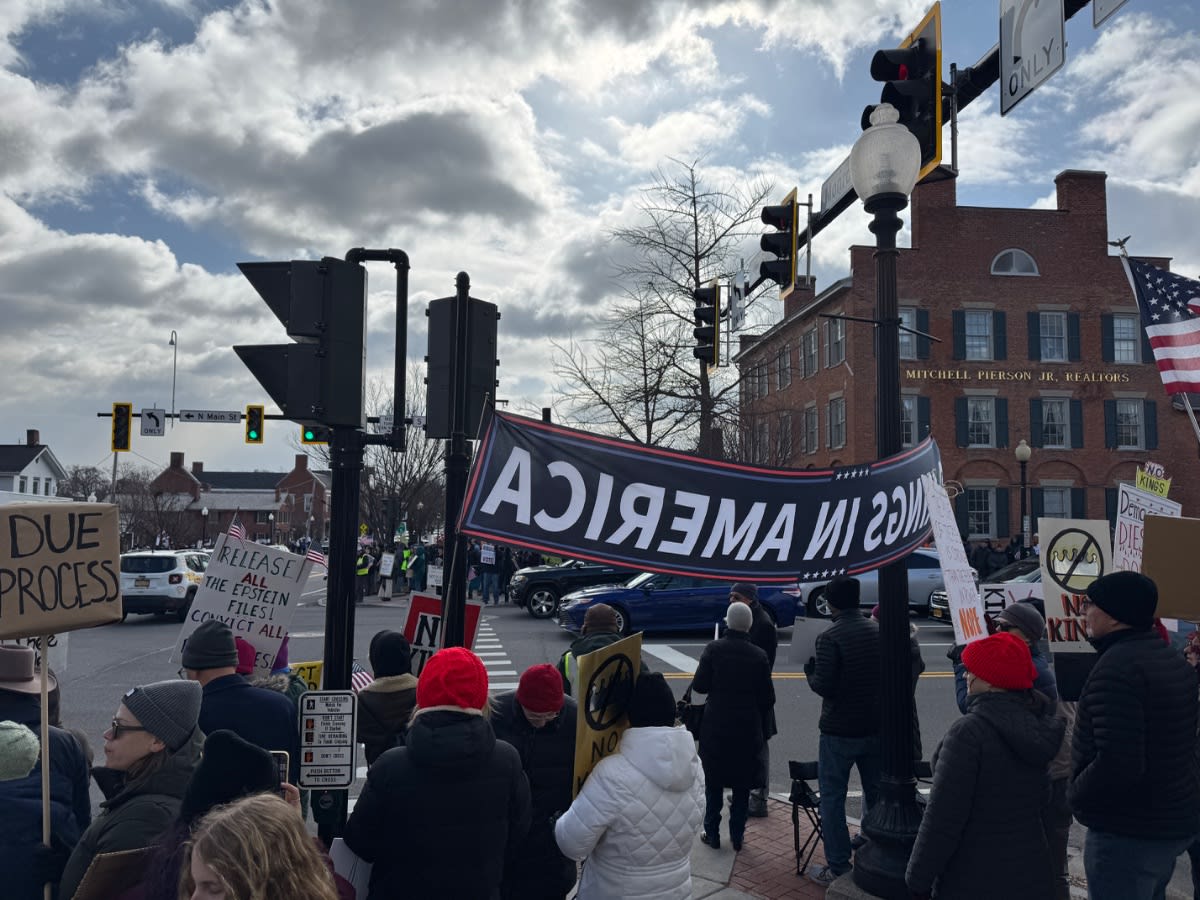
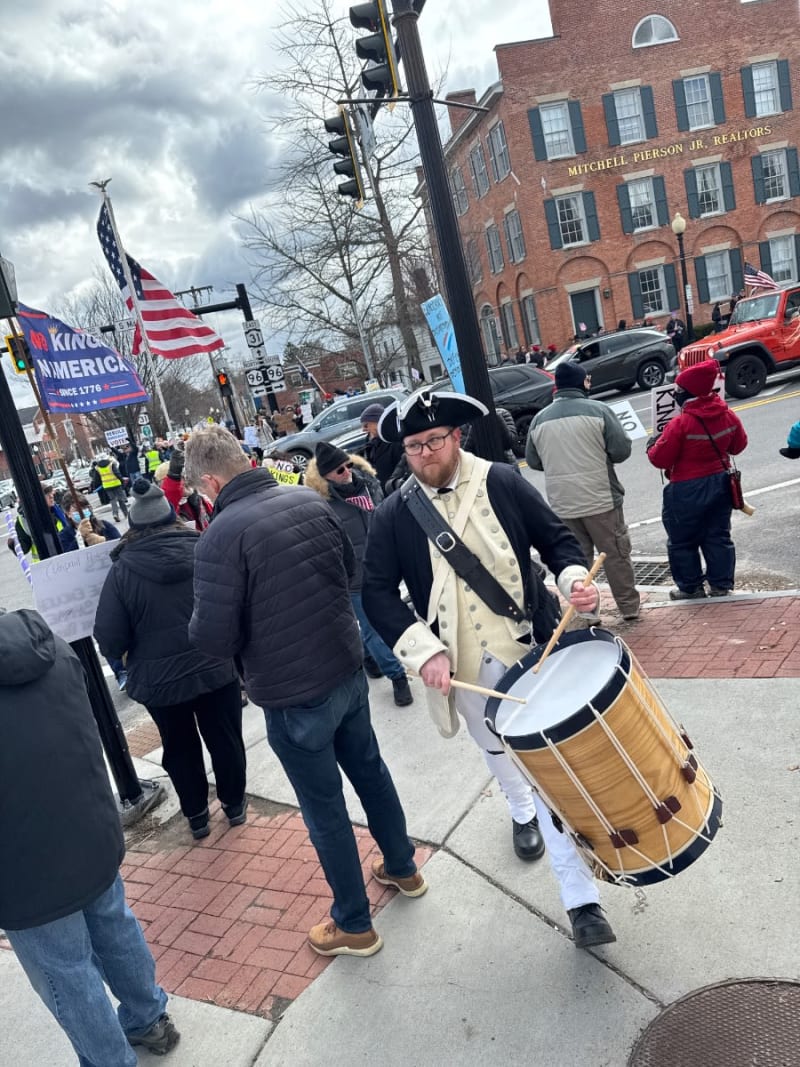
If you live within a block of Main Street and State Street, you already know what happened — the signs, the flag snapping in the cold air, and if you were close enough, the steady rhythm of a snare drum played in full Continental Army uniform. And then the horns. Not from the protesters. From the drivers going past. On Saturday, March 28, 2026, Pittsford showed up for the third time as a named location on the national No Kings protest map, and the photos in this article are from that gathering.
I'll be honest: the first two times this happened at the corner of Main and State, I treated it mostly as something worth documenting — neighbors exercising a constitutional right on a corner we all use. But three rallies at the same intersection in under a year changes the question. It is no longer just what happened. It is what framework does Pittsford actually have for this, and who is responsible for what. Those are governance questions, not political ones, and they are worth answering carefully and without heat.
What Happened: Three Rallies, One Corner, One Pattern
What Happened: Three Rallies, One Corner, One Pattern
The intersection of Main Street and State Street has now hosted a No Kings gathering three times. According to the 50501 RocNY event archive, the October 18, 2025 event was specifically scheduled at the S. Main/Route 31 intersection from 8:00 to 9:30 AM. The March 2026 event was listed by Hudson Valley Post's statewide guide at State and Main starting at 9:30 AM — one of dozens of Monroe County locations on that list.
The June 2025 gathering was part of the first national No Kings day, which per Wikipedia's documentation included crowds in Pittsford alongside over 2,000 demonstrators each in Fairport and Henrietta, and thousands more in Irondequoit and Brighton. The movement has grown substantially with each mobilization. Britannica's coverage of the protests documents that the June 2025 event drew an estimated 5 million participants across approximately 2,100 sites; October 2025 drew roughly 7 million across 2,700 locations; and March 28, 2026 drew approximately 8 million people across more than 3,300 sites nationwide — making it by multiple accounts the largest single-day protest in American history, according to reporting by ABC News.
Here is how the movement's scale has grown across all three events:
The number of protest locations has grown in parallel:
Pittsford was one of those 3,300 sites on March 28. That is worth sitting with — not as a political statement, but as a civic fact. What does it mean that a village of roughly 1,500 people has become a recurring node in a movement this size? And what does local government actually have in place to manage it?
The Colonial Drummer: What the Imagery Says
The Colonial Drummer: What the Imagery Says
The detail that stopped more than a few drivers in their tracks: one participant was dressed in a full Continental Army uniform — tricorn hat, white breeches, dark coat, buff waistcoat — playing a period-accurate rope-tension field drum. The full Spirit of '76 vocabulary, right here on our corner.
This kind of costuming is not new to American political demonstration. Revolutionary War imagery has appeared at labor rallies, civil rights marches, Tea Party demonstrations, and anti-war protests for generations — a shared national language connecting a cause to the founding era's explicit rejection of monarchical authority. The drum next to the banner reading No Kings in America Since 1776 is not accidental. Both make the same argument. Whether you find that argument compelling is entirely your own business. That it has roots stretching back to the Constitutional Convention is simply history.
What does it mean to you when a piece of that history shows up on a corner you drive past every week?
What the No Kings Movement Is — and Is Not
What the No Kings Movement Is — and Is Not
The phrase No Kings in America traces back to one of the most documented moments in early American history: the Continental Congress's deliberate decision not to offer George Washington a kingship after the Revolution. The founders designed a system of government — documented at length in the Federalist Papers — explicitly to prevent the concentration of power in a single executive. That's not a partisan claim. It's in every American civics textbook.
The modern No Kings movement gained national visibility as a response to what organizers describe as executive overreach. According to the Center for American Progress's analysis, the March 2026 event set yet another record for a single-day U.S. protest, with roughly two-thirds of the 3,300 rallies taking place outside major urban centers — meaning small communities like Pittsford were the backbone of the movement's geographic reach, not an afterthought.
Organizers have consistently framed the movement as nonpartisan and constitutionally focused — centered on separation of powers and due process rather than party affiliation. The crossed-out crown symbol on signs in these photos, the phrase No Kings in America Since 1776, the American flags carried as protest props rather than partisan signals — all of it reflects that stated framing. Reporting what organizers say their movement is, is not an endorsement. It is context any fair account of what happened on our corner needs to include.
The Horn Honking Problem: A Legally Complicated Situation

The Horn Honking Problem: A Legally Complicated Situation
Here is the part of this story that seems like it should have a simple answer — and doesn't.
The horn honking that disturbed residents near State Street was not produced by the protesters. It was produced by drivers passing through the intersection. That distinction matters for how the Village thinks about its response. But the more you examine the enforcement question, the more complicated it becomes.
The Village of Pittsford's noise ordinance, Chapter 133, adopted by the Board of Trustees on December 9, 1992 as Local Law No. 6-1992, establishes the general prohibition at § 133-1:
"It shall be unlawful and in violation of this chapter to create and/or suffer, permit and/or allow the creation of any unreasonably loud, disturbing or unnecessary noise in the village. Noise of such character, intensity or duration as to endanger the public comfort, peace or repose or to be detrimental to the life or health of any individual is declared to be a nuisance and is prohibited."
The Town of Pittsford's noise ordinance, Chapter 105, adopted August 5, 2003 as Local Law No. 3-2003, addresses vehicle horns more specifically, listing among explicitly prohibited acts:
"The sounding of any horn or signal device on any automobile, motorcycle, bus or other vehicle, except as a danger signal; the sounding of a multi-toned or musical horn; the creation by means of any such signal device of any unreasonably loud or harsh sound and the sounding of such device for an unnecessary and unreasonable period of time."
On paper, a single driver honking in support of a protest — rather than as a warning of danger — appears to fall within the definition of a prohibited act. Town penalties run from $150 to $350 per violation.
But here is where the practical and legal reality diverges sharply from the text. A single driver taps a horn once and is gone. Thirty seconds later a different driver does the same. Then another. The noise complaint that reaches a nearby resident is the cumulative effect of dozens of individual, fleeting acts by people who are never in the same place at the same time and each of whom would reasonably argue that a single brief tap was minimal and momentary.
The ordinance's language about "unnecessary and unreasonable period of time" was almost certainly written with a sustained single source in mind — an alarm, an idling truck, someone leaning on their horn in a parking lot. Not a rolling series of one-second expressions from fifty different vehicles passing over the course of an hour. Enforcement would require an officer to observe each individual honk, identify the vehicle in moving traffic, stop the driver, and issue a citation for what that driver experienced as a brief, isolated act. Whether a $150–$350 fine is proportionate to a single horn tap is a genuinely open question, and any citation issued in those circumstances would likely face challenge.
The noise is real. The disruption to nearby residents is legitimate. The law, as written, is simply a blunt instrument aimed at something it was never designed to address. That is not an excuse for inaction — it is an honest description of the difficulty, and it points toward why the Village Board may need new tools rather than simply applying old ones.
What would a fair noise standard actually look like when the source is fifty different people making a brief sound, rather than one person making a sustained one?
What the Village Can and Cannot Do: A Pittsford Protest Permit Framework
What the Village Can and Cannot Do: A Pittsford Protest Permit Framework
The First Amendment of the U.S. Constitution and Article I, Section 8 of the New York State Constitution both protect the right to peaceably assemble. These are not loopholes. They are the bedrock. And they come with specific, well-established legal limits on what a municipality can do in response — limits Village officials need to understand clearly, because missteps here carry real litigation exposure.
The NYCLU's Know Your Rights: Demonstrating in Central New York — the guide directly applicable to Monroe County — states:
"If you as an individual or small group want to protest or distribute flyers, have a demonstration or rally on a public sidewalk, and do not intend to use amplified sound, you do not need any permit. You do not have to notify police or other local government authorities ahead of time."
The NYCLU's statewide Your Rights to Protesting in New York (updated November 2025) confirms that New Yorkers may demonstrate on a public sidewalk without obstructing pedestrian traffic and march without amplified sound — with no permit requirement. A permit becomes legally required only when a demonstration moves into the street requiring traffic management, involves a crowd too large to safely use the sidewalk, or uses amplified sound beyond a standard bullhorn. Were those thresholds reached at the Pittsford gatherings?
The NYCLU's guidance on organizing demonstrations and the New York State Bar Association's 2025 analysis of municipal First Amendment law are clear on the constraints. The Village cannot require a permit or deny one based on the content or viewpoint of the protest. It cannot impose fees or insurance requirements that function as barriers to assembly. And it cannot treat protesters as responsible for the independent decisions of passing drivers under existing noise codes.
Critically, the Village also cannot design any new ordinance around the community reaction a protest produces. This principle has a name in constitutional law — the "heckler's veto" — and the Supreme Court has consistently ruled against it. As the First Amendment Encyclopedia explains, a heckler's veto occurs when the government restricts speech because of the anticipated or actual hostile reaction of opponents, and such vetoes have been repeatedly struck down as inconsistent with the First Amendment. The controlling Supreme Court precedent on the fee question is Forsyth County v. Nationalist Movement, 505 U.S. 123 (1992), in which the Court struck down a county ordinance that tied permit fees to the anticipated cost of managing crowd reactions — holding that such fees unconstitutionally condition the right to speak on the content of the speech. A Pittsford ordinance written in direct response to the community outrage that a particular protest generates, rather than to a neutral public interest like traffic safety, would face the same scrutiny. The offense taken by some residents or the honking of supportive drivers does not, legally, become the protesters' problem to solve.
As the NYSBA's 2025 analysis states directly: "Any doubt as to whether an ordinance unconstitutionally infringes upon freedom of speech should be resolved against the ordinance."
What the Village can do is establish content-neutral, narrowly tailored rules that apply equally to every public gathering — No Kings rally, Memorial Day parade, or block party. Reasonable options worth the Village Board's time include a voluntary advance notification process for organized events above a defined size threshold; clearer enforcement guidance on horn-honking noise complaints that accounts for the distributed-source problem described above; and a review of the timing gap — the October 2025 Pittsford event began at 8:00 AM, while the Town's special events noise exemption under Chapter 105 does not take effect until 9:00 AM.
Albany has not filled this gap. No new New York State legislation specifically addressing protest management for small municipalities has been passed in response to the 2025–2026 wave. Every village in Monroe County is navigating this with decades-old ordinances designed for Memorial Day parades. The chart below puts Pittsford's situation in context — this is a national phenomenon landing hardest on communities least prepared for it:
Three gatherings at the same corner in under a year is the system working as designed. The question is whether Pittsford's local governance infrastructure is designed to meet it — fairly, legally, and with the same evenhandedness it would bring to any other kind of public assembly.
What would a framework that genuinely works for all of us actually look like — for the people who show up to protest, and for the neighbors close enough to hear the horns?
This article is published for informational purposes and does not constitute legal advice. Residents or officials with specific questions about Village permitting or noise enforcement should contact the Village Clerk's office at (585) 586-4332 or consult with municipal counsel.
Content ID: MWmWBktJtXpyNbYVWy4R5DlU
See an error? Tell us.
Comments
Share with the Community