Pittsford Train Horn at Night: What a Quiet Zone Would Take
The Short Version
- The Pittsford train horn is federal law, not railroad preference — engineers must sound it at every public crossing, between 96 and 110 decibels, under a rule that took effect in 2005.
- Only a public authority can establish a quiet zone, not CSX; the Monroe Avenue corridor likely requires agreement from both the Village and the Town, and possibly the state.
- Westport Crossing's 156 apartments are opening for fall 2026 move-ins — those residents will sleep closer to the Monroe Avenue crossing than almost anyone else in Pittsford.
- The WHO recommends nighttime railway noise below 44 decibels at home; the federal minimum for a train horn is 96 decibels.
- The Voorheesville quiet zone on a CSX line cost about $288,000 in construction for two crossings, plus roughly $50,000 a year in maintenance.
- There is no record of Pittsford officials discussing a quiet zone in Town notices, regional news coverage, or the Village's 2026 agenda listings.
A Stuck Gate on Monroe Avenue
A Stuck Gate on Monroe Avenue
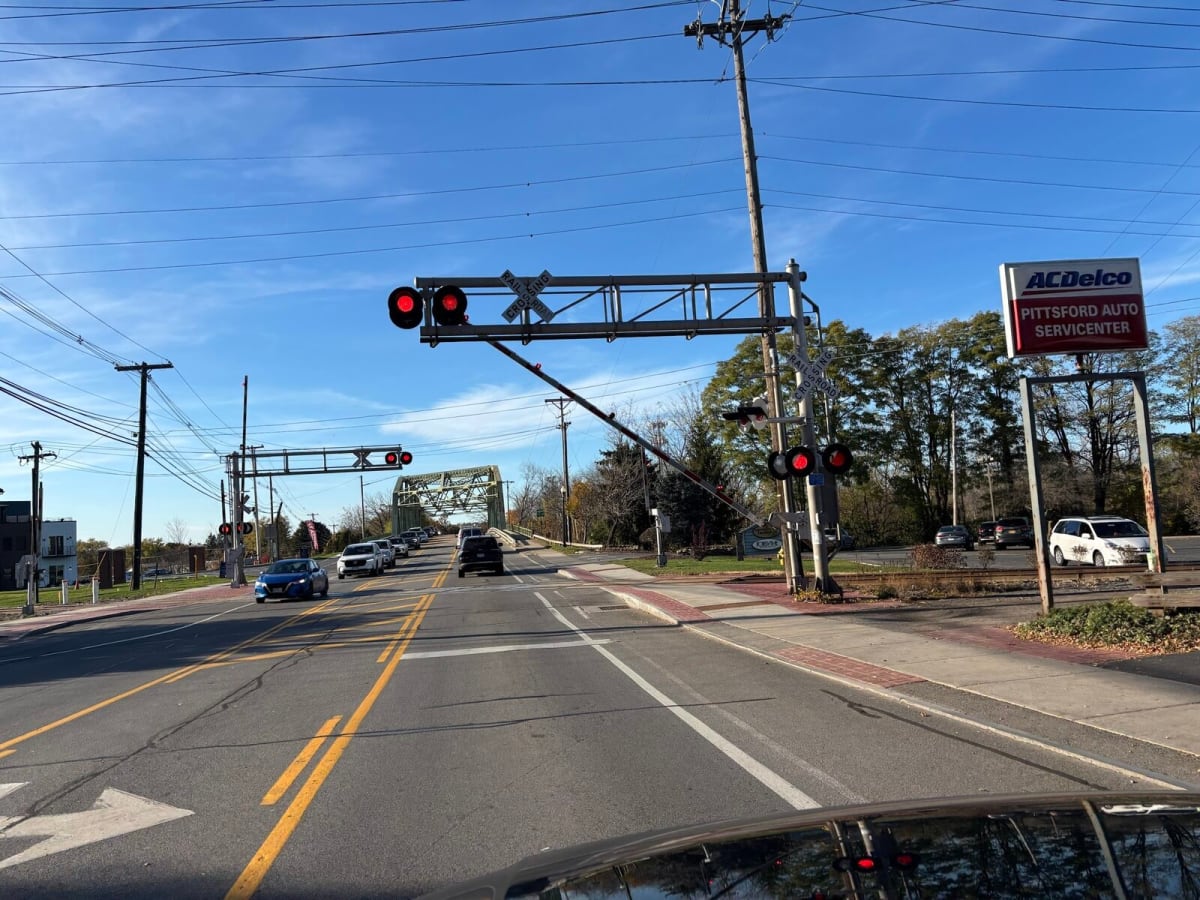
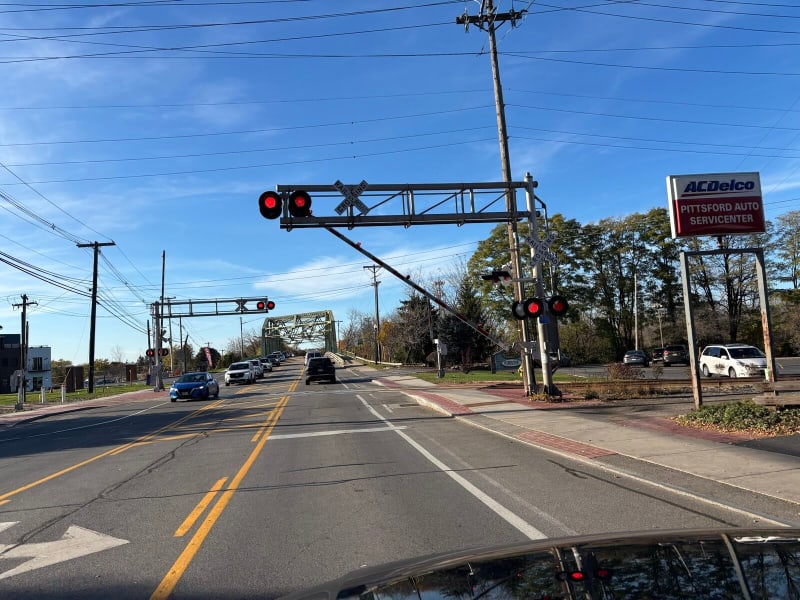
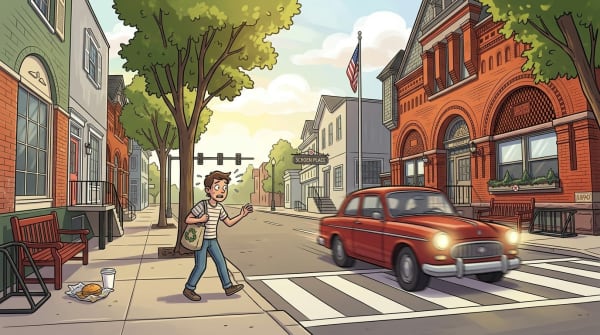
This afternoon I pulled up to the CSX crossing on Monroe Avenue in Pittsford, next to the canal bridge, and found the red lights flashing, no train in sight, and one gate arm stuck about halfway down. Traffic backed up for quite a ways in both directions while drivers worked out whether it was safe to cross.

Sitting in that line, I thought about the other thing this crossing does: the Pittsford train horn that carries across the village through the night. Communities across the country have quieted theirs. Pittsford has not, and I went looking for the reason.
Why the Pittsford Train Horn Sounds
The track belongs to CSX. Under CSX operation, the stretch from Fairport to Churchville is the West Shore Subdivision, the freight line that bypasses Rochester.
The horn is federal law, not railroad preference. Under the Federal Railroad Administration's train horn rule, engineers sound two long blasts, one short and one long before every public crossing, starting 15 to 20 seconds out. The horn must register between 96 and 110 decibels. The rule took effect in 2005, after FRA found that Florida East Coast Railway crossings with nighttime whistle bans saw a 195 percent increase in collisions during ban hours.
Any conversation about quieting the horn has to begin with the loss Pittsford already carries. On a Saturday afternoon in June 1997, two Brighton teenagers, ages 14 and 16, died on the railroad trestle over the Erie Canal near Monroe Avenue. A group of eight teenagers was on the tracks around 2 p.m. when a 77-car train approached. The girl's foot caught between the ties, and the boy went back to help her, according to the Democrat and Chronicle's June 23, 1997 report. It happened at 2 p.m. A nighttime quiet zone would apply only from 10 p.m. to 7 a.m.
Who Can Create a Pittsford Quiet Zone
CSX cannot grant quiet hours. Under 49 CFR Part 222, only a "public authority," the government responsible for traffic control at the crossing, can establish a quiet zone. The Town's own 2015 notice placed this crossing in the Village. When a zone includes crossings controlled by different authorities, every one of them must agree, so a corridor along the West Shore line could require the Village, the Town and possibly the state, since Monroe Avenue here is Route 31. The railroad comments and installs equipment, but the rule gives it no power to approve or create a zone.
I found no record of Pittsford officials discussing a quiet zone in Town notices, the 2001 waterfront plan, regional news coverage or the Village's 2026 agenda listings. Older Village minutes are the remaining place to check.
What a Pittsford Quiet Zone Requires
The federal checklist has four parts, set out in 49 CFR Part 222. First, the zone must cover at least a half-mile of track. Second, every public crossing inside it needs flashing lights and gates, plus constant warning time circuitry where practical and power-out indicators. A nighttime-only zone, from 10 p.m. to 7 a.m., is allowed.
The third part is a risk test. FRA scores the corridor with a Quiet Zone Risk Index. If that score already sits at or below the Nationwide Significant Risk Threshold, the zone qualifies without any added safety measures. If it does not, the local government adds supplementary safety measures until the score comes down: medians at least 100 feet long that keep drivers from weaving around lowered gates, four-quadrant gates that block the full roadway, one-way streets, or closures.
The fourth part is paperwork. The local government sends a Notice of Intent to the railroad and state agencies, waits through a 60-day comment period, then files a Notice of Establishment. Horns can stop as soon as 21 days later.
Pittsford already meets part of that list. My photos show the Monroe Avenue crossing with flashing lights, gates and an overhead signal mast. I could not confirm whether it has constant warning time circuits, which measure a train's speed and start the gates a set interval before it arrives, or power-out indicators. Neither is the same as the crossing bells, and neither is easy to check from the road. I also could not confirm which other public crossings fall within a half-mile stretch or where the corridor's risk score lands. That score decides the price.
What a Quiet Zone Costs
In Voorheesville, a village outside Albany on a CSX line, CSX estimated about $288,000 in construction costs for two crossings, plus about $50,000 a year in maintenance. The Town of Hamburg, near Buffalo, received a $475,000 federal appropriation in 2009 for its quiet zone. Nationally, an FRA official put the count at 1,016 quiet zones in 2025.
156 New Neighbors Beside the Tracks
Westport Crossing, the Mark IV development on the former Monoco Oil site, has 156 apartments and began taking applications for fall 2026 move-ins. In the approval record I could find, the only mention of trains came from a resident at the 2012 hearing, who cited 17 trains a day through the village.
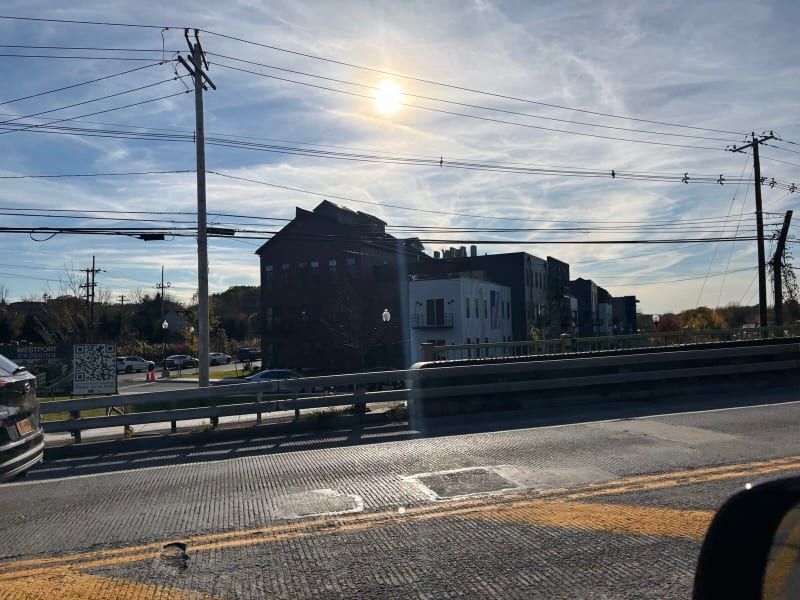
Many of our neighbors who live farther from the tracks probably hear the whistle as part of the village's charm, even a little quaint. The well-being of the people who sleep right beside it matters too, and the new Westport Crossing residents will sleep closer to the crossing than almost anyone in Pittsford. Adults need seven or more hours a night, and the World Health Organization recommends keeping nighttime railway noise at home below 44 decibels. Here is how that guideline compares with the horn's legal range:
In a German lab study, railway noise caused more awakenings than aircraft noise, and freight trains had the greatest effect. Lost sleep carries real costs: short sleepers face a 48 percent higher risk of coronary heart disease, and insomnia roughly doubles the risk of later depression.
Reporting a Broken Crossing
If you find a crossing malfunctioning, call the railroad's emergency number on the blue Emergency Notification System sign mounted at the crossing and give the crossing number printed on it. The Village Board of Trustees next meets Tuesday, Nov. 10, at 6 p.m. at Village Hall, 21 North Main Street.
Content ID: 6AKwkAqErE5scaJi5nT1ON1i
See an error? Tell us.

Comments
Share with the Community