
Monroe County Stores Must Now Tell You If They Are Scanning Your Face
The Short Version
- Monroe County is the third Western and Central New York jurisdiction to act on biometric privacy in 2026 — but the only one that stopped at disclosure rather than an outright ban.
- Any store scanning faces, collecting fingerprints, or capturing other biometric data must now post signage near the entrance; a missing sign means either no collection or a violation of the new law.
- The law also bans stores from selling or trading biometric data and requires its destruction within two years of collection — the restrictions go well beyond signage.
- Erie County and Syracuse both passed outright bans; Monroe County's penalties top out at $1,000 per violation compared to Erie County's $5,000-per-day cap for non-destruction of stored data.
- The Wegmans revelation in January 2026 — the Rochester-headquartered grocer quietly using facial recognition in select stores — is what triggered the regional legislative wave.
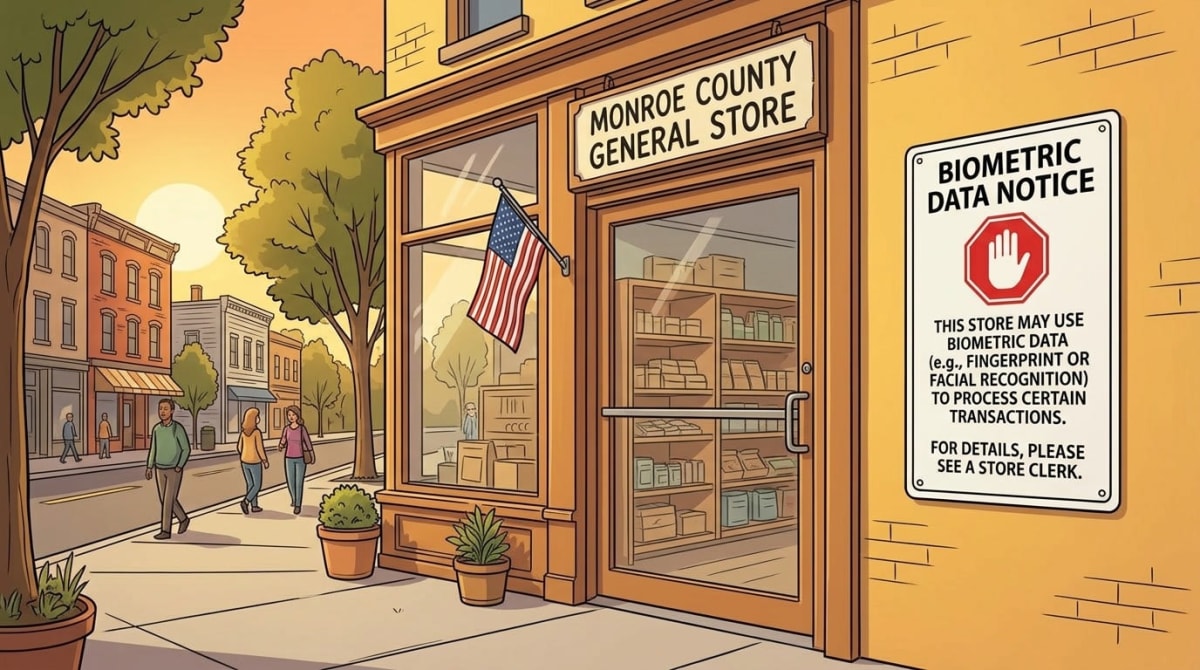
The Monroe County facial recognition law, passed unanimously on September 9 by the County Legislature, is one of the few local privacy statutes in New York State to carry real enforcement teeth. Starting this fall, any store in Monroe County that scans your face, collects your fingerprints, reads your retina, or captures other biometric identifiers must post a notice near the entrance telling you so. No sign means no collection — or a violation.
What Monroe County's New Facial Recognition Law Actually Requires
What Monroe County's New Facial Recognition Law Actually Requires
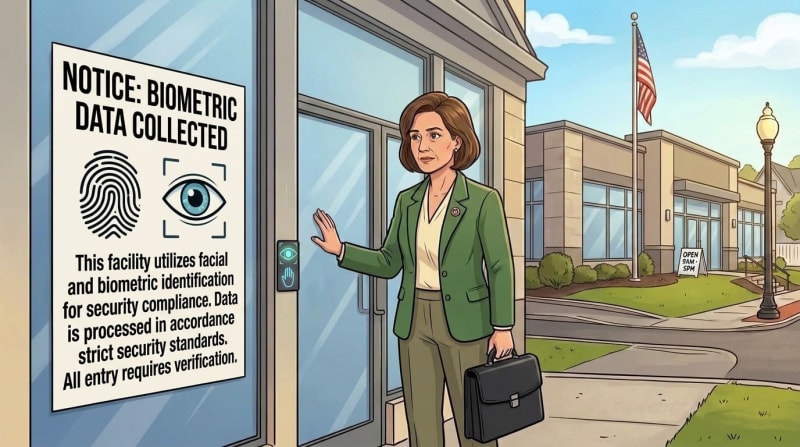
The law, co-sponsored by Legislators Rachel Barnhart and David Long, works through signage and data handling restrictions together. A business that collects biometric data must post clear, conspicuous notices near customer entrances. The law also prohibits businesses from selling, leasing, trading, or exchanging biometric information for anything of value and requires destruction of collected data within two years.
Penalties run $500 to $1,000 per violation. Businesses receive a 30-day notice and opportunity to correct before fines apply, which gives stores time to get into compliance rather than absorbing a penalty on day one.
"When your password gets hacked, you can change your password. You can't change your face."
— Legislator Rachel Barnhart, Monroe County Legislature
The Wegmans Revelation That Set This in Motion
The Wegmans Revelation That Set This in Motion
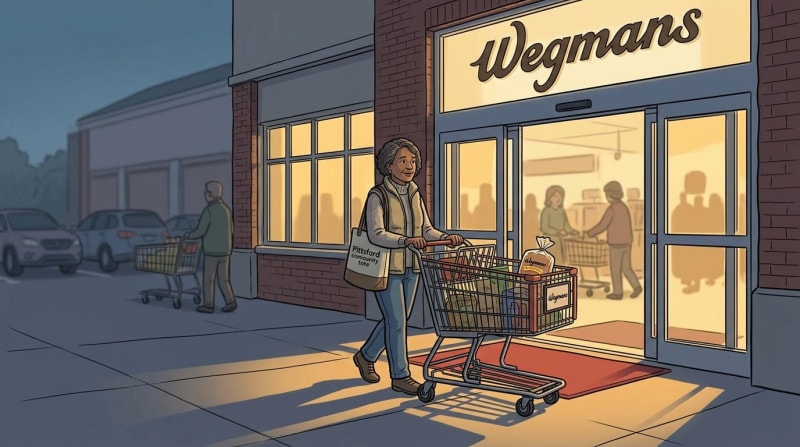
The regional push on biometric data disclosure started in January 2026, when Gothamist reported that Wegmans had been using facial recognition technology in select stores — capturing customers' faces, eyes, and voices without telling them. Wegmans is headquartered in Rochester. The stores designated as "elevated risk" locations used the technology to identify people "previously flagged for misconduct," according to the company, which declined to share supporting data on how that flagging worked or how many people it affected.
For a company that sits at the center of Monroe County life — and whose Pittsford store is a daily stop for much of the village — the disclosure landed differently than it would have from a distant retailer. Lawmakers in Monroe, Erie, and Onondaga counties all moved on biometric rules within months.
How Monroe County Compares to Erie County and Syracuse

How Monroe County Compares to Erie County and Syracuse
Monroe County chose disclosure, not prohibition. Erie County went further on April 30, 2026, enacting the Biometrics Transparency and Privacy Act — the first outright ban on commercial biometric data collection by any New York county — with penalties reaching $5,000 per day for failure to destroy stored data. Syracuse's Common Council voted unanimously on May 18, 2026 to ban biometric collection entirely, covering facial features, fingerprints, eye scans, and walking patterns.
Monroe County's biometric privacy law is the lightest of the three. Barnhart called it "a great start" while acknowledging that some constituents wanted a full prohibition. The enforcement ceiling of $1,000 per violation is also softer than Erie County's $5,000-per-day cap for non-destruction of stored data.
What to Expect When You Shop in Pittsford Now
What to Expect When You Shop in Pittsford Now
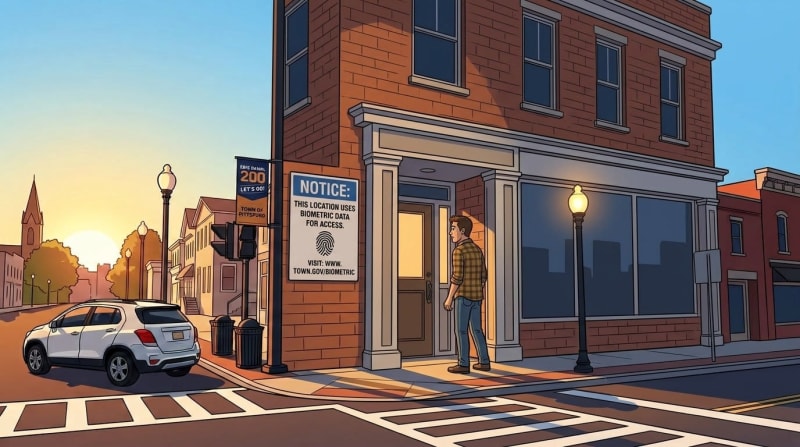
The law takes effect in September 2026. What changes is visible and simple: any store in the county that collects biometric data now has to tell you at the door, before you walk in. The coverage is broader than facial recognition alone — fingerprints, retina scans, voiceprints, and "other identifying characteristics" all fall under the store surveillance notification requirement.
Residents who believe a store is non-compliant have standing to take legal action; the 30-day correction window means the first step is a notice, not an immediate fine. Look for posted signs near the entrance of any store you frequent — if the sign is there, you know what the store is collecting, and if it isn't, the store either doesn't collect biometric data or is in violation of Monroe County law.
Content ID: XDNiqOs5Jc4pLHDFZFgaMY83
See an error? Tell us.


Comments
Share with the Community