
Pittsford Traffic Calming: Why Our Village Streets Need to Belong to People Again
The Short Version
- Pittsford’s streets are genuinely dangerous — pedestrian injuries happen every year at crosswalks that were never designed for people.
- The fluorescent flags quietly admit the infrastructure is not safe enough on its own.
- A painted crosswalk alone produces 10% driver yielding; add a beacon and that jumps to 80%.
- Monroe Ave is posted 30 mph but the village’s traffic calming study found drivers average 38 mph outbound, with 85th percentile at 44 mph — well into the danger zone.
- Other small towns have fixed this with roundabouts, raised crosswalks, and narrowed lanes — without losing their character.
- The question is whether we want streets that belong to cars, or streets that belong to people.
I've stood at the corner of Washington and Monroe Ave with a neon orange flag in my hand, waiting for a gap in traffic that never quite feels safe enough — and I keep thinking: this is a charming, walkable village, so why does crossing the street feel like a dare? I'm not a traffic engineer. I'm not a city planner. I'm just someone who lives here, shops here, and has spent more time than I'd like frozen on a curb, flag raised, hoping that the next driver sees me before I see their bumper. Pittsford traffic calming isn't a wonky policy debate happening somewhere else — it's a question about who our streets actually belong to. And I think it's time we answered it together. According to the Governors Highway Safety Association, pedestrian deaths in the US have climbed nearly 75% since reaching a modern low in 2009 — and while the last two years show a modest decline, the numbers remain close to a 40-year high.
Source: Governors Highway Safety Association and IIHS Fatality Facts 2023. 2016 and 2019 figures are approximate based on NHTSA trend data.
These Crashes Aren't Accidents — They're a Pattern

These Crashes Aren't Accidents — They're a Pattern
Look at the photos that accompany this piece for a moment. Really look at them. A rollover. A car wrapped around a lamp post like it was always supposed to be there. A Cadillac that took out a street light on Monroe Avenue with enough force to make you wonder what was going through the driver's mind in that last second. These are not rare outliers. These are not the kind of images you assemble by trawling through decades of archives. These village of Pittsford crashes happen with startling regularity, in and around the same corridors, involving the same design conditions, producing the same outcomes.
And it isn't only cars. Pedestrians have been struck here. Cyclists have been struck here. These are not hypothetical risks buried in a risk assessment document — they are documented harms that happened to our neighbors. People who live on your street, shop at the same grocery store, cheer at the same little league games.
Source: U.S. Senator Chuck Schumer press release, August 2023, citing Monroe County crash data. Rochester averages 1.35 pedestrian and cyclist injuries or deaths per day.
Here's a question I keep sitting with: if this pattern of injuries were happening on a hiking trail through Mendon Ponds Park, we'd close the trail. We'd reroute it. We'd ask what went wrong with the design. Why do we apply a completely different standard to Main Street? A community that truly belongs to its people shouldn't require residents to be brave just to pick up a prescription or walk to dinner. Courage is a fine quality. It shouldn't be a prerequisite for running an errand.
The Fluorescent Flag Fix — Grateful, But Not Good Enough

The Fluorescent Flag Fix — Grateful, But Not Good Enough
I want to be honest here: when I first saw the pedestrian crossing flags at our intersections, my reaction was genuinely warm. What a thoughtful gesture. The village noticed that crossing the street was stressful, and they did something visible and immediate about it. That kind of responsiveness matters, and I don't want to wave it away.
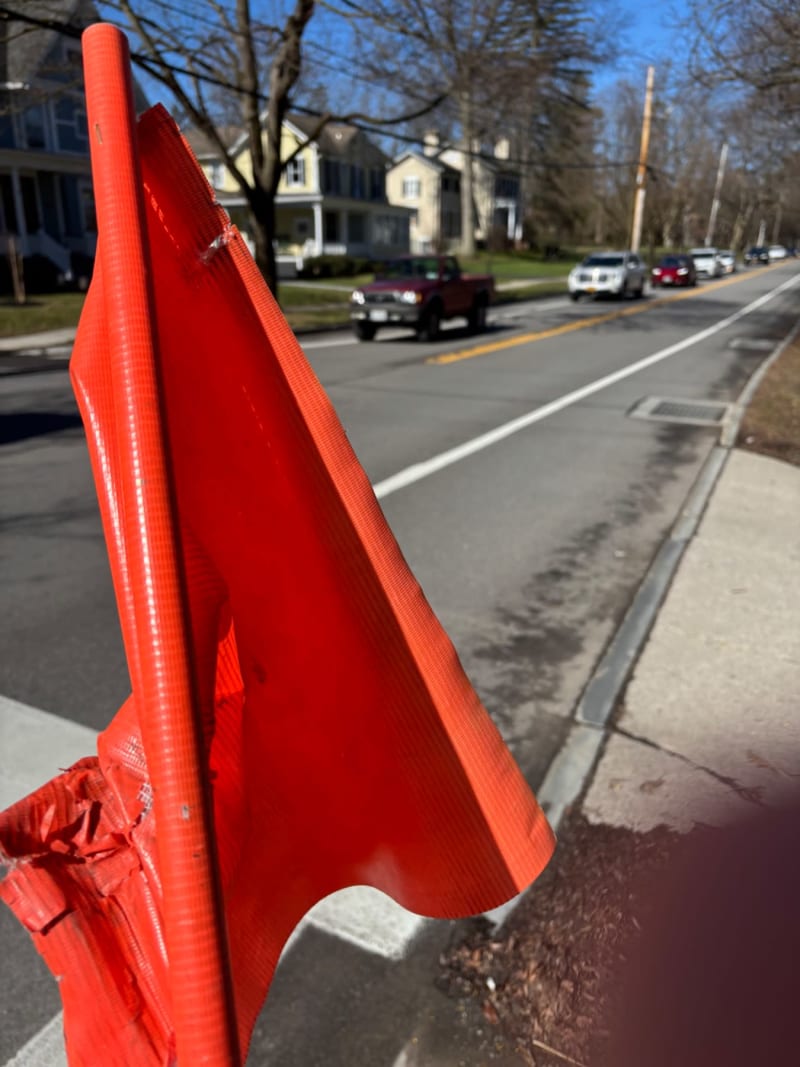
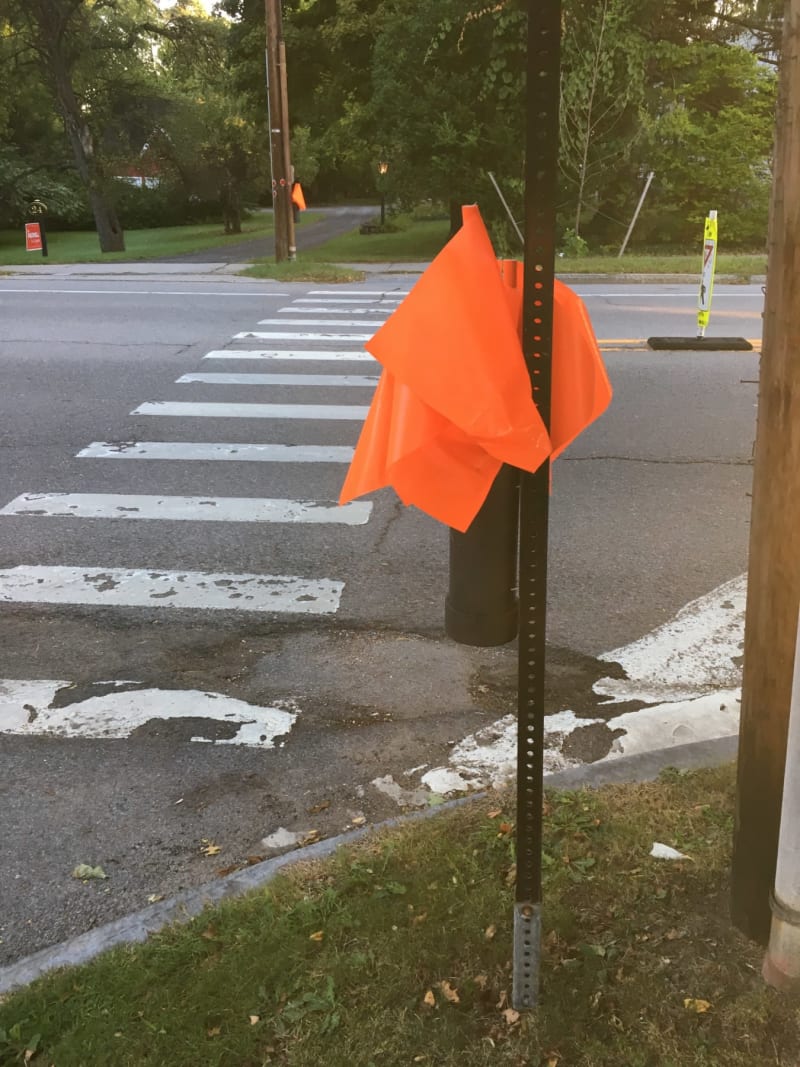
But I've had enough time standing at those crossings to name the honest absurdity of it. We are handing pedestrians high-visibility props because the infrastructure itself isn't safe enough to do the job alone. The flag is an admission, wrapped in orange nylon, that pedestrian safety in the Village of Pittsford currently depends on a person waving a stick and hoping for the best.
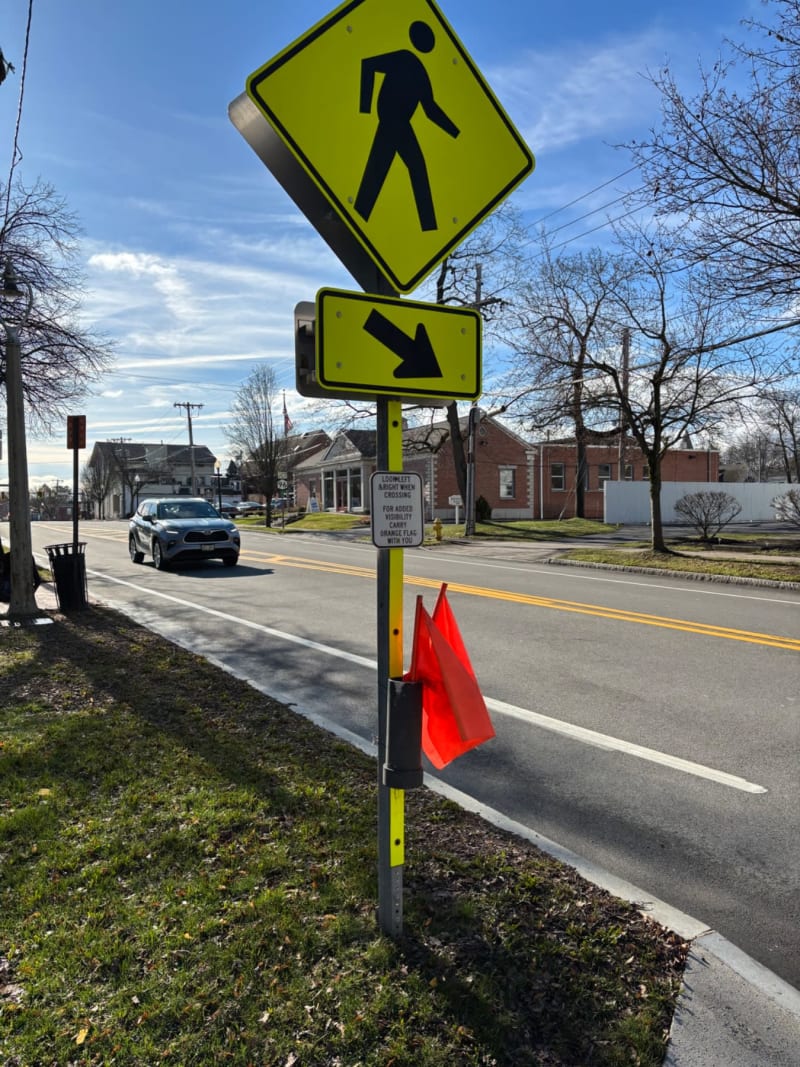
Neighboring communities that have implemented genuine traffic calming infrastructure don't need flags. They don't need them because the street design itself does the work — narrowed lanes signal to drivers that they've entered shared space, raised crossings create a physical cue to slow down, and the geometry of the road communicates what no sign can fully convey. The research on this is well established. A concept called "safety in numbers" — documented extensively in pedestrian safety literature and supported by studies from the National Highway Traffic Safety Administration (nhtsa.gov) — shows that streets designed for people see fewer injuries per pedestrian, not just more warnings distributed to them. When more people walk, drivers expect them. When the design accommodates them, everyone moves more carefully.
So I'm grateful for the flags. Truly. And I think we can do better than them. What does it say about how we've designed this space that the solution we reached for first was to put the burden back on the pedestrian?
Here's what the research says about what actually moves drivers. According to FHWA studies of crosswalk interventions, a painted crosswalk alone produces driver yielding rates around 10%. Add a rapid-flashing beacon activated by the pedestrian, and that number climbs to 80%. Combine a beacon with triggered crosswalk lighting, and IIHS research found drivers are more than 13 times as likely to stop. The flag doesn't appear in this research — not because nobody thought to study it, but because it's not classified as a safety countermeasure. It's classified as a pedestrian behavior prompt.
Source: FHWA — Evaluation of Pedestrian and Bicycle Engineering Countermeasures. RRFB yielding rate based on study of 22 sites across 3 cities (average increased from 4% to 80%). Beacon + lighting figure based on IIHS crosswalk illumination research, 2024.
The Bike Ordinance That Almost Made Things Worse

The Bike Ordinance That Almost Made Things Worse
A while back, the village took up pedestrian safety legislation aimed at protecting people on sidewalks from cyclists. The intention was genuinely noble. Anyone who's been startled by a fast-moving bike on a narrow sidewalk near Schoen Place understands the impulse. Pedestrians — especially older residents and kids — deserve to feel safe on the walkways designed for them.
But here's where good intentions ran straight into bad geometry. The practical consequence of the Pittsford bike ordinance as it was originally constructed would have been to push cyclists off sidewalks and into active vehicle lanes. On Monroe Avenue, where the posted speed limit is 30 mph but where the village’s own traffic calming study found drivers averaging 38 mph outbound — with 85% traveling 44 mph (Walk Bike Pittsford, citing the Village of Pittsford traffic calming study). Without protected infrastructure. For cyclists — many of them recreational riders, older adults, and kids — this wasn't an inconvenience. It was a fatality risk. The sidewalk isn't ideal for bikes, but neither is the middle of a fast-moving road without a buffer. And the data makes clear these are not equivalent risks.
The speed difference between what the sign says and what drivers actually do is not a minor detail. According to research by Brian Tefft at the AAA Foundation for Traffic Safety, at the posted 30 mph limit, roughly 20% of pedestrians or cyclists struck by a vehicle will die. At the average operating speed of 38 mph — where Monroe Ave actually functions, with 85th percentile drivers hitting 44 mph — that fatality risk climbs to well above 50%. The numbers don’t lie. The sign on the road says one thing. The physics say something else entirely.
Source: AAA Foundation for Traffic Safety — Impact Speed and a Pedestrian's Risk of Severe Injury or Death, Tefft 2013. Data reflects average risk across all ages for pedestrians struck by a car or light truck.
To put it in terms specific to this street: the ordinance would have moved a cyclist from a 30 mph posted environment into a corridor where drivers average 38 mph and 85th percentile speeds hit 44 mph — a gap that represents a dramatic, potentially fatal increase in risk.
Source: AAA Foundation for Traffic Safety / Tefft 2013, via FHWA Pedestrian Safety Synthesis. Speed data from the Village of Pittsford traffic calming study via Walk Bike Pittsford. At 30 mph: ~20% fatality risk. At 38 mph average operating speed: ~55% fatality risk.
Now, it's true that research consistently shows cyclists on sidewalks experience more incidents overall than cyclists on roads — primarily because of blind conflicts at driveways and intersections where drivers don't expect moving traffic on a sidewalk. A study of cyclists in the Ottawa-Carleton region found that injury rates on sidewalks were four times higher than on roads when measured per trip. That sounds damning for the sidewalk. But injury rate and fatality rate are not the same number, and on a 35 mph arterial without a bike lane, they point in opposite directions. More sidewalk incidents, yes — but survivable ones. Fewer road incidents, yes — but each one carries a 50% chance of killing someone.
Source: Ottawa-Carleton region cyclist study, cited in Reynolds et al., 2009 — The Impact of Transportation Infrastructure on Bicycling Injuries and Crashes, Environmental Health. Sidewalk injury rate is 4x the road baseline — but these are primarily low-speed driveway and intersection conflicts, not high-speed vehicle strikes.
I want to be clear about what the data does and doesn't prove here. No single study has tracked a specific sidewalk ban in a village like Pittsford and measured the resulting change in cyclist fatalities. What the research does show — from Tefft's speed-survival data, from the Ottawa-Carleton injury frequency work, from the physics of a 35 mph impact — is that the logical outcome of pushing unprotected cyclists into Monroe Ave traffic would have been fewer minor incidents and more dead cyclists. That hypothesis is well supported. No data contradicts it.
What happened next is, to me, the most quietly remarkable part of this story. Residents showed up. Not with a petition. Not with a hashtag campaign or a coordinated letter-writing effort. Just neighbors, speaking plainly, making the case that the unintended consequences of this ordinance would cause the exact harm the ordinance was trying to prevent.
And the village listened.
I want to give direct, specific thanks here to David Marshall, Lisa Cove, and Mayor Plummer for hearing those voices and adjusting course. That kind of responsiveness — being willing to revise a position in the face of constituent concern, without defensiveness, in the middle of a process — is not something we should take for granted. It matters. It deserves to be named out loud.
It's also worth noting where Pittsford stands relative to other New York State communities that have enacted sidewalk cycling bans. According to the NY Bicycling Coalition's summary of state bike law, the City of Ithaca bans sidewalk cycling for anyone over age 10, and the City of Elmira bans it for anyone 14 and older. New York City bans it outright for adults. What every one of these communities has in common is protected infrastructure — bike lanes, sharrows, dedicated cycling corridors — that gives cyclists a legal, safer alternative to both the sidewalk and the unprotected travel lane. Ithaca built marked bike lanes on State Street and Green Street before enforcing its sidewalk ban. The ban and the infrastructure came as a package. Pittsford's ordinance proposed one without the other. That distinction is not a technicality. It's the whole argument.
The sidewalk isn't the right place for a bicycle. But a 35 mph travel lane without a buffer isn't either. The answer every comparable community eventually arrived at — and the answer the data has been pointing to all along — is a protected lane that makes both questions moot.
Source: Protected lane injury reduction from Teschke et al., 2012 — Route Infrastructure and the Risk of Injuries to Bicyclists, American Journal of Public Health. NYC 9th Avenue data from NYC Department of Transportation, 2012 — Measuring the Street, via PeopleForBikes.
This is what community self-governance actually looks like. Not a formal campaign. Not an advocacy organization with a budget. Just people who care enough about their town to show up and say so — and a village government willing to listen. The question the ordinance raised hasn't gone away. It just found its right answer: not a ban, and not blind acceptance of the status quo, but a third option the street doesn't have yet.
Our Streets Were Designed for Cars — And It Shows

Our Streets Were Designed for Cars — And It Shows
None of what I've described above is a mystery once you understand the history. Street design for cars and traffic safety diverged from livability decades ago. After World War II, American road engineering made a collective choice — largely invisible to the people who would live alongside its consequences — to optimize for vehicle throughput above everything else. Move cars efficiently. Minimize friction. Time the signals for flow. Pittsford's main corridor carries that legacy in every lane width and signal cycle.
Urban planners have a term worth knowing: "stroads." A stroad is a street that tries to function as a road — wide enough to move regional traffic at speed, but lined with the driveways, storefronts, and pedestrian crossings of a town center. Traffic safety researchers, including those at the Strong Towns organization (strongtowns.org), have documented that stroads are the most dangerous surface type for all users precisely because they satisfy neither function well.
That regional through-traffic creates a genuine tension. Pittsford isn't just a destination — it's a corridor. Drivers from outside the village are moving through it at speeds that make sense on an open road but are genuinely hazardous in a pedestrian environment. And the design, calibrated for that through-traffic, makes the village feel — and function — more like a highway than a town.
This is what most of us feel but can't always name. It's hard to linger. It's hard to window shop. It's hard to let your kids walk to Pittsford Dairy or the library when the road beside them feels like a speedway with a 30 mph sign tacked on as an afterthought. The problem isn't distracted drivers or inattentive pedestrians — though both exist. The problem is a design that was never built for the kind of place Pittsford wants to be.
What Traffic Calming Actually Looks Like — And What's Working in Small Towns

What Traffic Calming Actually Looks Like — And What's Working in Small Towns
So what's the alternative? Pittsford traffic calming, as a physical practice, is more concrete than the phrase makes it sound. Traffic calming is a set of design interventions — narrowed travel lanes, raised crosswalks, curb extensions that shorten crossing distances, roundabouts, textured pavement at crossings, adjusted signal timing — that reduce vehicle speed not through enforcement but through design. The road itself does the persuading.
The reason this matters so much comes down to physics and survival. The relationship between vehicle speed and pedestrian fatality is steep and unforgiving. According to data from the World Health Organization (who.int), a pedestrian struck by a vehicle traveling at 50 km/h (about 31 mph) has roughly a 25% chance of survival. At 30 km/h (about 19 mph), that survival rate jumps to around 90%. The NHTSA echoes this: speed is the single most significant factor in pedestrian fatality outcomes (nhtsa.gov). Traffic calming is, at its core, a life-safety intervention.
And it works in places that look a lot like us. Davidson, North Carolina — a college town with a historic walkable center — implemented comprehensive complete streets measures and dramatically reduced pedestrian conflicts while increasing foot traffic to local businesses. Woodstock, Vermont, a village comparable in scale and character to Pittsford, has maintained its walkable identity through design rather than hope. Yellow Springs, Ohio used a combination of raised crossings, reduced lane widths, and community-engaged planning to calm its main corridor without losing the small-town vitality that makes it worth visiting. Complete streets policies — which plan for all users, not just drivers — have now been adopted by more than 1,600 jurisdictions across the United States, and many qualify for federal transportation funding through programs administered by the Federal Highway Administration (fhwa.dot.gov).
Here's the thing about Pittsford specifically: we're not starting from nothing. We have a community that shows up. We have a local government that has demonstrated it will listen. We have a village character so worth protecting that people move here specifically to be part of it. The will is already here. The models exist. The question is just whether we're ready to take the next step.
What Pittsford Could Look Like If We Reclaimed the Street

What Pittsford Could Look Like If We Reclaimed the Street
Close your eyes for a second — or don't, since you're reading, but bear with me — and imagine a Saturday morning on State St where the street feels like it belongs to everyone who lives here. The canal is right there. The small shops are open. The farmers market is humming. The foot traffic around Schoen Place spills naturally across the street because crossing it doesn't require a personal pep talk. Kids walk to the village without a parent doing threat-assessment calculations at every intersection. To reclaim streets in Pittsford as a truly walkable village, we don't need to bulldoze anything. We need to redesign some of what we already have.
Concretely, this could look like: raised pedestrian crossings at the highest-volume intersections, which physically force vehicles to slow while giving pedestrians a level crossing surface. Curb bump-outs at Monroe and Main that shorten the distance a pedestrian spends exposed in the roadway and visually narrow the lane to signal shared space. A reduced speed limit through the village core — not just posted, but enforced through geometry, so drivers feel the change before they read the sign. And at least one protected bike corridor, so that cyclists have an option that doesn't require them to choose between a crowded sidewalk and a fast-moving travel lane.
None of this is speculative. The transportation economics literature consistently shows that corridors that undergo traffic calming see increases in both property values and local business revenue — because people stay longer, come back more often, and spend more when they feel safe (Victoria Transport Policy Institute, vtpi.org). Safer streets are also better for business. That's not a tradeoff; it's the same investment.
What would we build here, I keep wondering, if we started from the simple assumption that this street belongs to the people who live on it?

Pittsford doesn't need to invent anything. The research is there. The design playbook exists. There are other towns that have walked this road ahead of us are easy to visit and easier to learn from. And most importantly — as we proved when residents showed up and quietly changed the outcome of a bike ordinance without a single Zoom meeting or formal advocacy structure — the community will is already alive and our leaders are listening.
The question isn't whether Pittsford Village can have safer, more human streets. It's whether we'll decide, together, that we deserve them. I think we do. I think most of you reading this already know we do. So — what are we going to do about it?
Content ID: YksWtVPkszc5RHs4bK4i9SFM
See an error? Tell us.
1 Comment
Dennis
Paint and speed bumps won’t fix the dangerous village streets. Try this … residents sign a petition pledging to go the speed limit. Those who sign get a sticker for their car. Since they are state roads post a trooper by the canal bridges once a week for three months. When the motorist shows in court to see the judge, do not dismiss the ticket … make the fine as high as the law allows. Comments please …
Apr 13, 2026 at 6:15 pm
Share with the Community