
Solar Panels in Pittsford's Historic District: 4 Applications
The Short Version
- Four solar applications came before the Historic Preservation Board between September 2025 and May 2026: one approved, one denied, one withdrawn for lack of jurisdiction, and one that failed despite two votes in favor.
- Pittsford already has a written solar policy - twelve numbered criteria handed out at Board meetings and referred to in the minutes as 'Village solar principles.'
- Only two of those twelve criteria concern visibility from a public way, yet visibility is what nearly every decision turns on.
- The 15 Maple application failed on a 2-1 vote because Village Code requires three affirmative votes, a majority of the full five-member Board, regardless of how many members attend.
- Cooperstown wrote a renewable-energy presumption directly into its zoning law; Pittsford's criteria operate instead through a catch-all phrase in Chapter 112.
- Every Pittsford solar decision on record came in under 62 days - the statutory deadline Cooperstown's board must meet and Pittsford's board is not subject to.
On the evening of May 28, three rooftop solar applications came before the Village of Pittsford Historic Preservation Board. Three different things happened. Together with a fourth decision last October, they are the clearest record we have of how Pittsford historic district solar panels actually get decided — and the record is more considered than I expected.
One application was withdrawn after it was determined the panels would not be visible from a public way, which meant the Board had no jurisdiction. One was denied. One received two votes in favor and one against, and failed anyway.
That is not a story about a board getting something wrong. Read the minutes and what comes through is volunteers working carefully through a genuinely hard question, one property at a time, on a night when only three of five members could be there. What is the right way to think about solar on a house in a historic village? Pittsford is not the first place to ask. So I went looking — at our own record first, then at what a comparable village has done.
Four Applications, Ten Months

Four Applications, Ten Months
The May meeting was not the beginning. Going back through the Board's minutes, four solar applications have come before it since September 2025.
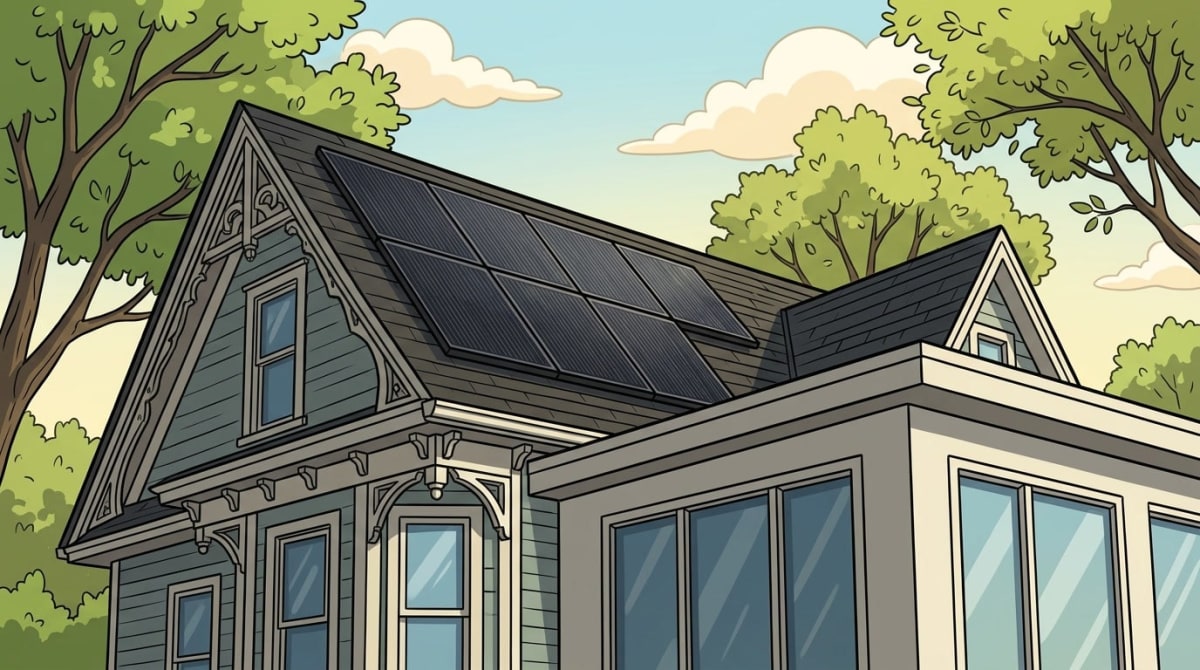
The first was 19 Boughton Avenue — an eight-module, roughly four-kilowatt array, flush-mounted on the rear southwest-facing roof of a 1970s addition to a house dating to about 1900, with black panels chosen to match the existing roof. The Board deferred it in September and approved it 4–1 in October. The written findings are worth noting: the addition was not original to the structure, the installation was reversible, the panels were low-profile and minimally visible from public ways, and the application aligned with sustainability objectives in the Village's Comprehensive Plan.
Then came May 28 — a meeting that had itself been rescheduled after the Board could not reach a quorum on its original date. The Chair opened by noting that only three members were present, the bare minimum for action, and told applicants they could proceed or come back before a larger board. All of them chose to proceed.
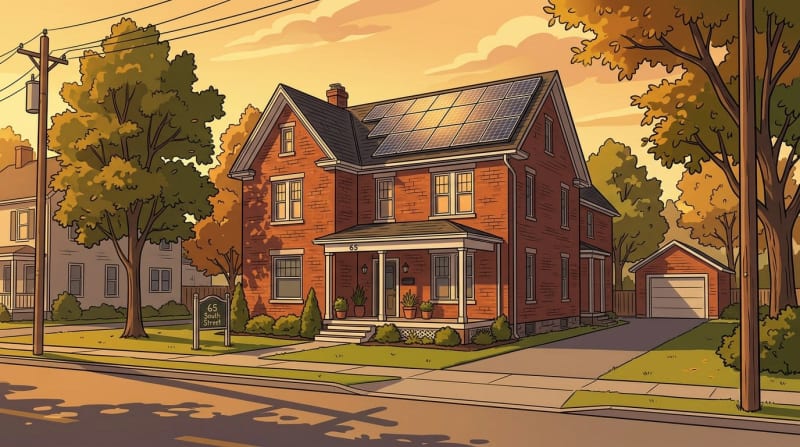
Sixty-three South Street was denied, with findings citing visibility from public ways and coverage of multiple roof planes that would significantly alter the appearance of the structure. Sixty-five South Street was withdrawn once it was determined the panels were not visible from a public way. And 15 Maple drew two votes in favor and one against — which, under Chapter 112 § 112-4F(3), is not enough. An affirmative vote of a majority of the full Board is required to approve any matter, and on a five-member board that means three votes no matter how many people are in the room.
Here is what each application actually received:
That is the whole of it. Not a pattern of inconsistency — four different sets of facts producing four different answers.
What the Pittsford Historic District Solar Panel Criteria Actually Say
What the Pittsford Historic District Solar Panel Criteria Actually Say
Here is the thing I did not expect to find, and nearly got wrong.
My assumption going in was that Pittsford had no written solar policy — that each application was argued from scratch against the general compatibility standards in the Code. That is not true. Filed in the Board's 2025 meeting materials, and handed out at both the September and October meetings, is a document titled Criteria for Design Principles for Installation of Solar Harvesting Resources on Historic Pittsford Village Buildings, Structures and Resources. Twelve numbered criteria. The October minutes record members debating an application's compliance with "Village solar principles," and the May minutes refer to "the Village solar guidelines." They were using it.
The criteria open with a basic principle: the historic character of all properties in the Village is to be considered, retained and preserved when any solar application is reviewed. Then twelve numbered items, of which these matter most to a homeowner:
- Every Village building — commercial or residential, old or new construction — counts as a historic resource for solar purposes.
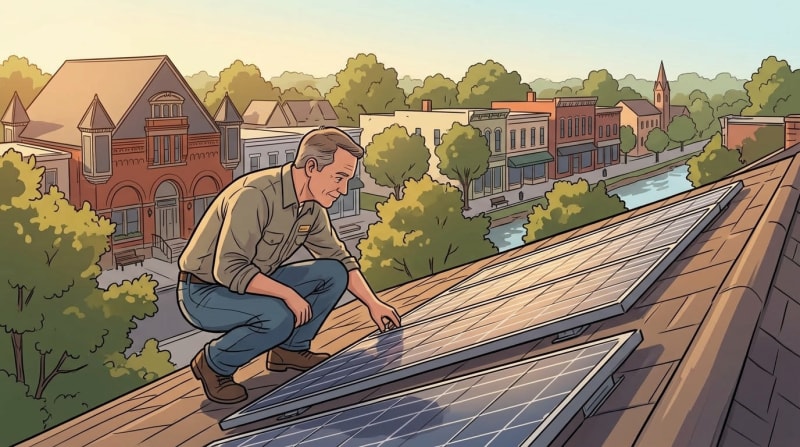
- Roof-mounted systems should have no, or very minimal, visibility from any public way.
- Solar shingles are treated differently: they may be visible from a public way if applied to the roof like ordinary shingles, non-reflective, and similar in look and color to the non-solar shingles around them.
- Where minimally visible panels are approved, they must sit parallel to the roof, protrude as little as possible, and stay below the roofline of a primary façade.
- Systems that cannot be seen from the ground will generally meet the Secretary of the Interior's Standards for Rehabilitation.
- Installations must be reversible, leaving no damage to historic fabric if removed later.
- Ground-mounted systems are encouraged in inconspicuous, screened locations.
- There is a stated order of preference: new buildings and additions first, then existing non-historic additions or accessory structures.
Sort the twelve by what they actually govern and something interesting appears:
Only two of the twelve are about visibility from a public way. Yet visibility is what nearly every decision turns on — because it is the criterion that most often decides whether the Board has anything to review at all.
The criteria also mix their verbs. Several say shall. The visibility criterion says should. That is not sloppiness; it is the difference between a rule and a judgment, and it is why four applications produced four answers.
Most volunteer boards never write their reasoning down. This one did.
That is a real gift, and worth naming: it means an applicant can know something about how a proposal will be received before spending money on a design.
Where the Word "Visible" Comes From
Where the Word "Visible" Comes From
The 65 South Street outcome rests on a distinction worth understanding, because the Village Code states it in two places and does not state it identically.
Chapter 210 § 210-23.2A, the zoning law, is the cleaner of the two. It requires a certificate of appropriateness for the construction or exterior alteration of any building, structure, or architectural feature in the Historic District that is, in any respect, visible from a public street, park, the Erie Canal, or any other space accessible to the public. Read plainly, the visibility test governs both construction and alteration.
Chapter 112 § 112-5A puts the same words in a different order — requiring a certificate for the alteration of any exterior architectural feature of any building in the Village, and for construction of any building in the Village that is visible from those same places. Read strictly, the visibility qualifier attaches to construction, and alteration carries no visibility limit at all.
That is a genuine ambiguity, not an error by anyone. Chapter 112 also exempts ordinary maintenance and repair that does not change design, material, color or outward appearance, with the Building Inspector deciding what qualifies — a separate off-ramp that turns on whether something changes, not on who can see it.
One clarification that matters locally: the Village of Pittsford and the Town of Pittsford are separate governments with separate codes and separate boards. If you are reading rules about historic review, check which one you are reading. It is an easy thing to mix up, and the answer differs.
How a Village of Comparable Size Answered It
How a Village of Comparable Size Answered It
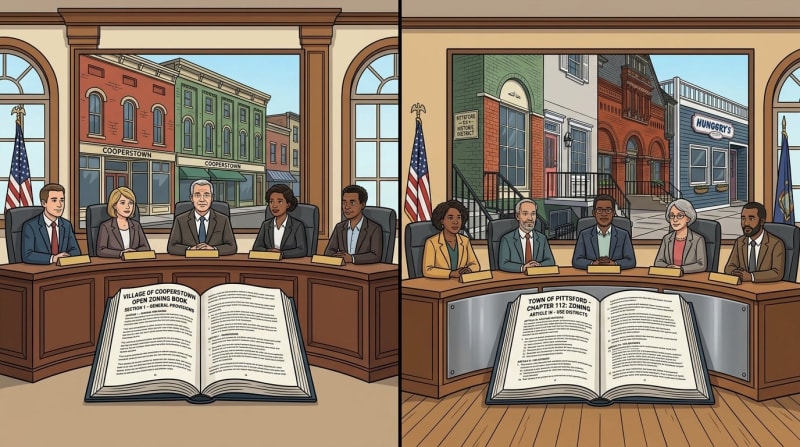
Most places that have wrestled with this are cities, and comparisons to New Orleans only go so far. Cooperstown, New York is a closer fit — and the structural resemblance is striking.
Cooperstown's zoning law establishes a Historic and Architectural Control Overlay District encompassing the entire Village, just as Pittsford's Trustees placed the entirety of the Village within a historic district and the H District covers the whole of its corporate limits. Both are governed by five-member appointed boards. Both boards seat a quorum of three. Both villages sit inside National Register districts.
Cooperstown made one choice Pittsford has not. Written into the zoning section governing its historic overlay is a subsection on energy efficiency stating that conservation and reuse of existing buildings, greening the existing building stock, and reinvestment in older communities are important components of energy conservation and combating climate change — and that the section "shall not presumptively prohibit the utilization of renewable energy, green materials or energy conservation technologies for any property." The same subsection says such work should still be assessed for negative impact on historic character, and that character-defining features must not be obscured, damaged or destroyed.
That is a starting presumption, written into law. Pittsford's equivalent thinking exists too — but it operates differently. Chapter 112 directs the Board to apply the Secretary of the Interior's Standards, any regulations adopted by the Trustees, the Village Design Guidelines, and "any other locally developed standards for review." That gives the Board more than one place to stand. Which of those the solar criteria rest on — a regulation the Trustees adopted, or the locally developed standards catch-all — is not something the public record settles. And it is the difference between guidance the Board chose to follow and a rule the Village voted for.
Since the solar criteria were written, the Village has taken its sustainability record to the state level. In September 2025 the New York State Department of Environmental Conservation certified the Village of Pittsford as a newly bronze-level Climate Smart Community. Worth repeating the caution from earlier: this is the Village. The Town earned its own bronze certification back in 2022, and the two are constantly mistaken for each other. Mayor Alysa Plummer says the Village is also a Clean Energy Community and is closing in on silver certification.
So the commitment is real and documented. It simply lives in state programs and Village practice rather than in the historic preservation code. Cooperstown wrote its version into the zoning law. Pittsford put its version to work nearly everywhere else.
Cooperstown's code differs in two other ways worth knowing. It gives its board 62 days from a complete application to approve, deny, or approve with modifications, with a public hearing mandatory only for demolition. And its supplementary regulations name solar energy systems explicitly as requiring a certificate of appropriateness. The word "solar" does not appear anywhere in Pittsford's Chapter 112.
Pittsford has no statutory clock. So how long does it actually take?
Every one of them came in under a deadline Pittsford is not subject to. That is worth saying plainly: the Board is already moving faster than the benchmark, without being made to.
One thing I cannot tell you: whether Cooperstown's rules would have produced a different result at 15 Maple. Its code sets a quorum of three but states no separate voting threshold, and New York's General Construction Law generally requires a majority of the whole body for public bodies anyway. That is a legal question, not something to infer from a code page.
Mayor Plummer says she thinks the Cooperstown code has merit and deserves further review by the Trustees, alongside more contemporary municipal codes — a review that makes sense to her as the technology changes quickly.
Questions a Neighbor Might Ask
Questions a Neighbor Might Ask
If my panels cannot be seen from any street, do I still need a certificate of appropriateness? That is the question 65 South Street raised, and the Board's answer that night was no — not visible from a public way meant no jurisdiction. But Chapter 112 and Chapter 210 do not phrase the test identically, so the safe move is to ask the Building Inspector before you order equipment, not after.
Are solar shingles treated differently from panels? Yes, and this surprises people. The Village's criteria allow solar shingles to be visible from a public way if they are applied like ordinary shingles, non-reflective, and similar in look and color to the surrounding roof. Panels get the visibility test; shingles get a compatibility test.
What about ground-mounted systems? The criteria do not merely tolerate them — they encourage ground-mounted systems in inconspicuous locations, screened from public view. If your roof faces the wrong way, the yard may be the easier path.
The Streetlights Already Answered a Version of This
Mayor Alysa Plummer raised an analogy I hadn't considered, and it reframed the question for me.
The Village's historic streetlamps are no longer filled with whale oil or lit by gas. They carry LED fixtures now — safer, more efficient, and consistent with the Village's clean energy commitments. The fittings are historic. What's inside them is not.
"It is a use of a modern technology with historic fittings that still enables our village to tell the story of our past."
— Mayor Alysa Plummer, in written comments to Pittsford Village Chat, July 2026
She also points out something easy to miss on an evening walk: the Village has plenty of thoroughly contemporary streetlights too. Do those change how Pittsford reads as historic — or do we simply appreciate a well-lit street on the way home?
From there she offers two questions, and she offers them as questions rather than positions. First: does installing solar panels in the best manner the guidelines allow so negatively affect a historic property that it no longer reads as historic, or of a period of significance, within the Village? Second: if a majority of homes across our neighborhoods carried removable panels, would we stop recognizing those houses for their character, their architectural detail, and what each one contributes to the fabric of the community?
That word removable is doing quiet work. Reversibility is already one of the twelve criteria — an installation must leave no damage to historic fabric if it comes off later. A panel that can be removed is a different kind of change than a window that cannot be put back.
Neither question has an obvious answer, which is presumably why she asked them rather than answered them.
What Happens Next
What Happens Next
The 15 Maple application returned to the Board's June packet and again to its July 20 agenda as continued business. Minutes for those meetings had not been posted when this was written, and the Board's meeting recordings are on the Village's website for anyone who would rather watch the discussion than read the summary.
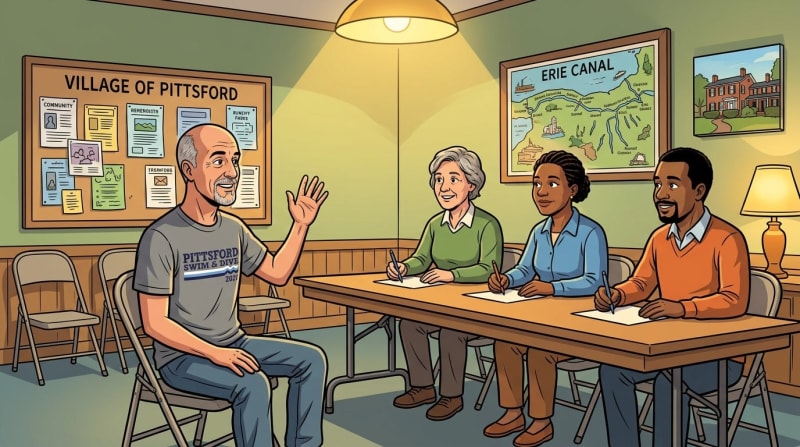
It is worth seeing what an evening in front of this board actually looks like:
Eleven applications in one evening, worked through by three people who volunteered for it.
The Historic Preservation Board meets monthly, and its meetings are open. Its members took the trouble to write down what they think about a question most communities argue about without ever committing anything to paper. Whether those criteria stay guidance or become something more formal is a decision for the Village — and the people best positioned to shape it are the ones who show up.
What would it mean for your street if the answer got decided by the neighbors who bothered to attend?
Content ID: d2nG8SXWAtje062Ffap9YMWS
See an error? Tell us.

26 Comments
Comment from Facebook
I think the town needs to do some soul searching and decide what it wants to be long-term. Denying someone solar on their 100 year old house while allowing some of the current development projects to go forward is hypocritical. We desperately want the town to be more historic than it really is. At the end of the day, many of these houses are just that, old houses. There needs to be some real village-wide consistency and direction. Right now, it seems like the large developers get a lot more leeway than homeowners, which I disagree with.
Jul 30, 2026 at 4:22 pm
View on Facebook ↗Comment from Facebook
Robert Greendyke This is a core misunderstanding of how historic preservation works. Think of it more like each of these old houses is a historic painting. Could you change the frame, yeah? Should you paint in something new that didn't exist when the painting was made? Probably not. But also, why wouldn't that art gallery have a newer painting in it? You're not supposed to fake history on a historic house because it will never go back to the way it was and it's not accurate. But also, you're not supposed to make something new and have it "trick the eye" to appear if it's original to the historic district. Look at 75 Monroe through that lens: it melds with the vibe of the historic district but no one is mistaking that as original. That said, the goal of the board is only to preserve the integrity of the "resource" that exists, not to make opinions about solar existing or not. They have no discretion over that. The village board would need to change what the guidelines are and I have no idea if that can be done by the board or a community vote or even if deviating from the US Interior Guidelines would qualify it as a historic district anymore.
Aug 2, 2026 at 11:44 pm
View on Facebook ↗Adam Stetzer
This is a genuinely thoughtful framing — and your read on the Board's mandate holds up against the code. Chapter 112 directs the HPB to apply "the Secretary of the Interior's Standards for Rehabilitation and any regulations adopted by the Village of Pittsford Board of Trustees for historic preservation purposes" and any locally developed standards, so the scope of their discretion really is defined by what the Trustees have set.
Aug 3, 2026 at 12:03 am
View on Facebook ↗Comment from Facebook
Christopher Dabroski a bit condescending... And many cities in Europe would disagree. I can't speak to what the layers of bureaucracy referenced in your last paragraph permit, but I can stand behind my point that if we are going to be this hard on homeowners for houses newer than my barn, especially given the cost RG&E is passing through to people, perhaps we should put more effort into safeguarding the resource and not let disasters like 75 through because they invoke the privilege of barn facade. I can see it from my backyard, and it's far worse for the historic vibe of the village than any solar panel on a roof would be. We pick and choose too much. Need consistency.
Aug 3, 2026 at 2:01 am
View on Facebook ↗Comment from Facebook
Robert Greendyke We did preserve our 120 year old farm house and historic barn, meeting all of the village rules and codes set forth and it definitely was not a push.
Aug 8, 2026 at 12:49 pm
View on Facebook ↗Comment from Facebook
I think the solution is to allow solar but require it to blend with the historic character of the Village. Panels should first be placed on rear-facing roofs, additions, garages, barns, or screened areas whenever possible. If they have to be visible from the street, require low-profile black panels, matching frames, concealed wiring, and a layout that follows the roofline. That protects what makes the Village historic without pretending modern technology doesn’t exist. The goal should be finding a reasonable balance between preserving the Village’s character and allowing homeowners to make responsible improvements to their properties.
Jul 30, 2026 at 7:13 pm
View on Facebook ↗Comment from Facebook
That’s the current state of things I believe.
Jul 31, 2026 at 10:51 am
View on Facebook ↗Comment from Facebook
I own a local solar provider and have worked extensively with other historic districts across NY and the country. The pattern is usually the same, avoid panel exposure to visible areas upon review. Promote clean energy within certain aspects of the historic preservation and aesthetic
Jul 30, 2026 at 10:01 pm
View on Facebook ↗Comment from Facebook
If you're going to require people to spend a lot of extra money in order to maintain the historic nature of the home (like expensive window replacement vs modern) then there's no way you should be approving any hideous solar panels that are visible from the street.
Jul 30, 2026 at 10:19 pm
View on Facebook ↗Comment from Facebook
Global warming is real. If you want to keep the character of a roif, than you must tell people they can only have cedar shingles or a slate roof.
Jul 31, 2026 at 12:18 am
View on Facebook ↗Comment from Facebook
My bill this month.
Jul 31, 2026 at 12:20 am
View on Facebook ↗Comment from Facebook
Can we only use horse and carriage in the historic section of Pittsford?
Jul 31, 2026 at 12:21 am
View on Facebook ↗Comment from Facebook
Let's forbid cell phone service in those historic areas as well. And no snow plows in the winter.
Jul 31, 2026 at 12:29 am
View on Facebook ↗Comment from Facebook
Don’t get me started on the windows😡
Jul 31, 2026 at 3:44 am
View on Facebook ↗Comment from Facebook
The HPB is really, really reasonable. Read the minutes and you’ll see most things get conditionally approved if not outright approved. Renewables are great but I don’t think the Village should like Cyberpunk 3077.
Jul 31, 2026 at 10:51 am
View on Facebook ↗Comment from Facebook
The original question was whether there’s a way to balance energy goals with the historic character of the Village. It’s easy to reduce that discussion to “then everyone should have slate roofs and travel by horse and carriage,” but that doesn’t really address the question or offer a solution. Nobody is suggesting the Village should reject modern technology simply because it’s modern. The real question is how we allow it while still respecting the historic character that makes Pittsford unique. That requires reasonable standards, thoughtful compromise, and actual ideas—not exaggerated comparisons that shut down the conversation.
Jul 31, 2026 at 11:15 am
View on Facebook ↗Adam Stetzer
Thank you! I really is kinda hard question if you think about it…
Jul 31, 2026 at 11:35 am
View on Facebook ↗Comment from Facebook
Withdrawn doesn't appear to be the correct term to use. Withdrawn is an action that would be done by an applicant. It seems from this post that the board made a decision of some kind. Would not a better term be "rejected" or something similar? There is an intake part of the process where a question is accepted or rejected. If accepted, it then moves to to consideration part of the process to be approved or denied.
Jul 31, 2026 at 12:03 pm
View on Facebook ↗Adam Stetzer
That's a fair and precise question worth addressing directly. For 65 South Street, the minutes record that "the applicant withdrew the application from HPB review after discussion determined the installation was not visible from a public way and therefore not subject to HPB jurisdiction" — so that withdrawal was initiated by the applicant, not a board decision, which is why the article uses that term. For 15 Maple, the outcome was indeed a board action: a motion to approve received two yes votes and one no, and per Village Code, "an affirmative vote of a majority of the full Board is required to approve any matter" — meaning a 2–1 vote with only three members present at that rescheduled meeting could not reach the required majority of five, so the motion failed rather than being denied or rejected in a formal intake sense.
Aug 1, 2026 at 2:47 am
View on Facebook ↗Comment from Facebook
Christopher Cheney I cannot think of many rejected votes on the board. It comes close but usually if it's not going to pass the board had communicated that and asked the person to come up with something that would pass. As far as determining it's not jurisdiction, that's typically the boards or the code enforcement person, not the applicant. Plenty of applications I had approved because I felt it wasn't sufficiently visible whereas the code enforcement person believed it was.
Aug 2, 2026 at 11:45 pm
View on Facebook ↗Comment from Facebook
I've thought a lot about this. Power boxes, wires, and telephone poles are all over the village; they are part of life that we've accepted. Some might find them unattractive, and yet, we've all become comfortable with them because they are needed. You probably don't even notice them. Solar Panels are much less intrusive, visually, and are for the good of the owner, the community, and the planet.
Jul 31, 2026 at 3:41 pm
View on Facebook ↗Comment from Facebook
Mark Eggleston you mean the most visible and defining historic details on a historic structure. The thing the village pays for a consultation to see if repairing (which is often cheaper and more energy efficient) is the better option?
Aug 2, 2026 at 11:48 pm
View on Facebook ↗Comment from Facebook
Christopher Dabroski yes, that. It’s the energy efficiency I’m hung up on. I just think there are ample period correct replacements available which in addition to being energy efficient provide better emergency egress. In my opinion.
Aug 3, 2026 at 4:14 am
View on Facebook ↗Comment from Facebook
Mark Eggleston Been there, dealt with all of this. The fact is, there is, there is no way a restored 100 year old window comes close to he energy efficiency of modern windows, no matter what anyone tells you.
Aug 8, 2026 at 12:53 pm
View on Facebook ↗Comment from Facebook
Mark Eggleston if energy efficiency is all you're worried about, get some mylar blinds. The cost of the new window relative to the efficiency of energy saved would take 50-100 years to break even.
Aug 10, 2026 at 12:49 pm
View on Facebook ↗Comment from Facebook
Well, we made nine visits to the architectural preservation board to add 450 sq. ft. to our house. It was all about protecting the "scale, proportion and architectural integrity" of the home. Then one day, up pops a solar array, in the yard, not on a roof, that is visible from both South Street and Jefferson Road. I immediately protested to the board and the response was "we couldn't say no." On that day, I was done with the preservation board and to me, the entire effort to preserve the historic significance of the village is now dead. I will never apply for or go before the board for approval for any work to my house or property. I encourage others to do the same—just do what you want. And honestly, anyone who does their research will make an intelligent decision that spending your money on new windows, making updates to your home's insulation, or both, will offer immediate and -permanent rewards. Ask anyone in the village who wants to abide by the rules about replacing windows in the village! Oh, when you go looking for those windows, according to the board, you must replace with "wood windows" if the window is visible from the street or canal. Meanwhile you can go view the not-so-attractive solar panels in the middle of the yard on 83 South Street—again, visible from South and Jefferson while you drive by. Explain that to me. Lastly, when re-siding our home, the board insisted that the "milk door" had to be replaced due to it's historical integrity; it was. I'll wait for anyone who wants to give me the details of the architectural significance of solar panels anywhere on a property???
Aug 8, 2026 at 12:45 pm
View on Facebook ↗Comments marked “from Facebook” were shared from our Facebook page. Commenter names are not published here — open the original thread to see them.
Share with the Community