

The Erie Canal and Pittsford: What America's 250th Means for a Village Built on the Water
The Short Version
- On June 22, 2026, a hand-built Seneca Chief replica passes through Pittsford on a 22-day bicentennial voyage retracing the Erie Canal's 1825 opening route from Waterford to Buffalo.
- The Erie Canal cut freight costs by approximately 95 percent when it opened — a drop that transformed subsistence farming in western New York into a viable commercial enterprise practically overnight.
- Rochester had about 1,500 people in 1820 and more than 36,000 by 1850 — the canal did that, and Pittsford's own scale and character reflect the same economic force playing out at a village level.
- Schoen Place and Lock 32 are not just scenic amenities — they are the direct physical descendants of working canal infrastructure, and the footprint of the village was drawn by canal geography before any of its current buildings existed.
- The water-gathering ceremony at Pittsford's stop connects directly to DeWitt Clinton's 1825 Wedding of the Waters; water collected from every community along the route will arrive in Buffalo together in the same vessel.
- The canal opened 49 years into the republic — before the railroads, before the telegraph — and completed the economic independence that the Revolution only promised on paper.
Stand at the end of Schoen Place on a summer morning and the canal does something quiet. It doesn't announce itself. The water moves slowly, catching light off the old mill facades, and if you've lived here long enough you stop noticing how extraordinary it is — that this path, these buildings, this whole character of place you love, came from one engineering decision made two hundred years ago. On June 22, 2026, a hand-built replica of the original Seneca Chief packet boat will pass through Pittsford on a 22-day voyage from Waterford to Buffalo, retracing the route that opened the Erie Canal to the world in 1825. The Pittsford Erie Canal history that lives in these buildings and this water isn't a museum piece — it is the actual architecture of the village you live in.
Before the Canal: What Pittsford Was in 1820

Before the Canal: What Pittsford Was in 1820
In 1820, the stretch of land that would become Pittsford's village center was something far simpler: a small frontier settlement at the edge of a vast interior. Quaker farmers and New England transplants had begun staking claims in the Genesee Country in the late 1700s, cutting clearings from forest that ran unbroken across what is now Monroe County. The earliest permanent settlers in Pittsford arrived in the final years of the eighteenth century, drawn by the Phelps-Gorham Purchase lands that opened the western frontier of New York State to settlement.
Monroe County itself didn't exist yet — it was formed in 1821, carved out of Ontario and Genesee Counties as the Genesee Valley's population crossed a critical threshold. The nearest major market was days away by wagon over the Genesee Turnpike. Transporting goods from the interior to the Hudson River cost roughly $100 per ton by ox-team and road — an expense that made commercial farming barely viable and kept the western New York frontier economically isolated from everything east of the Appalachians.
The surveying parties for the proposed Erie Canal moved through this territory beginning in 1817. They were mapping a navigable route from the Hudson to the Great Lakes — a passage that would, if it worked, change everything about the economics of the American interior. This particular stretch had something going for it: the gradual descent of the Irondequoit valley, the proximity to water, and the relatively flat terrain that spared builders from the mountain passes blocking other proposed routes. According to the NY Canalway program, the completed canal would reduce freight costs by approximately 95 percent. The engineers studying these fields in 1817 were betting the math would hold.
A ninety-five percent drop in freight cost doesn't just make shipping cheaper — it rewrites who can participate in the economy. It means the farmer in Pittsford can sell flour in New York City. It means the merchant in Buffalo can receive goods from the coast without losing the year's profits to transport. The village of Pittsford grew because the math worked, and the math worked because the geology of this valley made it possible.
The Seneca Chief and What Opening Day Felt Like
The Seneca Chief and What Opening Day Felt Like
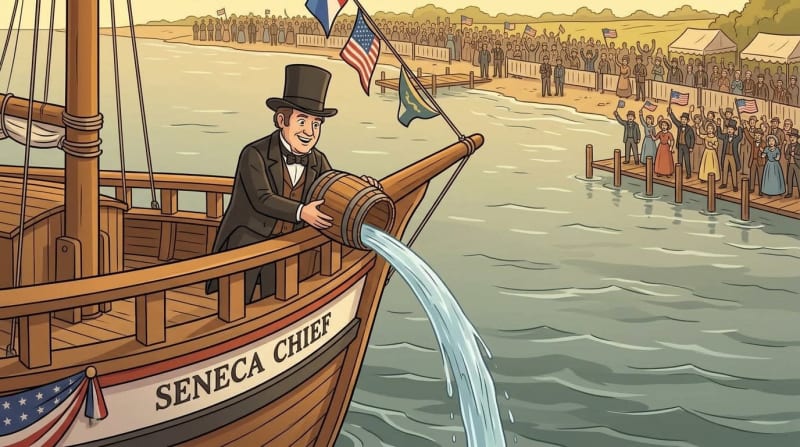
When the Erie Canal opened in October 1825, Governor DeWitt Clinton led a flotilla of boats from Buffalo east to New York Harbor in a ceremony that was, by the standards of the era, a spectacular act of national theater. The lead vessel — a packet boat called the Seneca Chief — carried barrels of Lake Erie water the entire length of the new canal. When the flotilla arrived in New York Harbor, Clinton poured the lake water into the Atlantic in what he called the "Wedding of the Waters" — a symbolic marriage of the interior to the ocean, the Great Lakes to global trade.
The towns along the canal route had spent eight years watching construction crews work the earth — picks, shovels, blasting powder, moving 11 million cubic yards of soil and rock to carve 363 miles of waterway through central New York. The workers were largely Irish immigrants living in tent camps along the route. The opening was the first moment the communities could see what had been built — and feel what it would mean for them.
Near Rochester, the celebrations were met with cannon fire and crowds. US Census Bureau records show that Rochester had about 1,500 people in 1820 — barely a town by any measure. What happened in the decade following the canal's opening is one of the most dramatic community growth stories in American history.
Pittsford sits six miles east of Rochester's center. Whatever transformation overtook Rochester rippled through Pittsford as well — not as a city, but as a canal-side village with economic purpose: a place to stop, to load, to sell provisions to the boatmen, to mill flour for the New York market. The Erie Canal bicentennial Pittsford is now commemorating isn't abstract history. It is the reason the village exists at the scale and in the form it does.
What was it like to stand on the towpath in October 1825 and watch the Seneca Chief pass through? We can't know exactly. But the people who stood there understood — or would soon learn — that they were watching something that would shape their grandchildren's lives. What are the things we witness today that carry that same weight without announcing themselves?
How the Canal Shaped the Village We Walk Through Today
How the Canal Shaped the Village We Walk Through Today
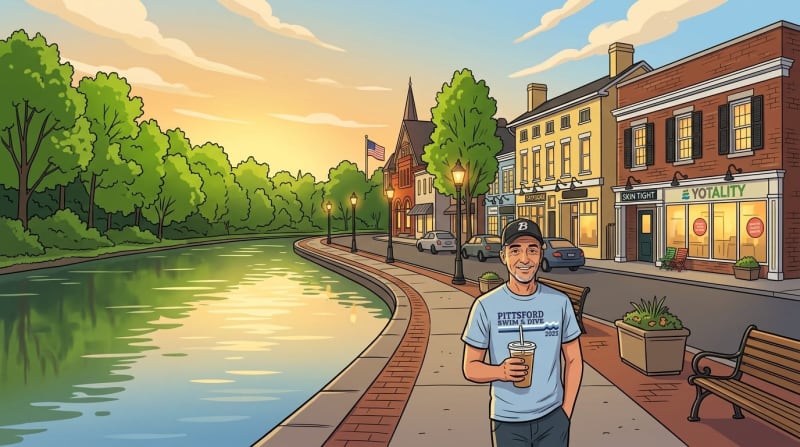
Schoen Place is where Pittsford's canal history is most legibly present. The buildings along the water's edge were built for canal commerce: warehouses, mills, and stores servicing the boats and their crews. What was once working infrastructure — the kind of place that smelled of grain dust and rope — is now one of the most beloved public spaces in the region, a gathering ground that sees more foot traffic on a summer weekend than it probably saw in a full week of working commerce.
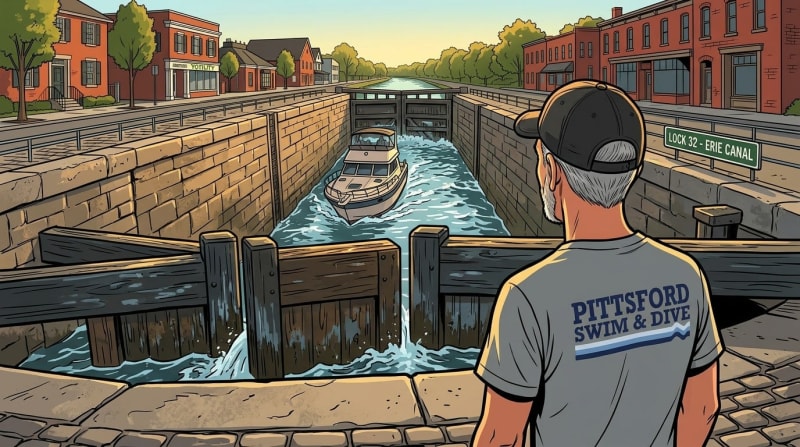
Lock 32 in Pittsford remains one of the Erie Canal's functioning locks — a living piece of canal engineering that still raises and lowers boats in the same fundamental motion as 1825. The masonry walls, the wooden gates, the water filling and draining: this is canal engineering as the physical skeleton of modern Pittsford. You can't fully understand why the village is where it is, shaped the way it is, without standing at Lock 32 and watching it work.
The Historic Pittsford organization has documented the canal-era origins of many structures that define the historic district — the 1820s-era mill and wharf buildings that form the commercial waterfront. Some businesses operating in Schoen Place today trace their location, if not their trade, directly to those canal-era buildings. The footprint of the village — where the center is, why certain streets run as they do, which lots held value — was laid out by canal geography more than two centuries ago.
Not every community along the 363-mile original route kept what Pittsford kept. Some grew into larger cities. Some faded when canal commerce ended and the railroads bypassed them. What Pittsford retained — the walkable scale, the waterfront character, the historic fabric — reflects choices made and preserved across generations. The canal gave Pittsford a gift of place. What has been done with that gift since is a story worth naming.
The Bicentennial Voyage and What It Means in 2026

The Bicentennial Voyage and What It Means in 2026
As the Village of Pittsford's June 2026 bulletin describes it, this summer's Seneca Chief is "a hand-built replica inspired by the packet boat that celebrated the opening of the Erie Canal in 1825, traveling west from Waterford to Buffalo on a 22-day voyage connecting communities along the canal corridor."
The boat's scheduled arrival in Pittsford on June 22 is not merely a historic boat visit. Visitors can meet the crew, tour the vessel, and participate in a water-gathering ceremony that echoes the Wedding of the Waters from 1825. Each stop along the route contributes water from the local community. The gathered waters will arrive in Buffalo together, as Clinton's barrels arrived in New York Harbor together two centuries ago. The ceremony doesn't recreate 1825 — it extends it, reaching forward to claim the same meaning for a different time and a different set of communities connected by the same waterway.
Those numbers tell the canal's deepest story. According to US Census Bureau historical records, New York State grew from 1.37 million people in 1820 to 3.1 million by 1850 — more than doubling in thirty years — driven by the economic engine the waterway created. The communities along the Erie Canal Bicentennial Voyage route in 2026 are the living evidence of that growth, and Pittsford's canal corridor is one of the best-preserved stretches of that living record.
June 22 in Pittsford isn't a spectacle. It is an invitation — to walk down to the canal, to see the replica that someone cared enough to build by hand, and to recognize that the waterway running through your neighborhood is the reason the neighborhood exists the way it does. The water-gathering ceremony is worth participating in. Your water, added to the waters from every other community along the route, will reach Buffalo in the same vessel.
America's 250th and the Erie Canal's Place in the Story
America's 250th and the Erie Canal's Place in the Story
The American Revolution ended in 1783. The Erie Canal opened in 1825. In those forty-two years, the young republic had political independence but not economic independence. British manufactured goods still dominated American markets. The vast agricultural interior beyond the Appalachians — all that territory the Revolution had nominally won — was economically stranded, too expensive to connect to coastal trade.
The canal changed that at a scale that is hard to grasp from the present. According to the NY Canalway program, the Erie Canal reduced freight costs between the Hudson River and Great Lakes by approximately 95 percent, transforming the economics of the entire interior of North America. Western New York's wheat could now reach New York City. American grain could compete on global markets. New York became the busiest port in the Western Hemisphere — not because of its harbor, but because of the waterway stretching 363 miles inland from it.
As America marks its 250th birthday in 2026, it is worth placing the canal where it belongs in the national story.
The canal arrives 49 years in — decades before the railroads, more than a century before the interstate highway system. It is the first great piece of infrastructure that made independence mean something economically. The Revolution gave Americans the right to govern themselves. The Erie Canal gave them the means to build something with that right. And the village of Pittsford built itself on that foundation — the history of Pittsford New York and the Erie Canal are inseparable in a way that is easy to take for granted when you're walking to dinner along Schoen Place on a warm June evening.
The Empire State Trail, which now runs through Pittsford along the canal corridor, attracted an estimated $1.87 billion in economic activity according to recent studies. The canal's function never ended. It changed form — from freight boats to trail users, from flour mills to restaurants and coffee shops along the towpath — but the corridor still produces and connects, two centuries on.
Pittsford didn't invent the Erie Canal. But the Erie Canal invented Pittsford. On June 22, when the Seneca Chief passes through, it will carry that whole story in its hull.
Come down to the canal. Bring the kids. Participate in the water-gathering ceremony if you can. There are very few moments when you can physically touch 200 years of history while standing in your own neighborhood at the same time. This is one of them.
Content ID: Nu21qEr03Be79Mw4sAy7fBvS
See an error? Tell us.

Comments
Share with the Community