
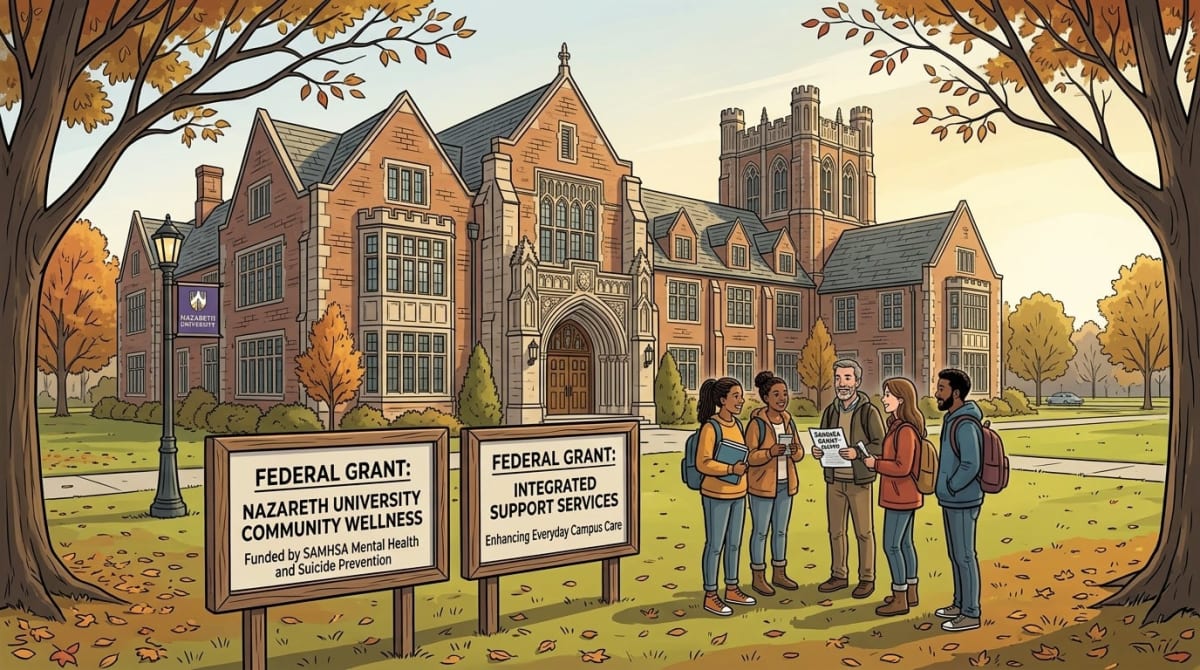
The University in Your Backyard Just Earned Its Second Federal Grant to Fight Student Mental Health Crisis
The Short Version
- Nazareth University earned a $366,000 SAMHSA grant — its second federal investment in campus mental health — covering four years of expanded suicide prevention work.
- The grant funds a new alcohol and other drugs suicide prevention coordinator and gatekeeper training for 600 faculty, staff, and students.
- Gatekeeper training teaches the specific three-part sequence of recognizing warning signs, intervening safely, and connecting someone to professional help — no clinical credentials required.
- Training 600 people distributes crisis-response capacity across an entire campus, well beyond what a single counseling center can cover.
- Federal re-investment in Nazareth signals the 2023 program produced documented outcomes — SAMHSA does not fund the same institution twice without evidence of results.
The Substance Abuse and Mental Health Services Administration does not fund the same institution twice without a reason. Nazareth University just earned its second SAMHSA grant — $366,000 over four years — to build on what the campus has already established around Nazareth University student mental health. The first arrived in 2023. This second one expands the scope.
What the $366,000 Grant Will Build at Nazareth

What the $366,000 Grant Will Build at Nazareth
The SAMHSA Campus Suicide Prevention Grant covers two concrete investments. First, Nazareth will hire a new alcohol and other drugs suicide prevention coordinator — a dedicated full-time position for campus crisis response. Second, the grant funds gatekeeper training for 600 faculty, staff, and students across the four-year period.
Six hundred is a substantial number on any campus. That's not one training cohort — it's a multi-year, community-wide expansion. When that many people know how to recognize warning signs and connect someone in crisis to professional help, the safety net extends well beyond what any single counseling center can cover. It reaches residence halls, classrooms, and administrative offices.
What Gatekeeper Training Actually Teaches — and Why It Matters
The training is specific and teachable — not a general wellness seminar. John Rigney, Nazareth's Assistant Director for Wellness Outreach & Education, describes the program as teaching community members to "recognize others showing warning signs of suicide or other mental health concerns, intervene safely, and connect them with professional help."
That three-part sequence — recognize, intervene, connect — requires no clinical credentials. It requires knowing what to look for and having the confidence to say something. For faculty, that might be a student whose emails shift in tone. For an RA, a resident who stops showing up for things. For a dining hall employee, a regular who disappears for two weeks and comes back changed.
Training 600 people distributes that capacity across an entire campus. One counseling center, however well-staffed, cannot be in every hallway and every classroom. Six hundred trained community members can cover far more ground.
Building on Success: Nazareth's Second Federal Commitment to Campus Wellness
Building on Success: Nazareth's Second Federal Commitment to Campus Wellness
Nazareth received its first SAMHSA grant in 2023. Federal agencies do not re-fund programs that produce no results. A second grant — larger in scope — signals that the 2023 work generated documented outcomes sufficient to justify continued support.
For Pittsford families with students at Naz, the picture is direct: a nearby campus with two consecutive federal grants specifically for campus suicide prevention, actively building the infrastructure to back them up. The new prevention coordinator is being hired now. The first gatekeeper cohort of those 600 trains from there.
Content ID: 9WvWySvhbY8YxBPhlCY2TU1R
See an error? Tell us.



Comments
Share with the Community