Frederick Douglass and Pittsford Village
The Short Version
- Samuel Crump was one of three documented Underground Railroad conductors in Pittsford — along with John Brown and Thomas Bancock — and his warehouse at the Four Corners is where Frederick Douglass gave his 1860 speech after being locked out of the Phoenix Hotel ballroom.
- When Douglass was blocked from the Phoenix Hotel ballroom, it was Crump who walked across the street and opened his warehouse — an immediate community response that reframes the story of that night entirely.
- The men who locked the Phoenix Hotel ballroom may not have been from Pittsford at all — and the local record, from the Underground Railroad network to the 1902 Political Equality Club, points toward a community that was largely on the right side of this history.
- Pittsford had at least three documented conductors, two additional sites with credible oral history, and properties at 26 Monroe Ave and 44 North Main Street with local Underground Railroad ties — evidence of a coordinated community effort, not a lone operator.
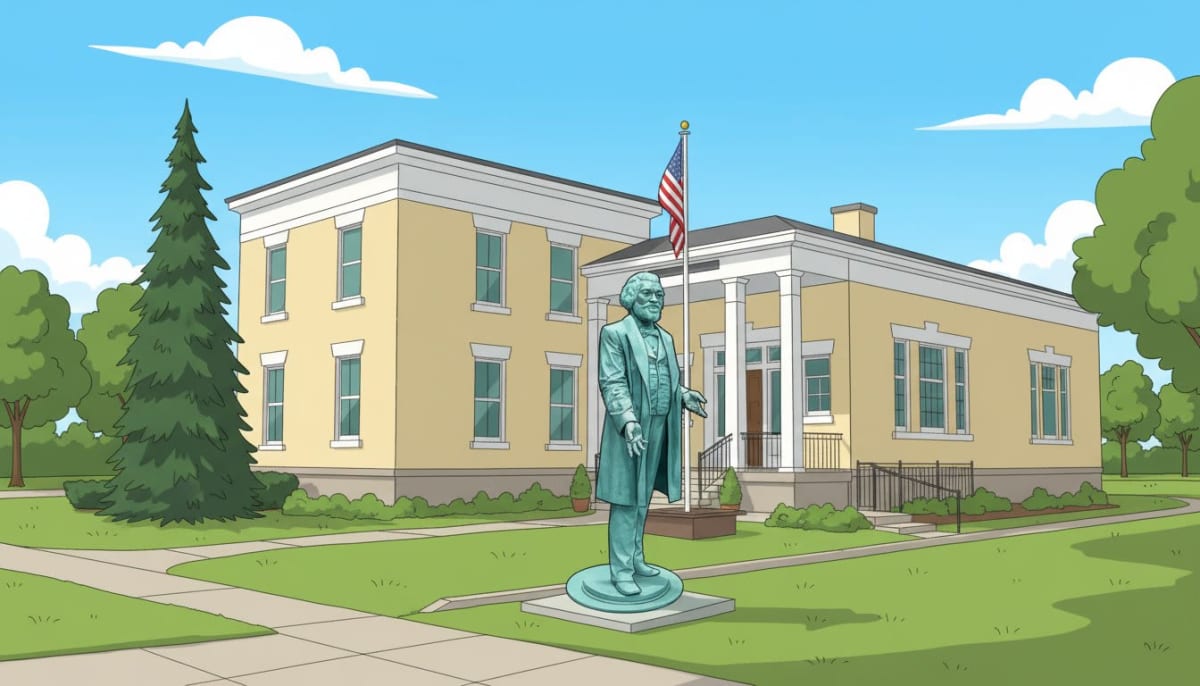
- The Village of Pittsford trustees are currently deliberating placing a life-size Frederick Douglass statue in the park across from Village Hall — steps from the Four Corners where Crump opened his warehouse door 165 years ago.
The Night Frederick Douglass Came to Pittsford

The Night Frederick Douglass Came to Pittsford
It was the fall of 1860, and Frederick Douglass had come to Pittsford to speak for the Republican cause. The presidential election was weeks away. Abraham Lincoln was on the ballot. The country was pulling itself apart at the seams over slavery — and Douglass, who had escaped enslavement in Maryland in 1838 and built himself into the most powerful Black voice in America, was traveling the region making the case for what the moment required.
The meeting was planned as an open-air event, which was common enough for campaign rallies of the era. Then it rained.
When organizers looked for a place to move indoors, the obvious choice was the ballroom of the Phoenix Hotel — one of the largest public gathering spaces in the village. What happened next is documented by a Rochester man named William E. Edmonds, who recorded that racist opponents of Douglass had anticipated exactly this problem. They rented the Phoenix Hotel ballroom first — and locked it for the entire day. Not a meeting held there. Not a conflicting event. Just a lock on the door, and a key in someone's pocket.
Who those men were is not entirely clear from the record. They may not even have been from Pittsford. What is clear is that Samuel Crump was watching from across the street.
Crump was a merchant and one of Pittsford's documented Underground Railroad conductors. His store and warehouse stood where the Wilitsie Crump ca. 1886 building stands today, directly across from the Phoenix Hotel. When he saw Douglass locked out of the ballroom, he walked across the street and invited Douglass to give his speech in Crump's warehouse. Douglass accepted.
The speech was given. The hall was denied. The warehouse opened. And in a village small enough that most people would have known exactly what was happening, someone made sure Frederick Douglass had a place to stand.
That moment — the locked door and the open warehouse — tells you something layered about Pittsford in 1860 that its Federal-style storefronts alone don't. This was a community where people had been quietly running one of the most active freedom networks in the region for years. The same street that produced the obstruction also produced the response to it. Frederick Douglass knew that terrain. And he showed up anyway.
The Phoenix Hotel and the Door That Was Closed

The Phoenix Hotel and the Door That Was Closed
The building at the corner of South Main and State Streets has been standing since 1820. Listed on the National Register of Historic Places since 1974, the Phoenix Hotel — now a private office building — is one of the oldest surviving structures in the village. It was built to serve stage passengers, then canal traffic, then railroad travelers, cycling through names and owners across a century of Pittsford commercial life.
By 1860, it was one of the social and commercial anchors of the village. According to the Phoenix Building's historical record, DeWitt Clinton stopped there when scouting the Erie Canal route, and the Marquis de Lafayette stayed there in 1824. The building had seen enough of American history that hosting a Republican campaign rally for one of the most famous orators in the country should have been unremarkable.
It was not the only public assembly space in Pittsford — a similar room existed on the second floor of the building where Breathe is located today, and other hotels that no longer stand may have had comparable spaces. But the Phoenix Hotel ballroom was the obvious choice for the evening's event, and whoever rented it first and locked it made a deliberate calculation.
That the Phoenix Hotel may itself have had Underground Railroad connections — a claim examined more closely below — makes the locked door land with a particular irony. The same building that may have sheltered freedom seekers in an earlier decade had its ballroom used as a tool against the most prominent Black abolitionist in the country.
The building still stands. You pass it when you walk through the village center.
A Warehouse on the Erie Canal

A Warehouse on the Erie Canal
Douglass gave the speech.
That's the thing to hold onto. He had just returned from England that spring — a trip that began as a planned lecture tour and turned into an emergency exile after John Brown's raid on Harpers Ferry in October 1859 implicated Douglass and put him at legal risk. While he was still abroad, his youngest daughter Annie died in Rochester on March 13, 1860, at age 10. He cut the tour short and came home through Canada. By fall, he was back at work on the campaign trail.
The warehouse speech in Pittsford left no transcript. What we have is Edmonds' account of a man who could not be stopped by a locked door. It was not his famous address — that was his July 5, 1852 speech at Corinthian Hall in Rochester, considered among the greatest antislavery orations ever given, delivered to nearly six hundred people. The Pittsford speech was a campaign rally on a rainy night that ended in a merchant's warehouse. But Douglass gave it.
By 1860, he had spent more than a decade in Rochester operating one of the most active stops on the Underground Railroad in the region. The National Park Service estimates he and his wife Anna Murray-Douglass sheltered some 400 fugitives at their South Avenue home — just seven miles from the warehouse where he now stood. His newspaper, The North Star and its successors, was the most important Black abolitionist publication in the country. When he stood up in Crump's warehouse, he was not diminished by the indignity of the locked ballroom. If anything, the locked ballroom was already an argument for everything he'd come to say.
Douglass would later write in his December 1860 editorial that Lincoln's election marked a turning point — that for the first time in a generation, the country had taken power out of the hands of the slaveholding oligarchy. The warehouse speech in Pittsford was part of that work. A small moment in a large story.
Pittsford and the Underground Railroad: History, Legend, and an Honest Debate

Pittsford and the Underground Railroad: History, Legend, and an Honest Debate
This is where Pittsford's history gets complicated in exactly the way history should.
The village sits directly on the Erie Canal. According to the Erie Canalway National Heritage Corridor, the canal system was one of the primary escape routes for freedom seekers moving north toward Canada — with towpaths, packet boats, and canal towns all playing roles in what the Erie Canal Museum describes as "a major conduit for freedom seekers." Pittsford was not a remote village. It was a waypoint on one of the most-traveled freedom corridors in the northeastern United States, and the work happening here was not the work of one person acting alone.
Local historical records, as compiled by Mayor Robert Corby, identify three well-documented Underground Railroad conductors in Pittsford: Samuel Crump, John Brown, and Thomas Bancock. This was a coordinated community effort — the kind that could only function in a small village because everyone knew what was going on and most chose to let it continue.
Crump is the most fully documented of the three. According to the Town of Pittsford's own historical record, his store and warehouse stood at the Four Corners — the intersection of Monroe Avenue and Main Street — where the Wilitsie Crump ca. 1886 building stands today.
Crump had come to Pittsford in 1842 as a young English stonemason on his honeymoon, walking more than ten miles from his cousin's home in Rochester after reading a newspaper advertisement that the village needed someone to build a cobblestone schoolhouse. He got the job, built what is now the District No. 6 cobblestone school on Church Street — a building still standing today — and never left. He opened a general store, became a leading citizen, and became one of Pittsford's most active conductors on the Underground Railroad.
The town's detailed account describes the operation: Crump would receive word that freedom seekers were coming. His wife kept extra food in the house for exactly this reason. After feeding them a full meal, he hid them in his barn overnight. The next morning, he loaded them under merchandise in his wagon and drove them to the Port of Charlotte — on the shores of Lake Ontario — where they boarded a boat to Canada and freedom. The Cobblestone Museum's historical catalog corroborates the full route: Crump transported freedom seekers "on his merchandise cart to the Port of Charlotte."
The barn is gone. The cobblestone schoolhouse he built still stands on Church Street. And the corner where his store and warehouse stood is the Four Corners of Pittsford village — the same intersection where life in this community has always organized itself, and the same block where, in 1860, Crump walked across the street to make sure Frederick Douglass had somewhere to speak.
Beyond the three documented conductors, local historical knowledge points to additional sites in the village that may have served as stations — including properties at 26 Monroe Avenue and 44 North Main Street. For obvious reasons, documentation of Underground Railroad activity was deliberately sparse. That is not a sign that the work didn't happen. It is a sign that the people doing it understood exactly what was at stake if they put it in writing.
The Erie Canal Museum offers a useful caution that applies throughout: verifying specific house claims in Underground Railroad history is genuinely difficult work, and differentiating "hard historical fact and urban legend" is a challenge historians wrestle with across the entire canal corridor. What the documented cases make clear is that Pittsford was not a passive waypoint. It was an active one, with named people taking real risks, on streets that are still here.
Several other sites carry documented or reported connections worth noting:
The Phoenix Hotel itself has been claimed as an Underground Railroad stop. The Advisory Council on Historic Preservation states directly that it "was a stop on the Underground Railroad, connecting with a cavern which lies under Pittsford." The Town of Pittsford's own short history acknowledges rumors of caverns beneath the village streets while noting there is "no evidence of any connection with Underground Railroad trafficking." The federal government says it was a stop. The town's own historians aren't convinced. That is the honest state of the record.
The Hargous-Briggs House at 52 South Main Street — a Federal-period brick building from 1810, now the Saint Louis Church Manse — carries a similar story. The town's record says a room in the basement is reported to have sheltered freedom seekers, with no documentation to confirm it. Regional historian Jerry Bennett, speaking from his own childhood memory of being shown a hidden cavern in the building as a student, offers firsthand testimony that carries weight even without a paper trail.
"Prior to the Civil War, there had been stories of runaway slaves being hidden in homes and cellars. We do know that Samuel Crump, a merchant whose store was at the Four Corners, is known to have received runaways into hiding in his barn and in turn, took them in his wagons to the Port of Charlotte where they boarded a boat for freedom in Canada."
— Town of Pittsford, A Short History of Pittsford
The picture that emerges is of a community that was, on the whole, on the right side of this history. That the Underground Railroad required coordination — multiple conductors, neighbors who didn't ask questions, a network that moved people from barn to barn to boat — tells you something about the character of a place. In Pittsford, that network ran for years.
The village's progressive character extended beyond the Railroad. In 1902, local women founded the Pittsford Political Equality Club — a suffrage organization whose minute books were only recently rediscovered by deputy town historian Vicki Profitt. And when the Ku Klux Klan attempted to establish a presence in Monroe County in the 1920s, historical records show the organization's Monroe County chapter had a total balance on hand of $55 at its peak — suggesting the area had little appetite for what the Klan was selling. Residents made their feelings known in other ways too, through direct confrontation with Klan members who revealed their affiliations to their neighbors.
The locked door at the Phoenix Hotel ballroom in 1860 stands out against this background. It was an act of obstruction. But it was answered immediately, from across the street, by a man who had spent years making sure freedom seekers found their way through. That's the more complete picture of what Pittsford was.
What does it mean that both things happened here — and that the response came so quickly?
165 Years Later, the Village Considers a Statue
165 Years Later, the Village Considers a Statue
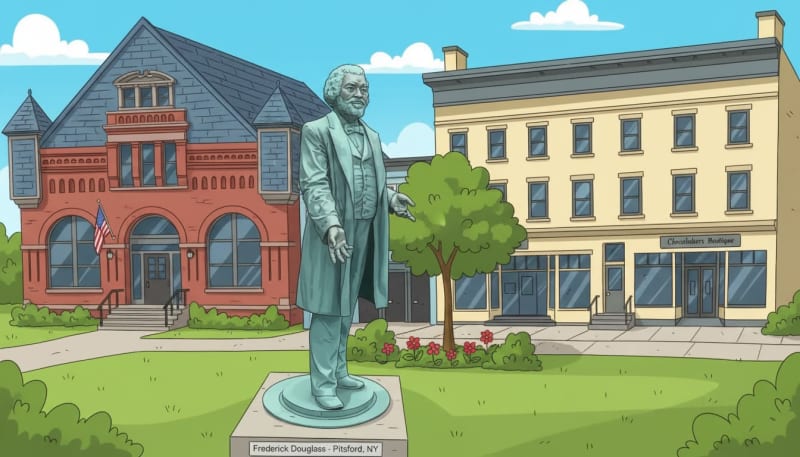
At a recent Village Board of Trustees meeting, trustees discussed an effort to bring a Frederick Douglass statue to Pittsford — part of a series of life-size fiberglass monuments created by Rochester sculptor Olivia Kim. Kim created thirteen of these statues for Rochester's 2018 Frederick Douglass bicentennial — each one modeled on the historic 1899 bronze by Stanley W. Edwards in Highland Park, with one notable addition: the hands were cast from those of Kenneth B. Morris Jr., the great-great-great-grandson of Douglass, connecting the sculpture directly to the living family of the man it honors.
The trustees are in discussions to rent one of those statues. Among the locations under consideration is the small park across from Village Hall — the same spot where Harladay Hots sets up its cart during the warmer months, a corner that has quietly become one of those places the village gathers without making a formal occasion of it. The park is owned by the Town of Pittsford, not the Village, so the placement requires coordination between the two bodies before a vote can happen. Nothing is finalized. The trustees are deliberating.
It's worth sitting with what that placement would mean. A six-foot rendering of Frederick Douglass standing across the street from Village Hall, a few hundred feet from the Phoenix Hotel building where his path was once blocked — and a short walk from the Four Corners where Samuel Crump's store stood, the same block where Crump crossed the street to open his warehouse door. The man who was locked out, honored at the center of the village that answered that locked door almost immediately.
Kim described her intention for these statues in terms that feel right for this moment. She wanted to show Douglass with "genuine relaxation and happiness in his face," because his life, she said, was about enormous struggle, but also about finding a way through.
Pittsford has been finding its way through this history for 165 years. The deliberation happening at the trustees' table right now is the latest chapter of that.
What would it mean for this village to put Frederick Douglass in that park — not as a gesture, but as a recognition of everything the record, honest and complicated and ultimately hopeful as it is, actually contains?
Content ID: 37r6XpZBetsGQPRkKtHf4YP6
See an error? Tell us.

Comments
Share with the Community