
How Do We Fill Pittsford's News Desert?
The Short Version
- A No Kings rally drew a real crowd to Pittsford's Main and State corner in March 2026 — and there was no local publication to cover it properly.
- 85% of Americans say local news is important to their community, but only 15% paid for any local news in the past year — the gap between what people value and what they support is the problem.
- Pittsford had the Brighton-Pittsford Post for decades, then lost it — and what replaced it was Reddit threads and Facebook groups, neither of which does what a local paper does.
- What a news desert actually costs isn't obvious until something happens: a zoning decision, a school board vote, a rally on your corner — and there's nowhere to read about it the next morning.
- This site exists to be part of the answer — not a replacement for journalism, but a resident's attempt to document what's happening here before it disappears into the algorithm.
- The question worth asking isn't whether Pittsford deserves better local coverage — it's who's willing to make it happen.
How Do We Fill Pittsford's News Desert?
On a Saturday afternoon in late March, Pittsford residents gathered for a No Kings rally — and by the accounts of those who were there, the turnout exceeded what anyone had quietly hoped for. People carried signs. One, apparently, spoke for introverts everywhere and made people smile. Neighbors who had never met stood together on a street corner in a village better known for its canal path and its farmers market than for public demonstration. The Rochester community took notice — the post documenting the gathering drew hundreds of responses from people across the region who wished they could have been there.
It was, by any measure, a moment worth documenting.
And yet if you search for a real account of what happened — the specific location, the headcount, the mood, the signs, the names of the organizers, the quotes from the people who showed up — you will not find one. Not from a Pittsford publication. Not from a reporter who covers this village. What you'll find is a Reddit thread, filling up with the same political noise that drowns out everything everywhere else online.
That gap — between something real happening here and somewhere to read about it properly — is what this piece is about.
What Pittsford Had

What Pittsford Had
If you have lived here long enough, you remember the Brighton-Pittsford Post.
It launched in April 1942 — itself a continuation of the Pittsford Post, which the Pittsford Print Company had been publishing since December 1932. For more than seven decades, it was a weekly paper that knew this place the way only a local publication can: not as a suburb, not as part of a metro area, not as a data point in a circulation report, but as a specific collection of streets and schools and businesses and neighbors with names and histories.
The Town Historian ran a regular column in its pages for years. Those columns covered the pickle factory on the Erie Canal. The origins of King's Bend Park. The "eccentric" Margaret Woodbury Strong. Fletcher Steele, the landscape architect who grew up here and went on to national fame. The first woman pharmacist in the village. The oldest house in the town. Kolaneka Farms. Early education in the Northfield district. Decades of documented community memory, published week after week, in a paper that arrived because it was about here.
That is not sentimentality. That is infrastructure.
The paper changed hands several times over the decades — from the East Rochester Herald Corp to Genesee Valley Newspapers to Wolfe Publications. It evolved, as all publications do. But it persisted. Through the postwar boom, through the growth of the suburb, through the rise of the internet, the Brighton-Pittsford Post kept showing up. Residents knew that if something happened in the village, it would be written down. Somewhere, someone was paying attention.
That certainty mattered more than most of us realized at the time. The era when the Brighton-Pittsford Post was in its prime — the 1960s through the 1980s — was also the high-water mark for American newspaper readership. According to Pew Research Center analysis of industry data, U.S. daily newspaper circulation peaked at roughly 63 million in 1984. By 2022, that number had fallen to under 21 million.
How It Was Lost

How It Was Lost
The end was not dramatic. That is the thing about losing a local paper — it rarely is. There is no fire, no front-page farewell, no single moment you can point to and say that is when it happened. It is more like a slow tide going out, and you only notice when you look down and realize your feet are dry.
The Brighton-Pittsford Post was absorbed into the Messenger Post chain, which consolidated coverage across Brighton, East Rochester, Fairport, Henrietta, and Pittsford under one shared weekly. Already a dilution — five communities sharing a paper that had once belonged to one.
Then in 2019, GateHouse Media — which had acquired the Messenger Post chain — merged with Gannett in a $1.4 billion deal, creating the largest newspaper chain in the United States. The merger was described at the time as a way to "accelerate digital transformation." What it actually accelerated was consolidation. Reporters who had covered specific communities for years were reassigned, reduced, or let go. Coverage areas grew. Local knowledge thinned.
Two years later, in September 2021, Gannett announced that six weeklies published under the Messenger Post umbrella would cease publication the week of October 24. The Monroe Post — which had once been the Brighton-Pittsford Post, which had once been the Pittsford Post — was among them. Readers were advised to subscribe to the Democrat & Chronicle for local coverage.
The Democrat & Chronicle serves a metro area of nearly one million people.
Pittsford village has about 1,400 residents.
That is not a substitution. That is an erasure.
What happened here was not unusual — it was part of a collapse that has been unfolding for two decades. According to the Medill State of Local News Report, the U.S. has lost more than 3,300 newspapers since 2005, with closures accelerating in recent years.
Where Pittsford Went Instead
Where Pittsford Went Instead
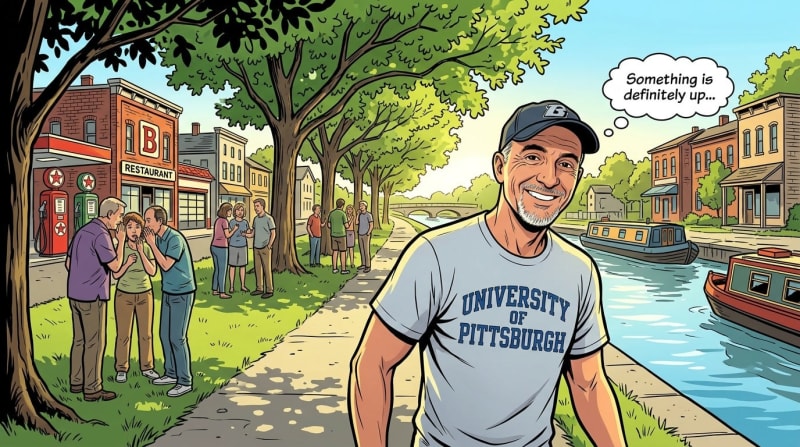
We went where everyone went. Facebook groups. Nextdoor. The D&C when something large enough to warrant regional coverage happened here. Word of mouth at Schoen Place, at the farmers market, along the canal towpath.
We are not alone in this. Not remotely.
Since 2005, the United States has lost more than one third of all its local newspapers — more than 3,300 in total. The pace is not slowing. In 2024 alone, 127 newspapers shuttered across the country at a rate of nearly two and a half per week. Today, 212 counties have no locally based news source whatsoever, and more than 1,500 have only one — usually a struggling weekly. Roughly 50 million Americans now live with limited or no access to local news about the place where they actually live.
Researchers at Northwestern University's Medill School of Journalism have a name for what we have become: a news desert. Not a place without information — there is more raw information available to us than at any point in human history. A place without local news. Without someone whose job it is to attend the village board meeting, ask the uncomfortable question, write down the answer, and publish it somewhere every neighbor can read it.
The economic engine that once funded all of that local attention has largely collapsed. According to Pew Research Center and the News Media Alliance, newspaper advertising revenue peaked at nearly $50 billion in 2005 and had fallen to under $10 billion by 2022 — a drop of roughly 80 percent in less than two decades.
So we landed on Nextdoor. And Nextdoor is genuinely useful, for some things. It is how you find a plumber. It is where you learn that someone's catalytic converter was stolen on Tobey Road. It is occasionally where you discover that your neighbor holds opinions you would have preferred not to know about.
But here is what Nextdoor cannot do, stated plainly by Nextdoor's own CEO. When the platform announced a major redesign last year, Nirav Tolia admitted: "We thought in our early days that neighbors would take over, almost as citizen journalists or local reporters. I think we've come to the conclusion that neighbors can only do so much."
The platform built to replace local news admitted it could not replace local news. A researcher at USC put it even more directly: when people turn to Nextdoor instead of a local paper, they learn which plumber to hire and which park has a controversy brewing — but they do not learn what is actually happening at the levels of government and institutional power that shape their daily lives.
A 2024 Pew Research Center survey of 5,000 U.S. adults found that Americans now get local news from a patchwork of informal sources — friends and family leading the way, with local news outlets a close second, and social media platforms rising fast.
We are hungry for Pittsford. We are being fed Rochester.
What We Actually Lost

What We Actually Lost
When a local paper closes, the loss is larger than the paper itself.
Harvard's Thomas Patterson, the Bradlee Professor of Government and the Press, has reviewed more than a dozen independent studies on what happens to communities when local journalism disappears. His conclusion is blunt and consistent: it harms the civic health of the community on virtually every dimension. Social trust goes down. Party polarization goes up. Voting rates in local elections decline. Accountability of local officials goes away.
The research behind that summary is specific and measurable. After major papers closed in Seattle and Denver, civic engagement dropped significantly — fewer people volunteering with the PTA, the American Legion, neighborhood watch organizations. Communities that lose a newspaper face higher municipal borrowing costs, paying the equivalent of roughly $85 more per person per year in interest on local bonds. When local political coverage declines, voters become less able to name their own representatives and less likely to hold opinions about them.
The findings that land closest to home involve suburban communities specifically. Suburban residents are among the most civically engaged when local news is present — and among the most adrift when it is not. We are digitally connected, educated, and genuinely eager to participate. We check our phones constantly. We share things. We have opinions. But right now, most of our picture of this village arrives through platforms engineered to maximize engagement, not to inform neighbors about their neighborhood.
Pew Research has found that more than four in ten Americans report difficulty getting information about their own neighborhood, even while national and international news feel endlessly accessible. The gap is not attention or interest. It is supply. According to a Civic Information Needs Census national survey, the difficulty gap between local and national news access is stark.
And the loss is not only civic. It is something quieter and harder to measure. When the Brighton-Pittsford Post ran the Town Historian's column about Kolaneka Farms or Fletcher Steele or the oldest house on the canal, it was doing something beyond reporting. It was telling the village: you are worth knowing about. What happens here matters. Your neighbors' stories are worth writing down.
That affirmation, repeated week after week for decades, builds something. Its absence quietly erodes something. We are only now beginning to understand the full cost.
What's Possible

What's Possible
Here is what I find quietly remarkable: the appetite for local news never actually went away.
Survey after survey, conducted in communities that have lost their papers, finds the same pattern. People miss it. They know something is gone. They feel the absence even when they cannot name it precisely. The American Journalism Project, which has spoken with nearly 5,000 residents across eight local markets about their relationship with local news, found that once conversations move past frustration with national media, people consistently say the same things: yes, they want verified, trustworthy information about the place where they live. They want to know what happened at the zoning board. They want to celebrate the neighbor who did something remarkable. They want to understand what a new development means for their street, their taxes, their view of the canal.
That desire is not nostalgia. It is a recognition that belonging to a place requires knowing about it.
Across the country, something is beginning to respond to that recognition. In 2024, there was a net gain of more than 80 standalone local digital news sites. Nonprofit newsrooms are growing revenue at double-digit rates. Publications built around free digital access, written by people who actually live in the communities they cover, are finding engaged and loyal audiences. The Medill State of Local News Report 2024 tracked that net gain as the biggest single-year increase in recent memory — and found that 85% of Americans still believe local news outlets are at least somewhat important to their community's well-being.
The model that works, repeatedly, is less complicated than the industry's collapse might suggest: show up for your community, cover what actually affects them, write like a neighbor rather than a broadcaster, and publish when there is something worth saying.
I have been thinking about what that looks like for Pittsford.
Not a recreation of the Brighton-Pittsford Post — that world is gone, and nostalgia is not a foundation. Something built for how we actually live and read now. Pittsford Village — this site — is already here. It has been here. What it has not been yet is a full publication: a place where the village documents itself, in real time, whenever something is worth documenting.
I imagine it having four dimensions.
Articles — longer pieces that give a topic the room it deserves. The history behind a zoning decision. A profile of a neighbor who has been quietly doing something extraordinary. A deep look at what the canal means to this community across generations.
Events — a calendar that belongs to us, maintained for residents by residents, covering everything from the farmers market to the village board schedule to whatever is happening at the library on a given weekend.
News Briefs — short, timely documentation of village life as it happens. The rally that took place on a Saturday afternoon in March. The ribbon cutting on Schoen Place. The outcome of last night's town board vote. The things that deserve to be written down even when they do not warrant a full article.
Opinion — guest pieces from residents, in their own voices, about the place we share. Not a comment section. Considered writing, by neighbors, for neighbors.
This is not a media company. It is not a startup. It is one person — me, a semi-retired Pittsford resident with a full life and a genuine love for this village — wondering out loud whether this community is ready to have a publication of its own again. Something that knows the difference between Schoen Place and Tobey Road. Something that would have covered the No Kings rally today and had the story up before dinner.
The Question I'm Asking

The Question I'm Asking
The Brighton-Pittsford Post ran for more than seven decades because enough people in this community believed that what happened here was worth writing down and sharing with their neighbors. That belief did not disappear when the paper did. It just has nowhere to go right now.
So here is the question I am putting to the village, honestly and without a predetermined answer:
If Pittsford Village became a real publication — covering village government, local businesses, schools and youth sports, the canal and parks, and the neighbors who make this place what it is — would you read it? Would you share it when something rang true? Would you occasionally have something worth contributing to it?
The form below is not a subscription. There is nothing to pay, nothing to commit to, nothing being sold. It is a show of hands from people who think this village deserves a voice of its own again.
If enough hands go up, something here becomes possible.
— Adam Stetzer, PhD Pittsford, New York March 2026
Content ID: ynM7FzbbwvRGkYFuYiZcy3OO
See an error? Tell us.
Comments
Share with the Community