
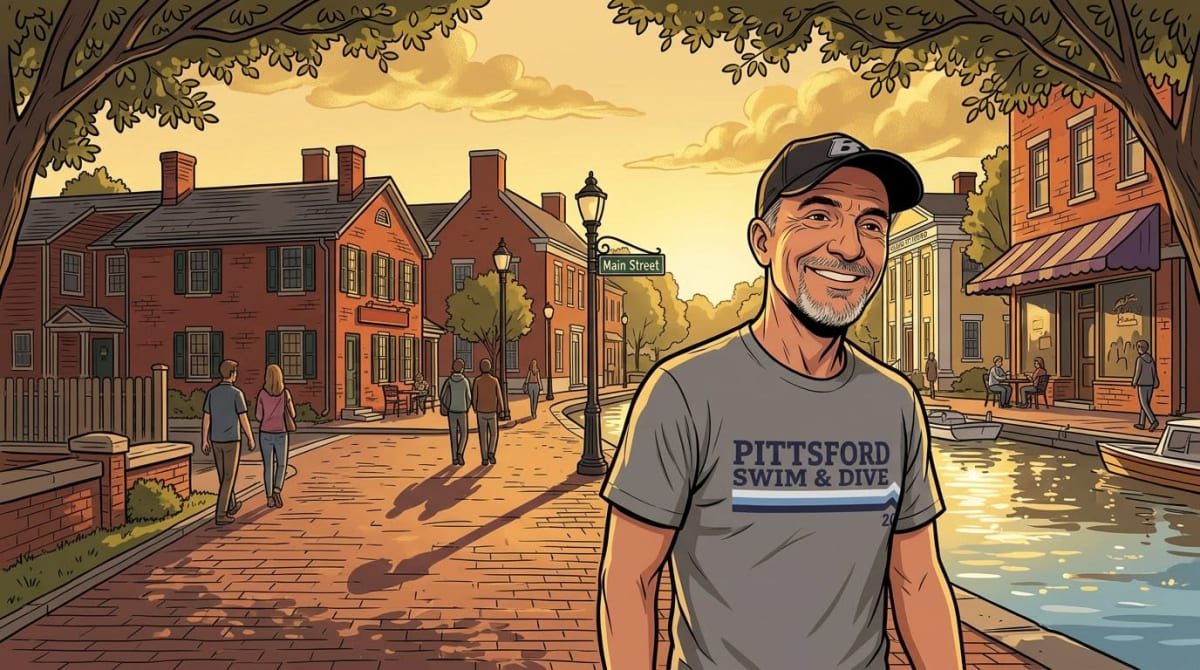
Pittsford Is Already in the National Register of Historic Places — Here's What That Means, and What Actually Protects the Village
The Short Version
- Pittsford's entire village historic district is already in the National Register — the 2016 action was a boundary expansion (Ref #16000163, listed 4/12/2016), not a new application; the original listing dates to the 1970s.
- National Register listing is largely honorary: it imposes no federal restrictions on private owners, but it unlocks historic rehabilitation tax credits.
- Income-producing properties can stack a 20% federal and roughly 20% state credit for up to 40% of costs, though the state portion generally requires a qualifying census tract.
- The real protection comes from Pittsford's local Historic Preservation Board — which, unlike the federal listing, can actually review and block demolitions and exterior changes.
- Per former mayor Bob Corby, Pittsford was the first upstate New York village to adopt a preservation ordinance (1971), and that local board is why the village hasn't gone the way of its suburban neighbors.
I almost published the wrong story. A single page on the Village website sent me down the path of writing that Pittsford was applying for National Register status — until I checked the document behind it and then sat down with Bob Corby, who served as the Village's mayor for nearly three decades and has spent a lifetime as an architect and preservationist here. The truth is both simpler and more interesting: Pittsford has been in the National Register of Historic Places for decades, and the thing that actually keeps the village looking like the village is not the federal listing at all.
Pittsford Is Already in the National Register — and Has Been for Decades
Pittsford Is Already in the National Register — and Has Been for Decades
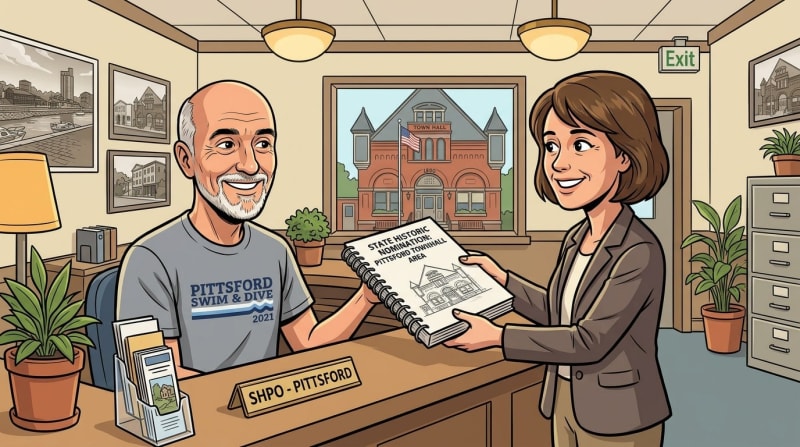
The Pittsford Village Historic District is listed in the National Register of Historic Places. The most recent action was not an application but an expansion: a boundary increase that was formally listed on April 12, 2016, under National Register reference number 16000163, covering community development and architecture as its areas of significance.
That 2016 expansion has a backstory Corby walked me through. The original effort traces to 1976, when members of the group Historic Pittsford filled out what were called "blue forms" — building-by-building documentation of the entire village. He considers that survey a small miracle of timing, because many of the old-timers who remembered the village firsthand were still around to inform it. Historic Pittsford proposed the whole village for listing. But according to Corby, the state preservation director at the time leaned heavily toward Dutch Colonial architecture in the Hudson Valley, and the listing got cut down to roughly 134 properties — essentially the residential stretches of Monroe Avenue, Lincoln Avenue, and South Main Street. Even the business district was left out.
The 2016 boundary increase is what fixed that. As Corby describes it, the entire village is now included, down to part of the Powers Farm, with only a few exceptions — the open space in the northwest corner, which has no particular historic significance, and a handful of individual and newer houses. The result is unusual. Corby makes the case that Pittsford is the best-preserved canal village in the entire state, because the full hierarchy of an early-20th-century canal community is still intact here: no parking-lot moat carved around the business district, and the historic mills and warehouses still standing along the water. In most canal towns those are long gone — maybe one survivor left in places like Baldwinsville or Lockport. Here it is a whole district.
So the corrected headline is not "Pittsford is applying." It is "Pittsford did this work two generations ago, finished the job in 2016, and most residents have never heard the story." What does it change to know that the recognition is already in hand?
What National Register Listing Actually Does — and Doesn't
What National Register Listing Actually Does — and Doesn't
Here is the part that surprises people: National Register listing is, on its own, largely honorary. It is a tremendous mark of recognition, and it unlocks some real money, but it is not a rulebook for private owners.
Listing does not restrict what a private owner can do with private property under federal law. The National Park Service is unambiguous about this, and so is the federal regulation behind the program: listing imposes no federal restrictions on an owner using private funds. There is no federal board reviewing your window replacement. Federal involvement only attaches when federal money, permits, or licensing are in play.
What listing does do is open the door to historic rehabilitation tax credits. Owners of income-producing historic properties — commercial buildings, mixed-use blocks — can claim a federal credit of 20% of qualified rehabilitation costs on a certified historic structure, and New York layers on its own state credit of generally another 20%.
Combined, that can reach 40% of qualifying costs, and the Preservation League of New York State notes it can climb toward 50% on smaller projects. One condition the headlines usually drop: the federal credit is statewide, but New York's commercial credit generally requires the building to sit in a qualifying census tract, so the full 40% is not automatic everywhere. There is also a separate homeowner credit — 20% of qualified costs, up to a $50,000 credit — for owner-occupants of contributing homes in qualifying tracts.
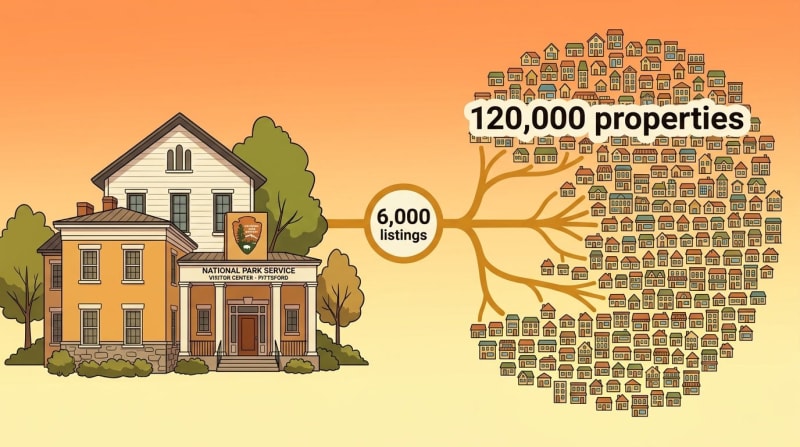
New York leads the nation in this program, with more than 6,000 National Register listings recognizing roughly 120,000 properties. A single "listing" is often an entire district, which is exactly what Pittsford's is.
Recognition and incentives are real and worth having. But ask Corby what has actually kept the bulldozers honest in Pittsford, and he does not point to Washington.
The Real Engine of Preservation Is Local
The Real Engine of Preservation Is Local
The instrument that genuinely protects Pittsford, Corby argues, is the Village's own Historic Preservation Board. He says Pittsford was the first village in upstate New York to adopt a local preservation ordinance, in 1971 — and the reason it happened is a cautionary tale.
In the late 1960s, suburban growth pressed in on the village: pressure for parking lots, pressure to remake a canal town into something more like its subdivisions. Several important buildings were lost in a few short years — a historic hotel where the Del Monte Lodge stands today, replaced by a modular building with a 1970s mansard roof; the original St. Louis Church on State Street; a house at the site of the State Street municipal lot; another on North Main. The losses galvanized residents, Historic Pittsford organized, and the Village Board adopted a preservation ordinance. The difference, Corby likes to point out, is visible to the naked eye: Victor's village once looked much like Pittsford's, and the two will never look alike again, because they chose different paths.
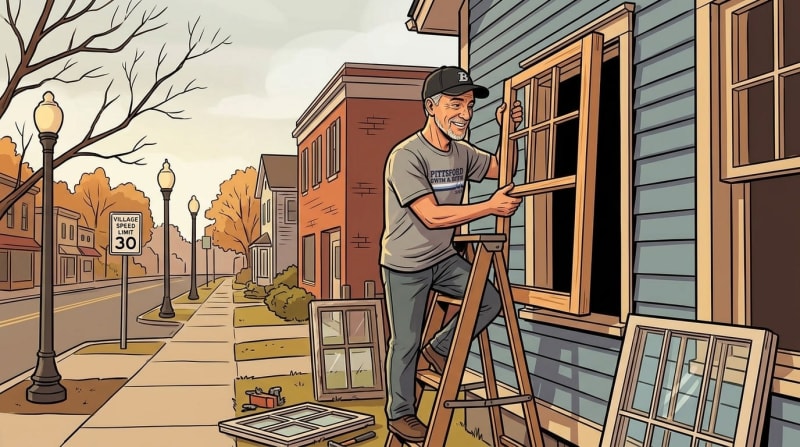
A local board, unlike the National Register, has teeth. It reviews exterior changes to contributing properties and can require its approval before — or withhold it from — alterations, additions, and demolitions. Corby rattles off the projects that never happened because of it: in the 1990s, a plan to demolish the old Messner carpeting building for a convenience store fronted by a parking lot; a proposal to tear down the two small houses behind the library for a one-story concrete-block carpet store. Drive around the village, he says, and the absence of those buildings is the point.
The federal listing is recognition. The local board is the reason the village still looks like the village.
The board is not arbitrary taste, either. The standards trace back to best practices the National Park Service developed in the 1970s and now used nationwide, and Pittsford's ordinance is built closely on New York's legally tested model preservation ordinance — refreshed several times over the decades, with Corby himself involved in updates as a member of a statewide committee and again during his time as mayor. The ordinance includes hardship provisions: if a building cannot be economically renovated, changes are permitted, guided by the principle of the minimum alteration necessary to keep a structure viable while protecting its character-defining features.
Pittsford also participates in the federal Certified Local Government program, created by 1980 amendments to the national preservation law and administered through the state. Membership means the board documents its decisions with written findings rather than opinion, and the Village files an annual report — how many cases were heard, approved, denied, or approved with conditions. Corby notes the program also calls for yearly training for board members, which he considers essential: most volunteers are not experts in regional historic architecture, and the high-stakes cases are exactly where a developer's professional consultants can run circles around an inexperienced board.
What Pittsford Chose
What Pittsford Chose
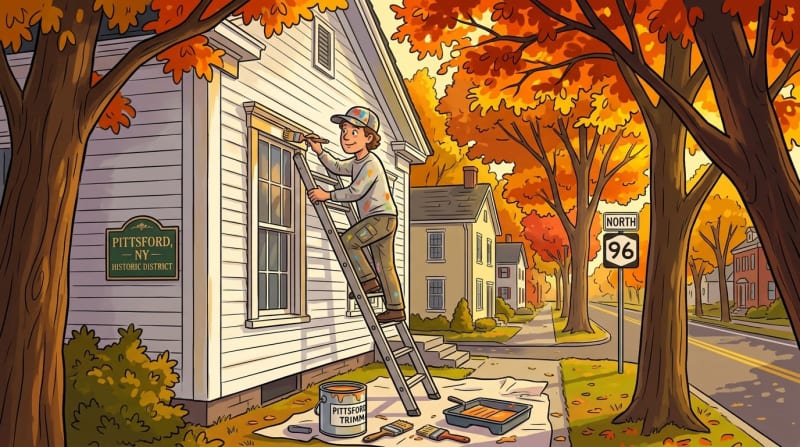
The honest accounting goes like this. The National Register of Historic Places gives Pittsford a permanent place on the country's roll of historic communities and puts real rehabilitation tax credits within reach of the right property owners. That is genuinely valuable. But it is, as Corby puts it, the ceremonial layer. The working machinery of preservation is the local board, meeting month after month, weighing fences and doors and signs and, every so often, a project big enough to change the whole character of a street.
It is worth sitting with what that means. The walkable scale, the canal path that draws people from across the region, the unbroken streetscape running from the 19th century into the present — none of it is an accident, and none of it is guaranteed by a federal certificate. It is the accumulated result of a community deciding, over and over, that this place is worth the hassle of protecting.
A National Register listing names what Pittsford already is. The work of keeping it that way belongs to the people who show up. What part of this village do we most want to hand to the people who come next — and who is going to do the unglamorous work of making sure it is still here?
Content ID: kk4llXFSySYdzNeft30Nb2Fj
See an error? Tell us.

Comments
Share with the Community