
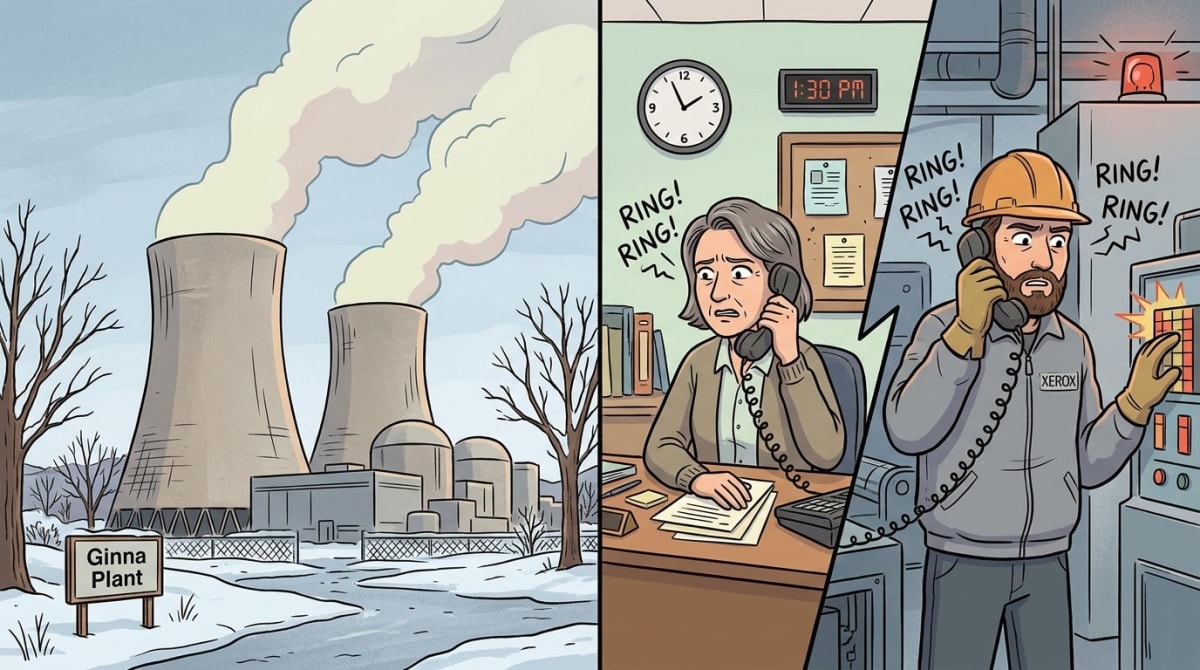
Pittsford Is 17 Miles From the Country's Second-Oldest Nuclear Reactor — And New York Wants to Build Another
The Short Version
- Pittsford is already named in Monroe County's radiological emergency plan for R.E. Ginna, which has operated 17 miles away since 1970 — Mendon High School is a designated evacuation reception center.
- Governor Hochul has directed NYPA to build at least 1 GW of new nuclear in Upstate New York, with a 2026 State of the State target of 5 GW — more than has been built anywhere in the U.S. in three decades.
- Nuclear supplies 21 percent of New York's in-state electricity today; the state wants to expand its nuclear fleet from 3.4 GW to 8.4 GW.
- Wayne County and Eastman Business Park in Rochester are both among the eight Upstate communities that responded to NYPA's siting inquiry — no shortlist has been published.
- Georgia's Plant Vogtle is the cost benchmark: estimated at $13 billion, it came in at $32 billion and raised ratepayer bills by $220 a year.
- Oswego County has a head start — Constellation received $17.3 million in federal funding toward an Early Site Permit for Nine Mile Point, one of the longest steps in nuclear licensing.
Pittsford Is Already in the Nuclear Emergency Plan
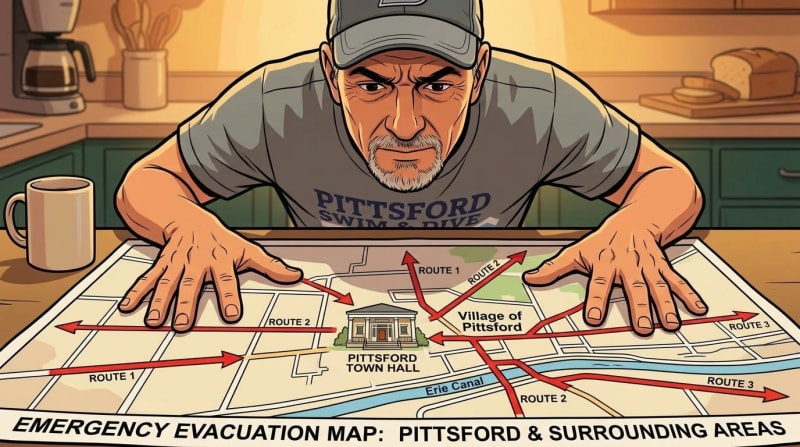
Pittsford Is Already in the Nuclear Emergency Plan
New York is deciding where to build its first new reactor in half a century, and a new nuclear power plant near Rochester is one of the possibilities on the table. There is a closer fact worth knowing first: Pittsford is already written into the emergency plan for a reactor that has been running since 1970.
Monroe County's 2025/2026 radiological emergency planning brochure, published by the New York State Division of Homeland Security and Emergency Services, names Mendon High School at 472 Mendon Road as one of three designated reception centers for the R.E. Ginna Nuclear Power Plant. Residents evacuating from three planning areas in Webster and Penfield would be sent to Pittsford.
Ginna sits on the Lake Ontario shore in the town of Ontario, Wayne County — about 17 miles from Pittsford Village, and 20 miles northeast of Rochester by the NRC's reckoning.
What New York Is Proposing

What New York Is Proposing
On June 23, 2025, Governor Kathy Hochul directed the New York Power Authority to develop and construct a zero-emission advanced nuclear power plant in Upstate New York with a capacity of no less than one gigawatt. It would be the first new nuclear construction in the state in a generation.
In her 2026 State of the State address, she raised the target to five gigawatts — more new nuclear than has been built anywhere in the United States in the last three decades. Added to the 3.4 gigawatts already running at Ginna, Nine Mile Point and FitzPatrick, that would produce what the state calls an 8.4-gigawatt nuclear reliability backbone.
Nuclear is not a small share of the existing grid. As of 2024, nearly half of New York's in-state electricity generation came from zero-emission sources, with nuclear supplying 21 percent and renewables 26 percent. Combustion — natural gas, oil, biofuels and solid waste — produced the other 53 percent.
Ginna Has Been Running Since 1970
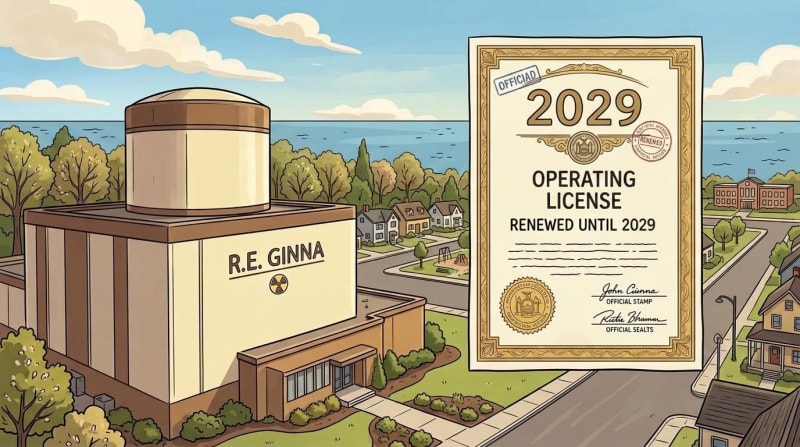
Ginna Has Been Running Since 1970
The Atomic Energy Commission issued the construction permit on April 25, 1966, and Ginna Station began commercial operation in July 1970. It is named for Robert Emmett Ginna, a former Rochester Gas and Electric chief executive and one of the earliest American advocates for nuclear electricity.
The single Westinghouse pressurized water reactor produces up to 576 megawatts — enough for the equivalent of more than 400,000 homes. It is the smallest operating commercial reactor in the country and among the most reliable, running at a capacity factor above 99 percent. After Nine Mile Point Unit 1, it is the second-oldest still operating in the United States.
Rochester Gas and Electric owned Ginna until 2004. Constellation Energy owns it now. The current license runs through 2029, and Constellation has applied to extend it another 20 years, to 2049.
What Happened in 1982
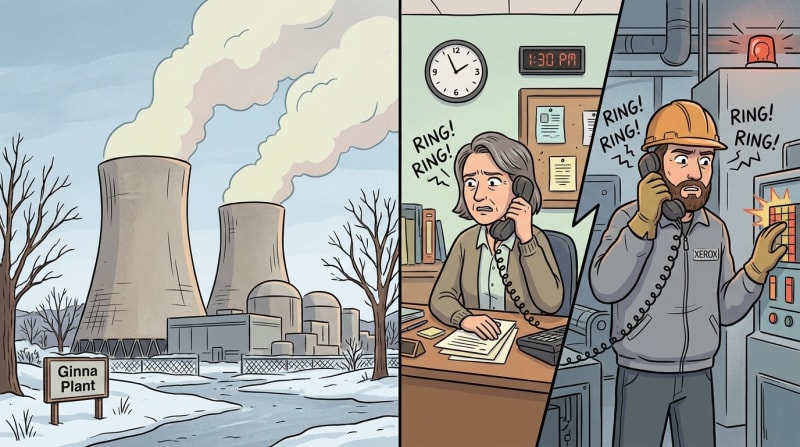
What Happened in 1982
The plant's most serious event came on January 25, 1982, when a steam generator tube ruptured at 9:25 a.m. The reactor scrammed automatically — an emergency shutdown. Contemporaneous Associated Press and UPI reporting described a small amount of radioactive steam venting to the outside air, though early accounts were unclear whether the radiation came from the primary or secondary coolant loop.
Officials declared a site emergency, the second most serious of four classifications, within 75 minutes. NRC officials said there was no damage to the reactor core and that the fuel elements were never uncovered. Local schools and a nearby Xerox plant were notified. The reactor reached cold shutdown 31 hours later. Roughly 40,000 people lived within 10 miles of the plant at the time.
Coming three years after Three Mile Island, the event drew national attention, and the NRC distributed its findings to every pressurized water reactor licensee in the country.
The record since has been mostly quiet, though not spotless. In 2009 the NRC placed Ginna under additional oversight after two findings of low to moderate safety significance involving the turbine-driven auxiliary feedwater pump. The plant's 2024 integrated inspection identified no findings or violations of more than minor significance.
Where a New Nuclear Power Plant Near Rochester Might Go
Where a New Nuclear Power Plant Near Rochester Might Go
NYPA issued requests for information in October 2025 and reported in January that 23 potential developers and eight Upstate communities had responded. The eight are Broome, Jefferson, Oswego, Schuyler, St. Lawrence and Wayne counties, the City of Dunkirk, and RED-Rochester.
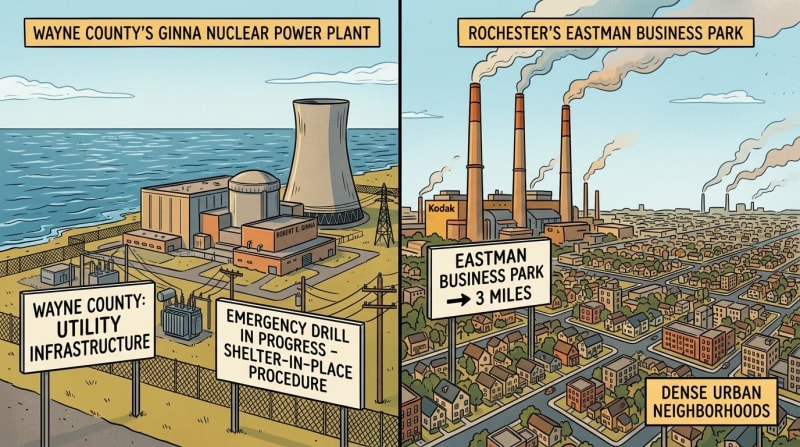
Two of those eight are local. Wayne County, already home to Ginna, has said for years it would welcome another facility. County Administrator Mark Humbert points to infrastructure the county already has: annual drills with the plant, transmission capacity, and trained emergency services. Scott Cicora of Nuclear New York calls Wayne and Oswego counties the "low-hanging fruit."
The other is more contested. RED-Rochester operates the utility system at Eastman Business Park, three miles from downtown Rochester. In its submission it pointed to the park's large-scale energy infrastructure, its proximity to transmission, its industrial zoning and its concentration of energy-intensive users, without stating a preference for a full-scale plant or a small modular reactor. The company has since been careful to say the filing described capabilities rather than any defined project, and that no site design, development plan or siting decision exists for the campus. Critics, including Tim Judson of the Nuclear Information and Resource Service, argue that siting a reactor that close to dense residential neighborhoods is inappropriate regardless of reactor size.
The region's construction trades are on the other side of it. UNICON, which represents much of the Rochester construction industry, told WROC News 8 it has urged state leaders to back the project. Executive Director Joe Morelle Jr. listed pipefitters, electricians, bricklayers, operating engineers, laborers and sheet metal workers among the trades a build would draw on.
NYPA has said it will weigh candidate locations on public safety, community support, water access, skilled labor and existing infrastructure.
Where the Selection Actually Stands
Where the Selection Actually Stands
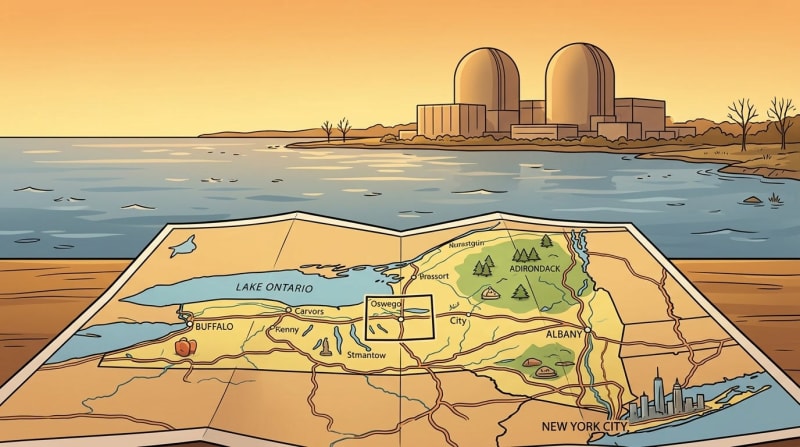
No site has been chosen, and no shortlist has been published.
The process did move forward on June 1, 2026, when NYPA issued a Request for Qualifications for nuclear developers and delivery partners, asking respondents to present credible pathways to at least one gigawatt, including siting and permitting strategy, schedule and cost assumptions. The same announcement included $40 million for nuclear workforce training.
Oswego County has one advantage no other candidate has. Constellation was awarded $17.3 million in federal funding to pursue an NRC-approved Early Site Permit for a location in New York, tied to adding reactors at Nine Mile Point. An early site permit is one of the longest steps in nuclear licensing.
Asked about the competition after the Micron groundbreaking in January, Hochul offered the closest thing to a public signal so far.
The people of Oswego County are "very good candidates" — and that was all the governor would say.
— Gov. Kathy Hochul, as reported by WSYR-TV
NYPA has set no deadline. A spokesman told Oswego County Business the authority is still reviewing responses. Wayne County has not been ruled out, and it has not been chosen.
Who Pays

Who Pays
The cost question is the one likely to reach Pittsford electric bills.
New York's own modeling estimates that making a five-gigawatt buildout commercially viable could require between $15.4 billion and $23.9 billion in public support, with total construction costs approaching $45 billion. The June options paper concluded that private investors remain reluctant to finance nuclear construction and that wholesale markets alone cannot make new reactors viable.
The reference case is Georgia's Plant Vogtle. A University of Pennsylvania analysis citing NYSERDA notes the units were originally estimated at $13 billion and eventually cost $32 billion. Georgia ratepayers' bills rose by more than $220 a year, a 25 percent increase.
The counterargument is that existing plants deliver. The state's Zero-Emission Credits program, which keeps Ginna and the Oswego reactors running, returned $151 million in savings to New York electricity customers in 2026, because federal nuclear production tax credits are required to be passed through to ratepayers.
How to Weigh In

How to Weigh In
The Public Service Commission opened a comment period on the Advanced Nuclear Policy Options Paper and the Order Establishing a Nuclear Reliability Backbone Process. Anyone can file — no attorney, no organization, no technical background required.
Comments are filed through the Department of Public Service Document and Matter Management system under Case Number 26-E-0335. After it closes, staff will convene a technical conference before October 31 and deliver a white paper to the Commission by November 13. The full Advanced Nuclear Master Plan is expected by the end of 2026.
Content ID: 8JbOcYEfQERHnTTCEJZwgItI
See an error? Tell us.

4 Comments
Comment from Facebook
Since it will probably be modular, build it here with the contract stipulating free electricity for life in exchange for the location.. modern nuclear isn't the 70's nuclear complex.. for reference, Ginna sits on ~70 acres.
Aug 10, 2026 at 12:59 pm
View on Facebook ↗Adam Stetzer
One data point worth anchoring to: the state's own financial modeling puts a 5-gigawatt buildout at potentially requiring between $15.4 billion and $23.9 billion in public support, so the structure of any "free electricity" trade would have to account for who's actually bearing that cost.
Aug 10, 2026 at 2:48 pm
View on Facebook ↗Comment from Facebook
Interesting article and definitely worth talking about. One thing I think is important to clarify is that Pittsford is not in Ginna’s evacuation zone. Mendon High School would be used as a reception center for people evacuating from parts of Webster and Penfield. I’m open to nuclear energy. New York needs reliable power to support residents, businesses and manufacturing. But before I could support a specific project, I’d want to know where it would be built, what it would cost taxpayers and ratepayers, how waste would be handled, and what the emergency plan would look like.
Aug 10, 2026 at 5:55 pm
View on Facebook ↗Adam Stetzer
Good to flag the evacuation zone distinction: The Ginna emergency plan designates Mendon High School at 472 Mendon Road in Pittsford as a reception center, which puts Pittsford directly in the emergency planning infrastructure, even if not inside the primary evacuation zone itself. I have not dug into secondary evacuation zones - it can get a little scary to think about. The winds in Rochester (life long sailer here) are usually from the west or south, and occasionally north - but very rarely from the east - so that helps. On your broader questions about siting, cost, and waste — those are exactly what the state's own process is still working through; NYPA's RFQ asks respondents to present "siting and permitting strategy, schedule and cost assumptions," and a DPS staff white paper with recommendations is due by November 13, 2026, so this is genuinely still open. https://www.dhses.ny.gov/re-ginna-nuclear-power-monroe-county https://pittsfordvillage.com/pittsford-is-17-miles-from-the-countrys-second-oldest-nuclear-reactor-and-new-york-wants-to-build-another
Aug 10, 2026 at 9:08 pm
View on Facebook ↗Comments marked “from Facebook” were shared from our Facebook page. Commenter names are not published here — open the original thread to see them.
Share with the Community