
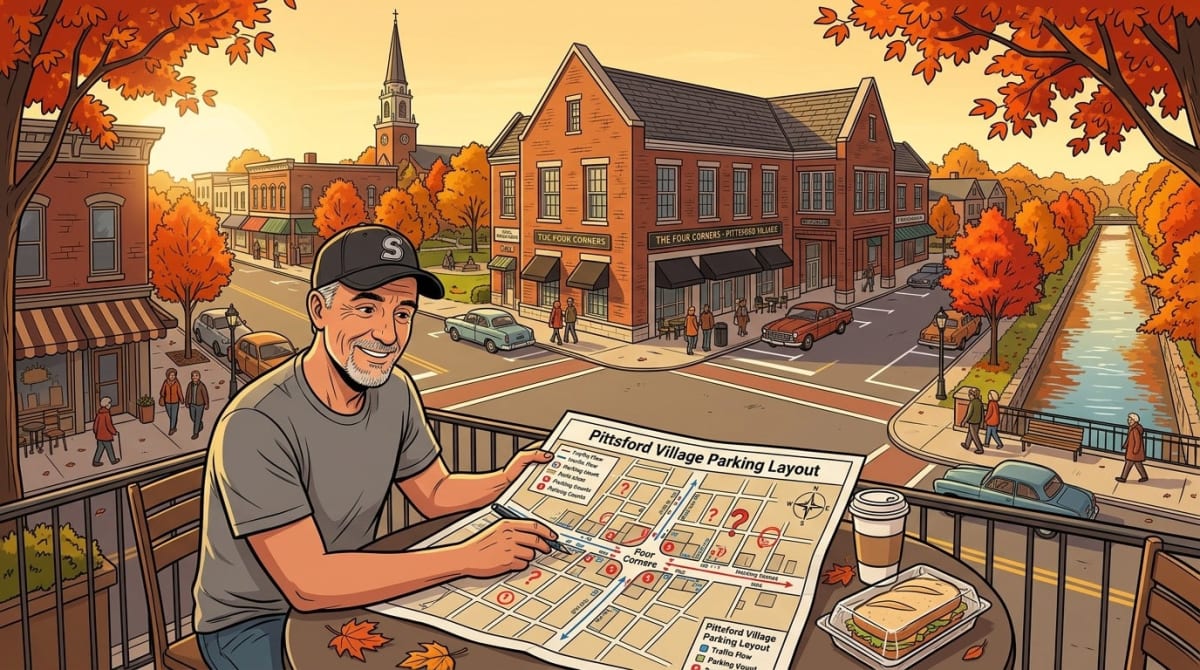
As Trustees Consider Minimum Parking Requirements, Pittsford Village Has a Chance to Get It Right
The Short Version
- A serious reform of Pittsford Village's minimum parking requirements needs to start with a comprehensive study — one that addresses not just how many spaces exist, but traffic calming, gateway design, sidewalk gaps, and the distinct parking logic of the village's three sub-areas.
- In tandem with changing the code, the village should max out what the street network already offers: lane narrowing on Monroe, reverse diagonal parking at the rec center, opening church lots and library employee spaces to the public, and eliminating right-turn lanes that consume high-value curb space.
- Vacancies on Main Street have multiple causes — not just the parking code. High rents, owner behavior, the broader challenges facing retail, and personal circumstances have all kept spaces dark in recent years.
- Zero parking requirements can work in the village center — but only as part of a coordinated plan. Schoen Place requires a different approach entirely, likely contingent on the village securing a permanent lease of the RG&E right-of-way.
- Congestion through a village center isn't a problem — it's a signal. The Monroe Avenue lane reduction, now underway, is the most significant live test of that principle in Pittsford right now.
- The village Bob describes is one where drivers creep not because they're told to, but because the streets make any other speed feel wrong.
The Seventy-Year Mistake — and How Pittsford Has Mostly Avoided It
The Seventy-Year Mistake — and How Pittsford Has Mostly Avoided It
Bob Corby doesn't start the Pittsford parking conversation with the village code. He starts seventy years ago.
Over the postwar decades, American planning was remade around the movement of motor vehicles. Parking minimums, wide arterials, setbacks, drive-throughs — the full apparatus of car-centric design — became the default template applied to communities of every size and character. The consequences, which planners and then the broader public have been reckoning with for the last forty years, are well documented: walkability gutted, traditional commercial corridors hollowed out, historic downtowns surrounded by asphalt until the qualities that made them worth visiting had been engineered away.
The mechanism, Bob explained, is specific. It isn't cars themselves that destroy traditional downtowns. It's the application of a suburban parking standard — design for maximum demand, provide a space for every possible car on the busiest day — to places that were built before cars existed and that derive their value precisely from what that standard destroys.
"Experience over the last seventy years has demonstrated that applying the standard suburban model of providing parking adequate to accommodate maximum demand destroys the basic positive qualities found in traditional downtowns and historic villages."
Pittsford Village has, by and large, avoided this fate. The parking that exists today does not dominate the visual landscape of the village center or overwhelm the adjacent historic neighborhoods that remain genuinely livable. That is not an accident. It reflects a series of decisions, some deliberate and some fortunate, that kept the asphalt from winning. The challenge now is to keep threading that needle — because the context has changed in ways that make the balance harder to strike.
The retail reality Bob describes is not the one that built Main Street. A century ago, village businesses were supported by village residents and the people who lived a mile or two outside it. You walked to the dairy. You ran errands on foot. The market area was small because it didn't need to be large. Today, the commercial calculus is entirely different. Village businesses have narrowed to niche retail — the things you can't get at a suburban big box or order from Amazon — and that niche draws from a much wider geography. A customer driving to Pittsford Village may be coming from ten miles away. They are almost universally arriving by car. And the village of 1,500 people sits inside a suburban town of 30,000, most of whom make every daily trip behind a wheel. Designing for a walkable village while serving a car-dependent region is the core tension that no single code change resolves.
What it does mean is that parking — the right amount, in the right places, managed the right way — remains genuinely important, even as the suburban model of maximizing it is clearly wrong for this context. Bob's argument isn't that parking doesn't matter. It's that how you provide it, manage it, and price it matters enormously — and that Pittsford Village has more tools available than it has yet used.
In Tandem With Changing the Code, Max Out the Street
In Tandem With Changing the Code, Max Out the Street
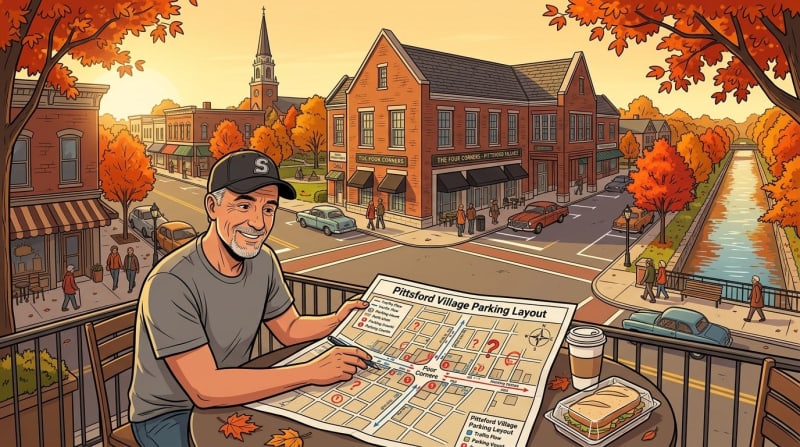
The conversation about minimum parking requirements in Pittsford Village has been building for a while. The village's Main Street is enviable by almost any measure — historic architecture, walkable blocks, the canal a short stroll away. But keeping it vibrant means keeping storefronts filled, and right now the zoning code is working against that. Consider what it took to get a pizza restaurant into 5 South Main Street: four Zoning Board of Appeals meetings just to secure a parking variance — and even after that was granted, a separate Special Use Permit from the trustees was still required before anyone could serve a slice. Two layers of review for a pizza restaurant in a historic Main Street building. Chapter 210 of the Village Code requires off-street parking for virtually every commercial use, with municipally-owned spaces counting as a credit for only up to 20% of what's required. On a landlocked 19th-century village lot with no room to build a parking pad, that standard isn't just difficult to meet — for many prospective tenants, it's a dealbreaker before the conversation even starts. The code designed to protect the village is quietly making it harder to fill it.
I recently sat down with Bob Corby, who served 28 years as Mayor of Pittsford Village and has spent a career as an architect thinking about exactly this kind of problem, to talk through what a serious reform effort should look like. His answer wasn't what I expected. It wasn't a yes or a no. It was a sequence.
"I think before you go to a zero parking concept, you've got to figure out — you've got to max out the on-street parking, which hasn't been done yet."
That framing — max out what you have in tandem with changing what you require — turned out to be the thread running through everything else he said.
The inventory of untapped on-street capacity Bob walked me through is specific. On Monroe Avenue between Washington and Sutherland, narrowing lane widths to nine feet would create room for parking on one side of the street where none currently exists — a move that would simultaneously add supply and calm a stretch that neighbors have been asking the village to address for years. Parking on South Main Street that, in his words, never should have been taken away. Reverse diagonal parking in front of the rec center — a configuration that creates more spaces per linear foot than parallel parking and, as a side effect, slows traffic. The parking that churches currently make available only on Sundays, which could be opened to the public all week. And the row of employee-only spaces in the back of the library lot — spaces that sit empty during peak demand because staff have reserved them, while customers circle.

None of these require a zoning code change. But they aren't simple either. Several of the most impactful interventions — including the Monroe Avenue lane narrowing and parking additions — run through roads owned and controlled by the New York State Department of Transportation. Getting there means sustained coordination, and in some cases active lobbying of NYSDOT, alongside conversations with the town. The Monroe Avenue lane reduction already in progress is proof it can be done. It's also a reminder of how long it takes.
There's more curb space to reclaim inside the village itself. The left-turn lane on North Main Street could be shortened without meaningfully affecting traffic operations — and the right-turn lanes at key intersections should be candidates for conversion to on-street parking entirely. Right-turn lanes consume linear feet of curb that could otherwise serve as the kind of high-value convenience parking that retail depends on: close, visible, and quick. The Washington Road intersection is a specific candidate. A driver running a quick errand doesn't need a dedicated turn lane. They need a spot within sight of the door.
Taken together, these moves represent a meaningful expansion of Pittsford Village's parking inventory — pursued in tandem with code reform, not as a prerequisite that delays it. The argument for eliminating minimum parking requirements in a village center rests on the assumption that the surrounding street network absorbs the demand. Right now, that network isn't working at full capacity. Both things can be fixed at once.
Three Different Villages, Three Different Problems
Three Different Villages, Three Different Problems
The reason a blanket elimination of minimum parking requirements needs to be done carefully isn't ideology — it's geography. And the geography here is specific.
He drew a comparison to Park Avenue in Rochester, where parking reform has worked well. Park Avenue has what Pittsford Village has less of: a dense grid of residential streets extending in every direction, feeding into the commercial corridor from multiple angles, plus a large municipal lot where the old Star Market used to be. When a restaurant fills up and its patrons need to park, there are dozens of streets and multiple directions to absorb them. The parking is fluid because the network is fluid.
Pittsford Village has a partial grid, and a constrained one. The Erie Canal arcs around the north side of the village, hard-stopping the street network. Schoen Place is sandwiched between the canal and the conservation easement lands of the Powers Farm — a single-access corridor with almost no overflow capacity. North Main Street, from the dairy and the pub up to the railroad bridge, is largely lot-based development with no meaningful side-street relief. And the central business district at the Four Corners, while the most walkable part of the village, still depends heavily on the old Burdett lot — named for Burdett's Food Market, which anchored that block for decades — and on-street spaces that are finite and currently underutilized.
"You can't just take something from an urban area and apply it here. You've got to look at the physical factors on the ground — are they the same? And the ones that are different here are the canal, and the half-grid, which is very small."
Bob sees three distinct sub-areas, each with its own parking logic. The central business district, where the case for reform is strongest but the stakes of getting it wrong are highest. North Main Street, where lot-based development creates a different set of constraints. And Schoen Place, where the physical geography essentially makes the parking question moot — there is nowhere for overflow to go.
A single policy applied uniformly to all three is unlikely to serve any of them well. Zero parking requirements in the central business district has the strongest case — the Four Corners is the most walkable part of the village and the area where the code's burden falls hardest on small commercial tenants. But Schoen Place is a different situation entirely. The physical geography essentially resolves the question: there is nowhere for parking overflow to go. A zero-requirement policy there without the village first securing a permanent lease on the RG&E right-of-way to the south isn't reform — it's a setup for a problem the village would have no answer to. And North Main Street north of the canal is different again: deeper commercial uses, limited on-street availability, and a parking picture that is already constrained without adding demand. What Pittsford Village actually needs is a sub-area analysis with teeth — what is the demand in each zone, when does it peak, where does overflow go, and what does the street network actually support? According to the Parking Reform Network, which has surveyed over 3,000 zoning codes, roughly 80% of communities that have reformed minimum parking requirements did so in specific sub-areas — a central business district, a main street corridor, or a historic district — rather than applying changes uniformly across an entire municipality. Pittsford Village's geography makes that kind of precision not optional but essential.
The Vacancy Illusion
The Vacancy Illusion
There's a timing dimension to this that Bob flagged and that I think gets missed in the current conversation. The parking situation in Pittsford Village right now looks more manageable than it normally would — and the reason is two significant vacancies.
Rocky Greco's, the salon that occupied a two-story space at 19 South Main Street — the same building that housed Burdett's Food Market for generations — was an intensive daytime use. A busy salon generates consistent demand on the Burdett lot through the entire business day. That space is now far less active. The old Starbucks on State Street — the space that was briefly Rachel's before going vacant — is also empty.
Here is the uncomfortable truth those vacancies reveal: under Pittsford Village's current minimum parking requirements, spaces like these are extraordinarily difficult to fill when the off-street parking requirement cannot be met on a landlocked 19th-century lot. But that's not the whole picture. Pittsford Village's vacancies have multiple causes operating simultaneously. Rent demands from property owners have kept some of the most prominent commercial spaces dark for years — one former restaurant space on Main Street sat empty for nearly a decade despite having convenient parking nearby, a reminder that the parking code isn't the only thing standing between a landlord and a signed lease. The retail landscape itself is under pressure that no parking reform addresses. And personal circumstances can explain a vacancy as easily as any zoning constraint. Honest reform starts by being honest about this. The parking code is a real impediment, but it is one impediment among several. Getting rid of minimum requirements won't automatically fill storefronts. What it will do is remove a barrier that, right now, makes some conversations with prospective tenants impossible before they start.
"During the day, with a salon that big when it's in operation, the demand on the Burdett lot is far less than it normally would be. You've got to be mindful that as we fill up again, you've got to have some convenience turnover parking to feed the businesses that depend on that."
Single-use and reserved parking is among the least efficient ways to manage a finite supply. The library employee row is the clearest local example — a row of spaces that sits nearly empty through the day because it has been designated for a specific group of users, while the public lot turns people away. In concert with code reform, dedicated single-occupant reservations should be eliminated wherever they exist, converting those spaces to shared public use.
Timed restrictions are the other tool the village hasn't yet deployed at scale. If current vacancies fill — and the goal of this whole effort is that they do — parking demand will tighten noticeably. Convenience parking for businesses like Fatoush, which depend on quick-turnover customers, could become genuinely scarce. Time limits on the highest-demand spaces near those businesses, enforced consistently, would keep the supply circulating rather than being held by parked-all-day commuters or employees.
This is why Bob's argument is a sequence, not a stall. The goal is a reformed code that works for Pittsford Village's actual geography — not the elimination of standards without the street infrastructure to support them, but not the preservation of standards that are strangling the commercial heart of the village either.
The old Bank of America building on North Main Street, recently purchased by the fire district, adds another wild card. Whatever use it becomes — a fire station addition, town offices, something else entirely — it will affect the parking picture on North Main in ways that aren't yet known. The fire district is at the beginning of their assessment process, and it will likely be at least a year before the direction is clear. Bob's hope is that the building itself is preserved: it matters too much to the North Main Street streetscape to lose.
Congestion Is Not the Enemy

Congestion Is Not the Enemy
One of the more counterintuitive things Bob said — and he said it with the confidence of someone who has been making this argument for thirty years — is that traffic congestion through Pittsford Village center is not a problem to be solved. It is, in the right form and at the right scale, a feature.
The comparison he reached for was Jefferson Road versus South Main Street. Jefferson Road still carries the character of a highway. Fewer stoplights, no meaningful streetscape armature, cobra-style highway lights instead of the pedestrian-scale acorn fixtures on Main and State and Monroe. Drivers move through it differently — faster, less attentively — because nothing in the environment tells them to do otherwise.
North Main Street, by contrast, was once four lanes. Getting it back to two — something Bob described as taking years to accomplish against significant resistance — changed the character of the street. Cars slow. The village feels like a village again rather than a connector between two faster roads.
"There shouldn't be an expectation that people should drive thirty miles an hour anywhere in the village. It's just antithetical to the whole idea of a walkable town center where people feel safe, whether they're walking, biking, or driving."
The practical implication is that backing up through Pittsford Village — a few more seconds at the Four Corners, a brief queue on Monroe — doesn't meaningfully affect overall travel times. The stoplights at Marshall Road and at Mitchells Road regulate the flow outside the village regardless. What the congestion does, if it's the right kind on the right kind of street, is signal to drivers that they are somewhere rather than somewhere in between.
The Monroe Avenue lane reduction — the stretch from the Canal Bridge to the 590 overpass going from four lanes to two, with a center turn lane and bike lanes on each side — is the most significant live example of this principle playing out right now. Bob has been advocating for exactly this kind of change for years. When it's done, the stretch of Monroe that currently functions like a minor highway will function like a village approach street.
Right-turn lanes at the Four Corners belong on the same list. According to FHWA research on pedestrian and bicycle safety, the provision of exclusive right-turn lanes is among the design factors associated with increased bicycle and pedestrian collisions at intersections — and the larger corner radii they require correlate directly with higher right-turn vehicle speeds. The throughput benefit at a low-volume village intersection is modest at best. The pedestrian cost is not.
The Gateway Moment

The Gateway Moment
Every street that enters Pittsford Village tells drivers what kind of place they are entering — or fails to. Right now, several of them fail.
Bob's model is Saratoga Springs, approaching on Route 9 from the south, where a planted median with American elms frames the village entrance in a way that is, in his words, one of the best gateway treatments he has seen anywhere. The effect isn't decorative. It is environmental cues doing the work that speed limit signs can't: telling a driver's nervous system to slow down before any signage says so.
For Pittsford Village, Bob has been thinking about a median at Woodcreek Drive on State Street — addressing both the dangerous speeding on State between the bridge and the village line and the need for a defined eastern boundary. On Jefferson Road, the east entrance between East Terrace and the first stoplight still reads as suburban arterial. Extended sidewalks helped. But there are no street trees, no gateway infrastructure, nothing that marks the transition from outside to inside.
"That still feels like a suburban arterial instead of a village street."
A roundabout at the Jefferson Road east entrance is an idea Bob raised that I hadn't heard before. Done right, it forces speeds down to around 20 miles per hour at the exact moment the village should announce itself — without the frustration of a stoplight. Roundabouts keep traffic moving while slowing it down. And there may be enough right-of-way at that intersection to make it feasible.
The sidewalk gaps matter here too. The east side of Sutherland Street has no sidewalk. The north side of Jefferson Road between Sutherland and Main Street — a route to school — has no sidewalk. These are not amenity items. They are the infrastructure that makes a walkable village actually walkable for the people who live in it. Minimum parking requirement reform without sidewalk completion is a half-measure.
What Pittsford Village Could Become
Bob drove through Fairport recently and came back thinking about it. He noticed something on our Main Street that Fairport's didn't have: more families walking around, more people on the canal. Pittsford Village is doing something right. The question is whether the village is willing to keep evolving — adapting its streets, its code, and its infrastructure to meet the changing nature of retail and the growing demand for walkable, livable places.
The village Bob describes — the one that is possible from here — creeps. Not as a metaphor, but literally. Drivers creep through English village centers not because they are told to but because the streets are designed to make any other speed feel wrong. Full-canopy street trees, 9-foot lane widths that require attention, no wide arterial approaches signaling that speed is expected. A street network that, as research on urban street trees has shown, can reduce vehicle speeds by seven miles per hour through design alone — without enforcement, without signage, without a single traffic fine.
The minimum parking requirements conversation that the trustees are considering is real and important. Parking reform has worked in small towns and villages — not just large cities with transit networks — when it is adapted to local geography rather than imported wholesale from somewhere else. Pittsford Village has the planning documents, the code infrastructure, the institutional knowledge on its boards, and — in Bob Corby's framing — the clearest possible articulation of what a serious, holistic effort looks like: reform the code, max out the street, calm the gateways, complete the sidewalks, and analyze each sub-area on its own terms.
The Rhinebeck village code, which Pittsford Village's situation most closely resembles among Hudson Valley comparables, frames the parking question exactly right: large parking areas can damage the historic layout and architectural fabric of a village and prevent desirable enterprises from locating there — but inadequate parking can also diminish quality of life by creating congestion and safety hazards. Both things are true. The work is holding both truths at once and designing policy that navigates between them with specificity rather than ideology.
That is what the trustees have a chance to do. Reform the code and max out the street — at the same time. Analyze the sub-areas. Account for the real causes of vacancy, not just the most visible ones. Calm the gateways. Build the sidewalks.
What Bob describes as the right process is as important as the right policy. Pittsford Village has a track record of adapting its codes to address changing conditions — sometimes through trial and error, sometimes through a slow consensus that only emerges after enough people have lived with a problem long enough to agree on the shape of a solution. That process works. Changes that emerge from genuine engagement with businesses, users, and residents tend to hold. Top-down impositions — changes that arrive without that groundwork — tend to polarize, and polarized decisions tend to be reversed or simply ignored.
The trustees have a chance to run the right process. That means bringing businesses, neighbors, and regular users into the conversation early, before positions harden. It means being willing to pilot something, watch what happens, and adjust. It means treating the code as a living document that responds to the village rather than one that is handed down to it.
The village that emerges from that work is one more families walk through on a Saturday afternoon. More people on the canal. Drivers creeping past the bakery not because they have to but because the street makes it feel right.
What would you change about the way you move through Pittsford Village today — and what would have to be different for you to leave the car at home?
Content ID: Wee9Mq1ZEd1zTyrkAPsVOBu8
See an error? Tell us.


Comments
Share with the Community