
The Empire State Trail's Economic Impact: $1.87 Billion a Year — and Pittsford's Small, Real Place in It
The Short Version
- The Empire State Trail pumps $1.87 billion a year into New York's economy — and the Erie Canalway corridor Pittsford sits on accounts for $687 million of that.
- Every public dollar invested in the trail returns $5.43, and quiet off-road stretches like Pittsford's deliver four times the impact of on-road miles.
- Schoen Place punches far above a village of three-quarters of a square mile — nearly one in four trail-area businesses say they located there because of the trail.
- Few of the hundreds of communities along 750 miles are as intact a historic canal port as Pittsford, which is what turns it from a pass-through into a destination.
- E-bikes already outsell electric cars nationally and aren't going away — making smart coexistence a better path than the sidewalk-and-canal bans the community rejected.
Standing at Schoen Place

Standing at Schoen Place
Most clear mornings I end up at Schoen Place, and the towpath looks the way it always does — walkers with coffee, a couple of runners, parents wheeling strollers, a few cyclists rolling toward Lock 32. It feels entirely local. Almost private. I've written before about what it's like to live a few steps from this water, and the truth is most of us treat this stretch as ours alone. That instinct is understandable — and it quietly undersells what the Empire State Trail's economic impact actually means for a village like ours.
It isn't only ours. That worn path is one small thread in the largest study of a trail's economic impact ever conducted in the United States, and the numbers are big enough to change how we see our own backyard. The question worth sitting with isn't whether Pittsford matters to that story. It's how.
The Empire State Trail's Economic Impact, Statewide

The Empire State Trail's Economic Impact, Statewide
In June 2026, Parks & Trails New York released what its researchers call the most comprehensive analysis of a trail network ever done in this country. The headline figure: the 750-mile Empire State Trail — the longest single-state multi-use trail in the nation, completed in December 2020 — generates about $1.87 billion in economic activity every year. It draws an estimated 9.75 million visits annually, supports 9,680 jobs, and produces roughly $206 million in state and local tax revenue, according to the report's executive summary.
"Where the trail goes, the economy grows."
— Parks & Trails New York, 2026
The return is the part that stops you. Every dollar invested in the trail returns $5.43 in economic output, and the off-road segments — the quiet, car-free stretches like ours — deliver four times the impact of on-road miles. Here is how the statewide output splits across the trail's three main corridors:
The benefits aren't only financial. The report attributes $78 million in annual health savings to the activity the trail enables, and notes that roughly two-thirds of its miles run through communities the state considers economically distressed. A trail, it turns out, reaches places traditional economic development often can't. What might that mean for a village that already has the path running through its heart?
The Erie Canalway Trail Carries Its Weight
The Erie Canalway Trail Carries Its Weight
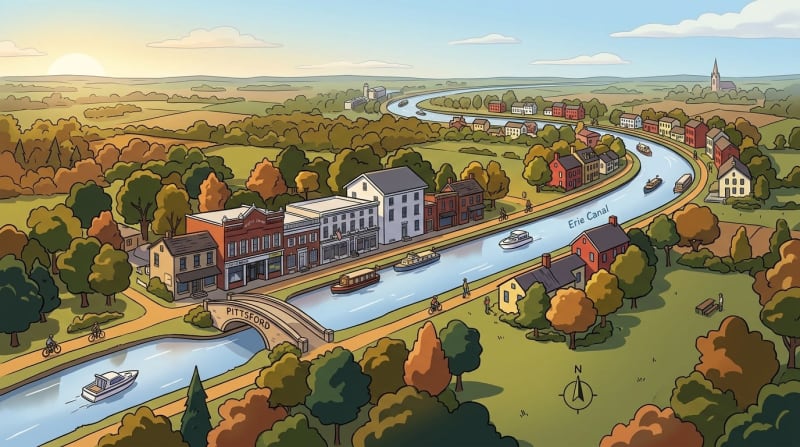
Pittsford sits on the Erie Canalway Trail, the Buffalo-to-Albany corridor — and it is no minor player. On its own, that corridor draws 3.66 million visits a year and generates $687.4 million in economic output, supporting 3,555 jobs. That's second only to the Hudson Valley, and it's the corridor most woven into everyday community life upstate. The visitor numbers tell the same story:
There's a hometown fingerprint on the study, too: it was authored with support from LaBella Associates, a Rochester firm. And the New York State Canal Corporation framed the findings plainly — the Erie Canalway Trail has always mattered to the state, and now there are numbers to prove it. Pittsford is one bead on that long string of canalside villages, from Fairport to Spencerport to Brockport. The string is only as strong as its beads.
Schoen Place: Pittsford's Seat at the Table

Schoen Place: Pittsford's Seat at the Table
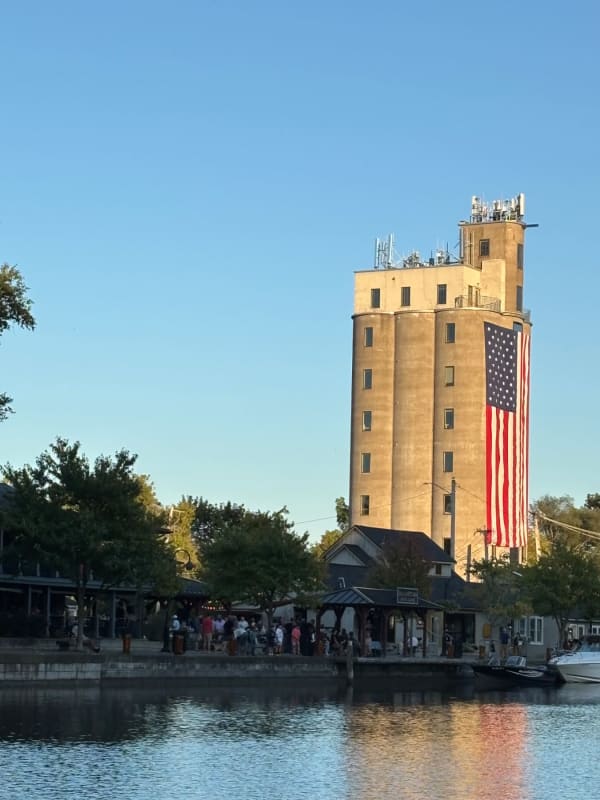
Pittsford is the oldest village in Monroe County, incorporated in 1827, and it has been an Erie Canal port the whole time. Three-quarters of a square mile. And yet on any summer day, Schoen Place punches far above its size. The Sam Patch tour boat departs from here. Lock 32 Brewing fills its patio. Towpath Bike has rented wheels to canal riders since 1971. The restaurants run full, and Carpenter Park hosts free concerts all summer long.
The report found that nearly one in four trail-area business owners say they chose to locate near the trail — and day visitors spend around $30 a trip. Multiply that across a season of canal traffic and you understand why a small village leans into its waterfront. This is the quiet engine behind the $5.43 every public dollar returns:
Here's the gift Pittsford brings to the table, and it's worth naming directly: a fully intact, walkable, historic canal port that visitors actually want to slow down in. That's not an accident of geography. It's the result of a century of people choosing to protect it — the same instinct behind everything we get right about walkability in the village. What would it look like to treat that gift as an asset we steward, not just a view we enjoy?
A Prized, Well-Preserved Destination

A Prized, Well-Preserved Destination
Of the hundreds of communities strung along 750 miles of trail, very few are as well-preserved a 19th-century canal port as Pittsford. That's something to be genuinely proud of. As I've written about Pittsford's place in the National Register of Historic Places, the protection that matters most has always been local and deliberate — the choices a community makes about what it keeps.
That preservation is exactly what makes Pittsford a destination rather than a pass-through. A cyclist riding the Erie Canalway could roll past a hundred ordinary stops. The ones they remember — the ones they tell a friend about — are the places that kept their character. Pittsford is one of those. What do we owe a place that so many people travel to see?
Sharing the Path: E-Bikes Aren't Going Away
Sharing the Path: E-Bikes Aren't Going Away
As the path gets busier, the real work begins: helping everyone — walkers, runners, kids, cyclists, and yes, e-bike riders — share it well. And e-assist bikes are not a passing trend. They outsold electric cars in the U.S. back in 2022, roughly 1.5 million were sold nationally in 2025, and the U.S. market is projected to nearly double by 2034.
New York law is clear and sensible: you must be at least 16 to operate an e-bike or e-scooter (VTL §1242). The handful of confiscations of e-powered vehicles locally have involved riders under that age. Last Tuesday, the Board of Trustees discussed the possibility of introducing escalating fines into our Village Code - but this is far from finalized.
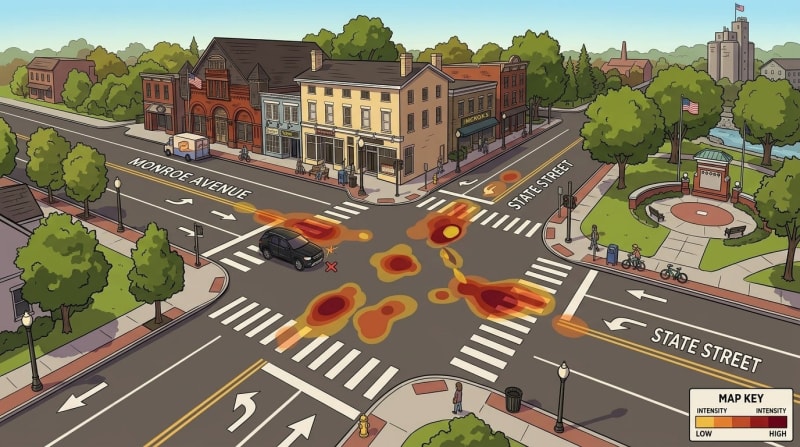
That's a different matter from the broader conversation, where there's been talk of banning all bikes from sidewalks and barring e-bikes from the canal path. The community pushed back, and the sidewalk ban didn't advance — for good reason. We laid out why in our pieces on walkability and on designing streets for people, where the crash patterns along Monroe Avenue and State Street tell you where the real danger lies — and it isn't on the sidewalk. The Monroe County Sheriff's Office took the constructive road instead: more patrols and public education along the canal this spring.
The evidence backs the calmer approach. Reconnect Rochester — whose whole mission is safety over speed — made the case years ago that as e-bikes grew in popularity, there was no significant rise in collisions or trail-user conflicts, while e-bikes opened riding to seniors, parents towing kids, and people with disabilities. They argued New York should clarify the rules rather than prohibit the bikes — and in 2020 the state did exactly that. Even the City of Rochester is showing the management path with its Veo e-bike and scooter program, using no-parking zones and corrals on shared-use paths to keep them clear. Design, not bans.
The task in front of us isn't to decide whether e-bikes belong on the canal. They're already here, and they're staying. The task is to help riders and walkers coexist safely — and that's never been accomplished by a heavy-handed ban. What would it take for our stretch of the towpath to be the place that gets sharing right?
What We Choose to Build Next
What We Choose to Build Next
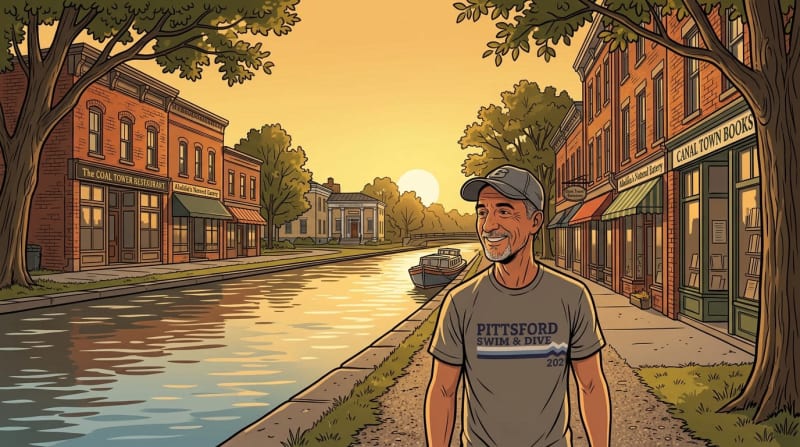
A $1.87 billion trail runs through the middle of our village. Most mornings it just looks like neighbors out for a walk — and it is that. But it's also a seat at one of the most quietly successful economic stories in New York State, and Pittsford earned that seat the old-fashioned way: by being a place worth stopping for.
The trail is ours to enjoy and ours to steward. Come stand at Schoen Place some morning and watch who shows up — on foot, on wheels, with assistance or without. Then ask yourself what kind of welcome we want this corner of the canal to be known for.
Content ID: 0h9J6X6DQ7wynxncG6kq0eCQ
See an error? Tell us.


2 Comments
Comment from Facebook
Much of Pittsford' Village's appeal is due to the unique historic character of Schoen Place. Our village's waterfront district comprises the most intact canal related commercial/industrial district remaining in New Yoirk state. For this reason, Schoen Place possesses both statewide and national significance. A community priority should be to preserve the district's resources, maintain the historic alignment and use of the canalside street, and to ensure the sensitive rehabilitation of the remaining underutilized and vacant barns, mills, and sheds that are part of the historic Hutchinson/Zornow mill complex.
Jun 16, 2026 at 7:09 pm
View on Facebook ↗Adam Stetzer
Thank you for sharing this — what a powerful reminder of what makes Schoen Place truly irreplaceable, not just for Pittsford but for the entire state. The Hutchinson/Zornow mill complex and that canalside character are the kind of living history that binds a community to its roots. I'd love to see more voices like yours helping shape how we steward and celebrate these spaces together.
Jul 27, 2026 at 10:10 pm
View on Facebook ↗Comments marked “from Facebook” were shared from our Facebook page. Commenter names are not published here — open the original thread to see them.
Share with the Community